

Quick answer: A wedding planning checklist is a month-by-month task list that runs from engagement to wedding day, and the useful version carries dates as well as tasks. The Knot’s 2026 Real Weddings Study of 10,474 US couples married in 2025 found couples hire an average of 13 vendors and spend an average of $34,000. Thirteen vendors usually means a deposit and a balance each, so roughly 26 payment dates. Put those on the checklist too.
Here is the part nobody warns you about: the checklist is the easy bit. You can find a free 12-month wedding planning checklist in about nine seconds. Book the venue. Order the dress. Send the invites. Tick, tick, tick.
What none of them tell you is that every one of those ticks moves money, and the money does not move on the same schedule as the tasks. You book the photographer in month eleven and feel wonderful. Then the deposit clears. Then the venue’s next installment lands in the same six weeks. Suddenly you are eight months out with a third of the budget already spent and a florist you have not even emailed.
That is not a willpower problem. It is a design problem. Your checklist and your budget are two separate documents, and they never talk to each other. So let’s fix that, and build the list properly while we are here.
Key takeaways
- A checklist’s real job is order, not memory. Some decisions lock others, so the sequence is the whole value.
- Couples hire about 13 vendors, which usually means a deposit and a balance each: roughly 26 dated payments, not 13 tasks.
- The early months are the expensive months, because venue, catering and photography get booked first and each one wants a deposit.
- Add three columns to any checklist you download: deposit due, balance due, and paid from.
What Is a Wedding Planning Checklist Actually For?
A wedding planning checklist is a sequenced task list that breaks one enormous project into small, dated decisions. Its real job is ordering rather than remembering. Certain choices lock other choices: the venue sets the date and the guest capacity, the guest count sets the catering quote, and the catering quote is typically one of the largest lines in the budget. A good checklist encodes that order so you rarely book something you then have to unbook.
Most published checklists assume a twelve-month runway and count backwards from the wedding date. That is a reasonable default, but treat it as a shape rather than a rule. A courthouse ceremony with 20 people and a 200-guest barn wedding are not the same project, and the second one is mostly a logistics problem wearing a romantic hat.
The other thing a checklist quietly does is protect your attention. Planning tends to expand to fill every conversation you have for a year. When the next three tasks are written down with dates on them, you get to stop carrying the whole thing in your head, which is genuinely the best part. That is also why I kept the wedding sheet to seven tabs on purpose rather than building one of the thirty-tab monsters that float around: a planner you avoid opening is worth nothing.
Why Do Wedding Checklists Fail Even When You Tick Every Box?
Because a task list tracks attention and a wedding runs on cash flow. The Knot’s 2026 Real Weddings Study found couples hire an average of 13 vendors. If each one takes a deposit to hold your date and a balance before the day, that is about 26 separate money dates spread across your engagement. A checklist showing 13 lines can be hiding as many as 26 deadlines, and the hidden ones are the expensive kind.
Deposits are also where the commitment actually happens. Signing is emotional; the deposit is the moment the date becomes yours and the money stops being theoretical. That is why the front half of planning drains the budget faster than anyone expects. Venue, catering and photography get booked first because they sell out first, and those three are usually among the heaviest lines in a wedding budget breakdown.
There is a real cost to getting that timing wrong. If a deposit lands before the cash does and it goes on a credit card, the Federal Reserve’s G.19 release from August 7, 2026 puts the average rate on card accounts assessed interest at 22.15% for the second quarter of 2026. A 2,000 dollar deposit carried for a year is not a 2,000 dollar deposit any more.
This is exactly why, when I built the wedding sheet, the vendor tab got a due-date countdown instead of a plain paid or unpaid checkbox. A checkbox tells you about the past. A countdown tells you what is coming in the next three weeks, which is usually the part you can still do something about.
The 12-Month Wedding Planning Checklist, Month by Month
Here is the timeline in the shape that matters: what you do, and what leaves your account while you do it. The month bands below are our own arrangement rather than an industry standard, so treat them as a starting shape. Count backwards from your date, and if your engagement is shorter, compress the top rows rather than the bottom ones.
| When | What you do | What money moves |
|---|---|---|
| 12+ months | Set the total number. Draft the guest list. Tour venues. | Nothing yet. Open the savings account. |
| 10 to 12 months | Book venue and date. Book photographer. Book caterer if separate. | Venue and photography deposits usually land here. |
| 8 to 10 months | Order the dress. Book music, florist, officiant. Book hotel blocks. | Dress deposit plus three or four vendor deposits. |
| 6 to 8 months | Send save-the-dates. Register. Plan the honeymoon. | Printing, postage, flights. Small but real. |
| 4 to 6 months | Order invitations. Cake tasting. Rentals and decor. | Rental deposits. Cake deposit. |
| 2 to 4 months | Mail invitations. Dress fittings. License and vows. | Alterations, license fee, first balances start coming due. |
| 1 month | Chase RSVPs. Finalize headcount. Build the seating chart. | Catering balance is calculated from this number. |
| Week of | Confirm arrival times. Pack. Assign day-of jobs. | Remaining balances plus cash tips, in envelopes. |
| After | Returns, thank-you notes, name change if you want one. | Final invoices and anything you forgot to log. |
Two rows deserve a warning label. The 10 to 12 month row is where most of your early deposits happen in a short blur, and the 1 month row is where your headcount stops being a guess and becomes an invoice. Everything you decided about your wedding guest list template in month twelve gets priced in month one.
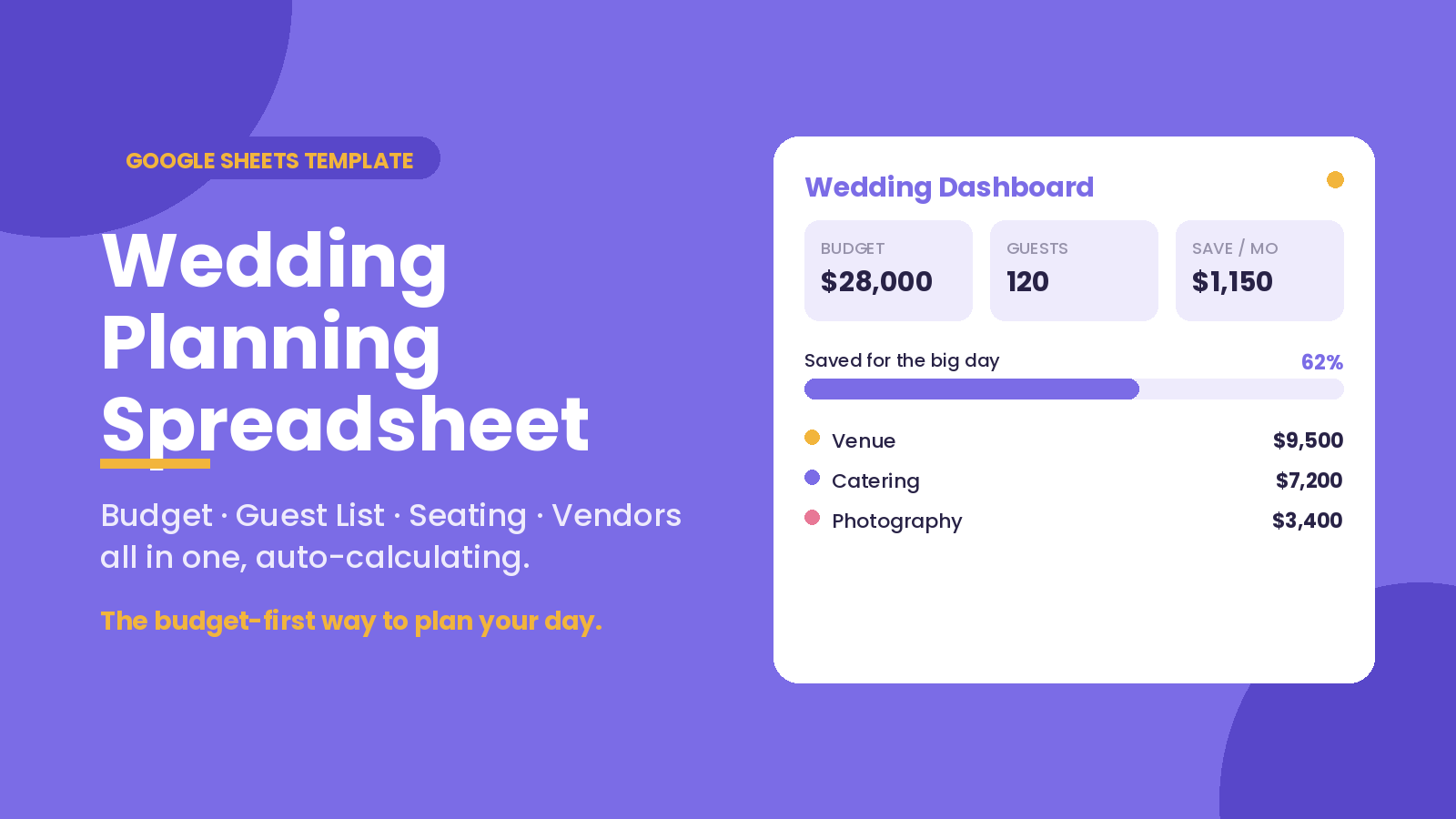
The checklist and the money, on the same screen
The Wedding Budget Spreadsheet ships with a pre-filled 12-month checklist, a vendor tab with due-date countdowns, and a budget that tells you what to set aside each month. Guest list, RSVPs, meals and seating all feed the same numbers, so a cancelled cousin updates everything at once.
Get the Wedding Budget Spreadsheet →What Should You Book First If You Have Less Than a Year?
Book the three that sell out first: venue, photographer, caterer. An officiant is rarely a sellout risk, but it is the booking people forget, so add it to the same first sweep. Most of the rest can usually be sourced late, substituted, or scaled down without changing the day. Pick your tier below and start at the top of it, and do not let a Pinterest board decide the order for you.
- Twelve months or more. Run the timeline above as written. Use the extra room to save monthly instead of borrowing, and to negotiate, since you are the easy booking rather than the desperate one.
- Six to nine months. Lock venue, photographer and caterer in the first two weeks, and be flexible on the day of the week, since Fridays and Sundays open up more options. Then compress the middle: save-the-dates and invitations become one mailing.
- Under four months. Choose a venue that includes catering, choose a photographer who is free rather than one you have to wait for, and skip save-the-dates entirely. Shorter timelines leave you less room to compare quotes, so protect the total by cutting the guest list rather than the quality. Our guide on how to plan a wedding on a budget walks through which line items survive that cut.
One more sequencing note that saves arguments: settle the funding conversation before you book anything, not after. Who contributes, how much, and by when belongs at the very top of the list, because a promise without a date is not money yet. We covered that in detail in who pays for the wedding.
How Do You Put Money on the Checklist?
Add three columns to whatever checklist you already downloaded: deposit due, balance due, and paid from. That last one matters more than it looks, because it forces you to name the actual account or contributor before the date arrives instead of improvising at the counter.
- Write the two dates off the contract, not off the vibe. Most vendor contracts state a deposit amount and a final payment deadline. Copy both into the row the day you sign, while the paperwork is open in front of you.
- Sort by the money date, not the task date. Ordering by “when should I think about this” hides the clusters. Ordering by “when does cash leave” shows you the two or three weeks that will hurt.
- Give each month a number to save. Total remaining, divided by months left, is your monthly transfer. It is the same mechanism as any other sinking fund, just with a guest list attached.
- Log the small stuff in the same place. Postage, license fees, alterations and tips are individually forgettable and collectively large.
The budget tab in my own sheet arrives pre-filled with U.S. average suggestions rather than blank, and that was a deliberate call: an empty estimate column is exactly where people stall out and quietly go back to guessing. A wrong starting number you can correct beats a blank cell you keep skipping. If you would rather build your own from scratch, how to budget for a wedding has the category math.
Wedding Planning Checklist FAQ
When should I start a wedding planning checklist?
Start it within the first month of the engagement, even if your date is two years out. The earliest entries are not bookings, they are the total number, the guest list draft, and the savings transfer. Those three decide everything downstream, and they cost nothing to make early.
How many months does it take to plan a wedding?
Twelve to eighteen months is the comfortable range for a full traditional wedding, three to six months works for a small one, and two to three months is possible if you accept fewer options. The constraint is rarely your effort. It is vendor availability on popular Saturdays in peak season.
What should be booked first?
Venue, photographer and caterer, in that order. The venue fixes your date and capacity, the photographer often books up far in advance, and the caterer prices off the guest count the venue just capped. An officiant is rarely a sellout risk, but it is the booking couples forget, so add it to the same first sweep.
How much does the average wedding cost?
The Knot’s 2026 Real Weddings Study, based on 10,474 U.S. couples married in 2025, reported an average of $34,000 and an average of $292 per guest, up 8 dollars per guest from 2024. Guest count averaged 117. Your own number will depend far more on head count and region than on any national average.
Do I need a wedding planner if I have a checklist?
Not necessarily. A checklist handles sequencing and a planner handles judgment, negotiation and day-of chaos. Many couples split the difference with a day-of coordinator, who takes over the one day you cannot also be running logistics.
Need the monthly number first?
Before the wedding math, you need to know what your normal month actually looks like. The free Monthly Budget Template shows you what is genuinely available to move into the wedding fund each payday, no formulas required.
Get the free Monthly Budget Template →This article is general information, not financial advice. Wedding contracts, deposit terms and cancellation policies vary by vendor and by state, so read your own paperwork before you sign or pay.