

Quick answer: To budget for a wedding, start from the number you can realistically save by your date, not the national average, then build the whole plan around your guest list, since catering, cake and rentals rise with your guest count. Couples married in 2025 spent about $34,000 on average (about $292 a guest), according to The Knot’s 2026 Real Weddings Study. Setting your budget early, before you fall for a venue, gives you a plan to spend against.
Congratulations. You’re engaged, your people are thrilled, and then soon after you open a blank spreadsheet and feel your stomach drop. Suddenly it’s venues and caterers and a cousin count and a pile of tiny decisions, each of them apparently costing money. Here’s something worth saying out loud at the engagement party: staying calm (and solvent) has a lot to do with setting a budget before you fall in love with a dreamy barn venue.
Skip that step and the numbers make the decisions for you, sometimes on a credit card. The Knot puts the average 2025 wedding at about $34,000, and in LendingTree’s 2025 survey of newlyweds, 67% said they took on debt for the day.
Key takeaways
- A wedding budget is a decision you make once, on purpose, before vendors and inspiration photos make it for you.
- Start from what you can actually save by your date, then reverse-engineer the rest. Don’t copy the $34,000 average.
- Guest count is one of your biggest dials: The Knot calls your guest list one of the biggest factors in what you’ll spend, so trimming it is one of the most effective ways to move the total.
- Fund it from savings, not credit. In LendingTree’s 2025 survey, 67% of newlyweds took on wedding debt, and future-you would much rather keep that money.
What a wedding budget actually needs to do
Let’s reframe this before it stresses you out. A wedding budget isn’t a restriction or a vibe-killer. It’s just a plan for money you already have or will save, turned into a set of small, already-decided numbers so you can answer “can we afford this?” quickly instead of agonizing over it. That’s the whole job.
Really, a good budget answers a few questions up front: how much in total, split into what, and tracked how. Nail those early and the rest of planning gets weirdly peaceful, because a lot of “should we do the fancy invitations?” questions already have an answer waiting. This is the kind of running-total, does-the-math-for-you situation a spreadsheet was born for. More on that below.
What the average wedding really costs (The Knot 2026 study)
Here’s your reality check, straight from the source. The Knot’s 2026 Real Weddings Study, based on more than 10,000 couples married in 2025, pegs the average U.S. wedding at $34,000, or about $292 per guest across roughly 117 guests.
But “average” is doing a lot of hiding. Couples with budgets under $15K spent about $8,900; the $15K–$40K crowd landed near $26,400; and the over-$40K group averaged $70,300. State matters too: the average ceremony and reception cost about $18,000 in Utah and $57,000 in New Jersey. So please don’t treat $34,000 as a target. It blends small budgets and big ones into one national number. Your number is your number. And if you are skipping the venue entirely, start with our guide to courthouse wedding cost instead.
Where does it all go? Here are some of the big line items:
| Where the money goes | Average cost (2025 weddings) |
|---|---|
| Reception venue | $12,900 |
| Live band / DJ | $4,500 / $1,800 |
| Photographer | $3,000 |
| Wedding rings | $3,000 |
| Flowers | $2,800 |
| Videographer | $2,300 |
| Wedding dress | $2,100 |
| Wedding planner | $2,100 |
That’s before catering. The Knot’s budget breakdown, based on its 2026 study of couples married in 2025, puts venue and rentals at about 29% of the average budget and catering, cake and drinks at about 24%. The Knot also notes that catering, cake and rental costs rise with your guest count. Hold that thought for the guest-count section below.
How to budget for a wedding, step by step
You don’t need a finance degree or a rich uncle for this. It just requires deciding on purpose instead of by accident.
- Set your real number first. Add up what you’ve already saved, plus what you can genuinely stash away each month until the date, plus any firm family contributions. That total, not the average and not the inspiration board, is your budget. Full stop.
- Have the awkward money talk now, not later. Who’s paying, how much, and is it a gift or a “we’ll see”? In LendingTree’s 2025 survey, 16% of newlyweds said help from parents or relatives was their main way of paying, which is wonderful, as long as the amount is real and agreed on before you spend against it.
- Each of you names your non-negotiables. Maybe it’s the photographer, the food, and an open bar. Fund those first, on purpose, and let the stuff neither of you cares about run lean. A budget is really just organized priorities.
- Lock your guest count early. It shapes several other lines, including catering, cake and rentals. Decide it before you start touring venues.
- Give each remaining dollar a job. Split what’s left into categories and assign amounts. Use the averages above as a sanity check, not a shopping list.
- Build in an “of course that happened” cushion. Alterations, overtime, the surprise cake-cutting fee. The Knot’s budget breakdown suggests earmarking at least 5% of your budget for unforeseen costs.
- Track it in one place, in real time. Not a pile of vendor emails and a running guess in your head. A wedding budget spreadsheet that shows each vendor’s remaining balance the moment you type a deposit, and updates what’s left of your budget as you log actual costs, is the difference between “we’re fine” and finding out months in that you’re very much not fine.
Let the spreadsheet do the scary math
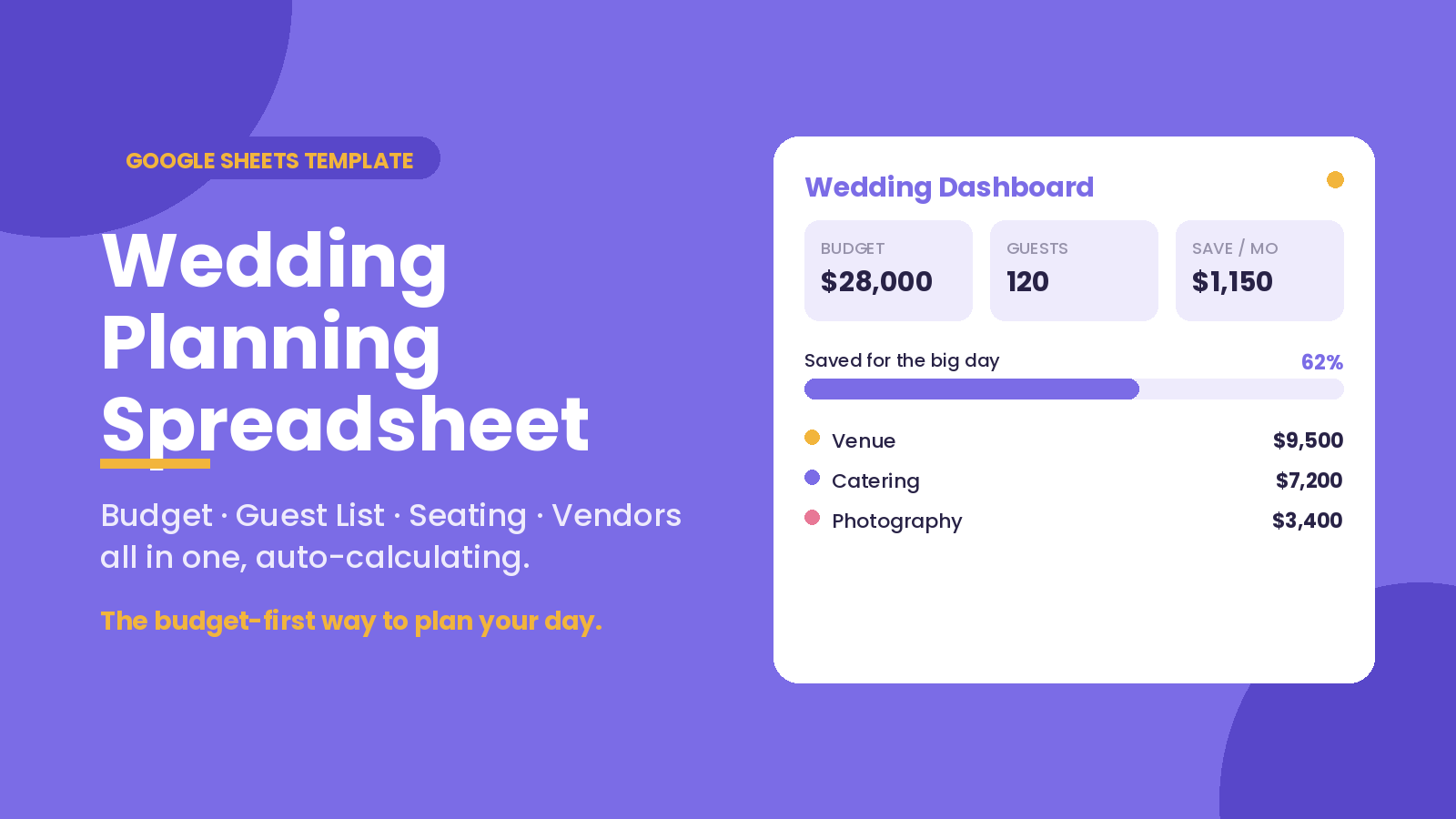
Planning a wedding means juggling a long list of budget categories, a stack of deposits, and a guest list that will not sit still. Our Wedding Budget Spreadsheet keeps them in one calm place: type in your total and your estimates, and it tracks each category, subtracts each deposit from that vendor’s total, and shows how much you have left to spend as you log what you’ve actually paid. No formulas to build and no mental math. You set the number up front, and the sheet keeps you honest on the way to “I do.” Works in Google Sheets.
Get the Wedding Budget Spreadsheet →One of the biggest levers you control: your guest count
If you remember nothing else, remember this. If you want to change a wedding budget, look past cheaper flowers or a DIY playlist. Look at the guest list. In The Knot’s 2026 Real Weddings Study, couples married in 2025 with 1–50 guests spent about $17,100 on average, those with 51–100 guests about $27,200, and those with more than 100 guests about $43,300.
It works because several costs scale per guest: The Knot notes that a caterer’s, baker’s or rental pro’s costs change with your headcount. Some costs, like a DJ or photographer, stay about the same whatever the headcount. Cheaper flowers help a little. Trimming the guest list touches catering, cake and rentals all at once. Start the count somewhere you can watch it add up: a wedding guest list template does the head math while you decide who makes the cut.
So before you agonize over centerpieces, agonize over the list. A trick that can spare some friendships: draft an honest A-list of the people you truly can’t imagine getting married without, then a B-list that only gets invited if A-list regrets open up room. A big part of “how to budget for a wedding” is the question “how many people are we feeding and dancing with?” Answer that one early and a lot of the rest gets easier.
Is $10,000 enough for a wedding? Divide it by your guest count
$10,000 can pay for a wedding, but usually a small one. At the average of about $292 per guest in The Knot’s 2026 Real Weddings Study (couples married in 2025), $10,000 covers roughly 34 guests. And in that same study, couples with budgets under $15K spent about $8,900 on average.
That one division is the quickest reality check for any total, not only $10,000. Take the number you set in step 1, divide it by $292, and you get a rough guest count your money supports at average spending:
| Your total budget | Guests it covers at about $292 each |
|---|---|
| $10,000 | about 34 |
| $20,000 | about 68 |
| $30,000 | about 102 |
| $50,000 | about 171 |
Read those as ceilings, not targets. The $292 is an average across the whole wedding, so it includes costs that don’t shrink when the list does, like the photographer or the DJ. That’s why small weddings tend to cost more per head: couples with 1 to 50 guests spent about $17,100 on average in the same study. If your list runs longer than the table allows, either the total goes up or the per-guest spending comes down. No third option, sadly.
This is also the number the wedding budget spreadsheet keeps on its dashboard. It divides your planned budget by whichever is bigger, your estimated headcount or the names actually marked invited, pending or confirmed on the guest tab, so when the list quietly grows by twelve, the cost per guest moves the same day. You don’t have to remember to redo the math.
Does the 50/30/20 rule work for a wedding budget?
The “50/30/20 rule for weddings” is a rule of thumb, not a research finding; the bridal shop blog below says it was inspired by everyday personal-finance budgeting. The version on one bridal shop’s blog puts 50% toward the venue, food and drinks, 30% toward attire, photography, entertainment, flowers and decor, and 20% toward everything else, honeymoon included if it comes out of the same budget. Real spending data lands closer to it than you’d expect.
In The Knot’s budget breakdown from its real-couple data, venue and rentals (29%) plus catering, cake and drinks (24%) come to 53%. Photography and video (10%), floral design and decor (9%), music (6%), and attire and beauty (6%) add up to 31%. So the 50 and the 30 make a fair first sketch.
The 20 is where it gets slippery. The Knot’s category list has no honeymoon line, so if your trip comes out of the same pot, that last slice has a lot more to cover than it looks. Our wedding sheet keeps the honeymoon in its own little budget on the Extras tab for exactly that reason: it’s easy to forget until the flights show up.
One more thing: this is not the everyday 50/30/20 rule, which splits take-home pay into needs, wants and savings. And if you want every category turned into dollars, the wedding budget breakdown guide does that math for you.
Common wedding-budget myths
“We need $34,000.” You really don’t. That average blends small budgets with $70K blowouts, and in The Knot’s 2026 study of couples married in 2025, those with budgets under $15K spent about $8,900 on average.
“A budget means a cheap wedding.” Backwards. A budget is what lets you spend generously on the few things you love, guilt-free, because you decided in advance to go lean everywhere else.
“We’ll just figure it out as we go.” That’s a common path to joining the 67% of newlyweds in LendingTree’s 2025 survey who took on wedding debt. Figuring it out as you go can quietly turn into a plan to overspend.
“Family said they’d help, so we’re covered.” Maybe! But turn “they’ll help” into an actual dollar amount before you build your budget on it. Vague generosity is hard to budget against.
And once the wedding’s behind you, the same muscle, one clear number tracked in one place, is what keeps married-life money calm too. If you want a simple, everyday version to land on after the honeymoon, our free monthly budget template picks up right where the wedding sheet leaves off, and the habits in how to stick to a budget can help keep either one going for the long haul.
Frequently asked questions
How much should you budget for a wedding?
Budget the amount you can realistically save by your wedding date plus any firm family contributions, not a number you saw online. Start from your savings and monthly cash flow and work backward. For reference, couples married in 2025 spent about $34,000 on average, according to The Knot’s 2026 Real Weddings Study, but couples with budgets under $15K spent about $8,900 and those with budgets over $40K spent about $70,300, so your own number matters far more than the average.
What is the average cost of a wedding in 2026?
The latest figure, from The Knot’s 2026 Real Weddings Study of more than 10,000 couples married in 2025, is about $34,000, or roughly $292 per guest across an average of 117 guests. Costs vary widely by state and guest count: the average ceremony and reception cost about $18,000 in Utah and $57,000 in New Jersey.
How do you budget for a wedding on a tight budget?
Cut the guest list first. Catering, cake and rentals rise with your guest count, and in The Knot’s 2026 Real Weddings Study, couples married in 2025 with more than 100 guests spent about $43,300 on average, versus about $27,200 for 51–100 guests. Then pick a few priorities to fund well, go lean on the rest, and track your spending in one place so costs are easier to see coming. In the same study, couples with budgets under $15K spent about $8,900 on average.
What percentage of the wedding budget goes to the venue?
According to The Knot’s budget breakdown based on its 2026 Real Weddings Study of couples married in 2025, venue and rentals take about 29% of the average wedding budget and catering, cake and drinks another 24%, so together they account for roughly half (about 53%) of the total, by far the largest chunk. The average reception venue alone cost about $12,900 for couples married in 2025, according to the same study. Because catering scales per guest, this share also moves with the size of your guest list.
Who traditionally pays for the wedding?
Customs vary from family to family, so there’s no need to follow a traditional split. The key is agreeing on exact contributions early rather than assuming. Once you know who is contributing, our guide on how to pay for a wedding turns those streams into a monthly number and a date.
How far in advance should you start a wedding budget?
Start your budget before you book anything, ideally as soon as you’re engaged. Setting the number first helps you avoid a common mistake: falling in love with a venue or vendor and then reverse-justifying the spend. The budget should shape your choices, not scramble to catch up to them.
How do you avoid going into debt for a wedding?
Set a budget you can fund from savings, then hold the line on guest count and your top priorities. Give each dollar a job, add a small cushion for surprises, and treat the credit card as off-limits for filling gaps rather than a backup plan.
What’s a good way to track a wedding budget?
Use one spreadsheet that lists each category, your estimate, and your actual payments, and updates your remaining total as you log what you’ve actually paid. A dedicated wedding budget spreadsheet keeps your estimated total, real spending, and what’s left in one live view so you can see where you stand at a glance.
Grab the free monthly template
If the hard part is just seeing your month in one place, start there. The free Monthly Budget Template lays out your month on one sheet and does the adding for you. It’s free, with no subscription.
Get the free Monthly Budget Template →This article is for general educational purposes only and isn’t financial advice. Your situation is unique. Consider consulting a qualified financial professional before making decisions about budgeting, saving, or borrowing for a wedding.