

Quick answer: How to plan a wedding on a budget: start with one number, not a Pinterest board. The Knot’s 2026 Real Weddings Study, which covered weddings held in 2025, puts the U.S. average at $34,200 for about 117 guests, or roughly $292 a head. Pick a ceiling you can pay in cash, protect the two or three things you genuinely care about, and shrink the guest list before you touch the flowers.
Here’s how it usually goes. You get engaged, everyone screams, and about nine days later you’re forty tabs deep into venue pricing at 1am wondering how a room and some chicken costs more than your car. Someone’s mother has opinions. A vendor just emailed you a PDF with the word “starting at” in it. And nobody has said an actual number out loud yet.
That’s the part that hurts later: a lot of couples start booking before they’ve decided what they can spend, then spend a year negotiating with a number that was never real. You end up cutting things you loved to pay for things you never chose.
So let’s do this in the boring, unromantic order that actually works.
Key takeaways
- The Knot’s 2026 study puts the U.S. average for weddings held in 2025 at $34,200, but the average is not a target. Your ceiling is whatever you can pay without borrowing.
- Only part of your budget scales with guest count, so “cut 20 people, save $5,800” is math that doesn’t survive contact with a real contract.
- Catering quotes are usually quoted before service charge and tax. In the example below, a 22% service charge plus 8% tax puts the real number about 32% higher than the per-plate price.
- The thing that actually breaks budgets isn’t the total. It’s when the deposits land.
What Does a Wedding on a Budget Actually Cost in 2026?
A budget wedding in 2026 is anything meaningfully below $34,200, the national average for weddings held in 2025 in The Knot’s 2026 Real Weddings Study. That study, which surveyed 10,474 U.S. couples married in 2025, found an average of 117 guests at about $292 per guest. The reception venue alone averaged $12,900, catering ran about $80 per person, and photography came in around $3,000.
Those figures are a map, not a destination. Plenty of couples marry beautifully for well under the average, and plenty spend far more and mostly remember the stress. What matters is knowing where the average sits, so a vendor quoting $9,000 for florals doesn’t sound normal to you. It isn’t: the average spent on flowers in that study was $2,800.
Why Do Wedding Budgets Blow Up Even When You Made One?
Wedding budgets blow up because the numbers you’re quoted are not the numbers you pay. A catering contract is priced per plate, then a percentage service charge is added, then sales tax, and gratuity for the staff can sit on top of that, so check your contract for each rate. That’s where the spreadsheet you built in month one and the invoice you sign in month ten start to split apart.
Run it with the averages. At 117 guests and $80 per person, catering is $9,360. Add a 22% service charge and 8% sales tax and you’re at roughly $12,300, about $3,000 more than the number you wrote down, for the exact same chicken. Food costs aren’t helping either: the Bureau of Labor Statistics’ August 2026 CPI release put food away from home up 3.4% over the year ending August 2026, so a quote you got last summer isn’t the quote you’ll get now.
This is genuinely the moment a wedding budget spreadsheet stops being an aesthetic choice and starts being self-defense. You want one place where the estimated cost and the actual cost sit side by side, so nothing gets to surprise you twice.
How Do You Plan a Wedding on a Budget, Step by Step?
Planning a wedding on a budget works in a specific order: decide the total first, then the guest count, then the venue, then everything else. It’s easy to do this backwards: fall for a venue, then reverse-engineer a budget around it, which is how a $20,000 wedding quietly becomes a $31,000 wedding. The guest count step is the one couples skip because it’s awkward, and it’s one of the biggest drivers of the total, so put the names in a wedding guest list template before you tour a single venue.
- Name the ceiling out loud. One number, agreed by both of you and anyone contributing. Not “around twenty-ish.” Twenty thousand dollars.
- Check what you can actually save by then. Months until the wedding × your monthly amount, plus whatever’s banked. If that’s smaller than your ceiling, the ceiling moves.
- Set the guest count before you tour a single venue. Guest count determines venue size, which determines almost everything else. Decide it early and it’s a planning decision; decide it late and it’s a fight.
- Pick your three non-negotiables. Three. If everything matters, nothing gets cut, and you’ll be over budget by March. Fund those properly and go economical everywhere else on purpose.
- Book the venue and catering first, because the reception venue averaged $12,900 in The Knot’s 2026 study of weddings held in 2025, the largest vendor average it lists, and catering at about $80 a head grows with every guest. Once those are locked, you know what’s genuinely left.
- Get every quote all-in. Ask each vendor, in writing: does this include service charge, tax, gratuity, travel, and overtime? Put the all-in number in your budget, never the headline one.
- Keep a 5–10% buffer that you plan to spend. Something usually comes up: alterations, a permit, a delivery fee nobody mentioned.
None of this requires spreadsheet skills. It requires one place where the math updates itself, which is exactly the job you should never be doing by hand at 11pm.
| Category | Average (2025 weddings) | Scales per guest? | Realistic way to cut it |
|---|---|---|---|
| Reception venue | $12,900 | Partly | Friday, Sunday, or off-season; ceremony and reception in one place |
| Catering | $80/person | Yes | Fewer guests; buffet or family style; shorter bar hours |
| Photographer | $3,000 | No | Six hours instead of ten; skip the album, buy the files |
| Band / DJ | $4,500 / $1,800 | No | DJ over band: same dance floor, $2,700 less |
| Flowers | $2,800 | Partly | In-season stems; fewer, bigger arrangements you move from ceremony to reception |
| Alcohol | $2,800 | Yes | Beer, wine, and one signature cocktail instead of full open bar |
| Dress | $2,100 | No | Sample sale, secondhand, or last season’s style |
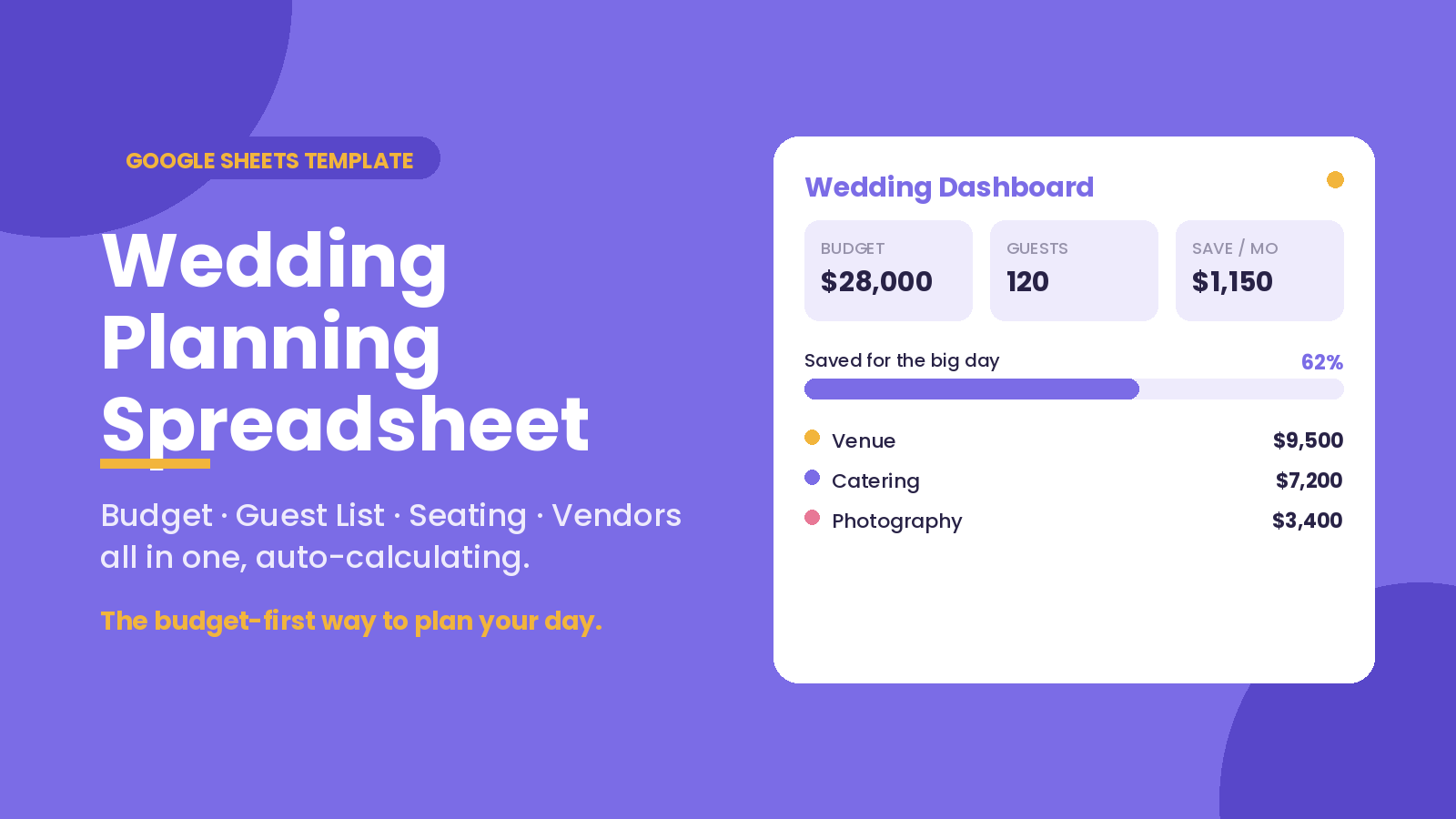
Your whole wedding budget, in one calm spreadsheet
Estimated versus actual cost, deposits with due dates, who’s contributing what, and how much is actually left, and it updates itself as you type. No formulas to build, no 3am arithmetic, no discovering in month nine that you’re $4,000 over. Set it up once and just answer the question “can we afford this?” in five seconds flat.
Get the Wedding Budget Spreadsheet →Which Wedding Costs Are Worth Paying Full Price For?
Photography, food, and music are the parts guests experience directly and the parts you keep afterward, which is why cutting them to the bone tends to show. Everything else is more flexible than the wedding industry would like you to believe. Save on paper goods, favors, transportation, elaborate florals, and anything a guest looks at for under four seconds.
A useful filter: will this still matter in ten years? Photos will. The chair covers will not. Spend where memory lives and be ruthless everywhere else. That’s not being cheap, that’s having taste.
Common Misconceptions About Planning a Wedding on a Budget
“Cutting 20 guests saves 20 × $292.” It doesn’t. That $292 is the whole $34,200 average spread across 117 guests, so it includes fixed costs like the photographer and the dress, which don’t shrink when your cousin declines. Only the per-head costs, such as food, bar, cake, rentals, and invitations, go down with each guest you cut, so trimming 20 people saves well under $5,800. Still a meaningful cut. Just not magic.
“DIY saves money.” Sometimes. DIY florals, DIY catering, and DIY décor all trade money for time and stress in the final week, when both are already in short supply. DIY the things that can be finished a month early. Never DIY anything that has to happen on the day.
“We’ll pay it off after with the gift money.” Please don’t plan around this. Gift totals are unpredictable, they arrive late, and a wedding financed on the assumption of generosity is a wedding financed on a credit card. The Federal Reserve’s May 2026 report found that 63% of U.S. adults would cover a $400 emergency expense with cash or its equivalent, meaning 37% would not, and 12% couldn’t pay it by any means at all. Starting a marriage in that group over a party is a rough trade. If the gap is already there, how to pay for a wedding compares what a loan actually costs against saving the same payment first.
“Off-season means January in a snowstorm.” A Friday or Sunday date, or a month outside the July–September peak, is often priced below a peak-summer Saturday, and nobody has to wear a parka.
The Part Nobody Tells You: Your Budget Is a Payment Calendar
Here’s the thing that actually sinks people. A wedding budget isn’t a total. It’s a schedule. You don’t need $25,000 on your wedding day. You need a venue deposit twelve months out, a photographer retainer eleven months out, a dress deposit that’s due before you’ve saved for it, and then a wall of final payments in the last few weeks.
That last part is what catches a lot of couples off guard. Many vendors want final balances in the last few weeks before the wedding, so check each contract. A huge share of the total can land in one month: the same month you’re paying for alterations, the rehearsal dinner, and a marriage license. Couples who budgeted perfectly on the annual total still put that final month on a credit card, purely because of timing. Our guide on rehearsal dinner cost covers how to pin that one down before it lands in the same month as everything else.
The fix takes twenty minutes. Write every deposit and final balance next to its due date, then look at what each month actually demands. Where a month is impossible, you either negotiate a payment plan (many vendors will, if you ask early), move the booking, or cut something now instead of panicking in month eleven. Treating each of those due dates like a sinking fund (a small amount set aside monthly for a known future cost) turns the whole thing from a cliff into a staircase. Laying those dates out in order gives you a wedding payment schedule, which is the version of the budget that actually tells you what each month costs.
This is also the exact reason to keep your emergency fund out of the wedding entirely. It is not wedding money. It’s the reason a transmission failure in month eight doesn’t cancel your florist.
Haven’t set your total yet? Our guide on how to budget for a wedding walks through picking that number first.
Wedding Budget Questions People Actually Ask
Where can you cut a wedding budget without guests noticing?
Guests tend to remember the food, the drinks, and the music far more than chair covers, printed programs, favors, or a second dessert. Cut in that order (decor and paper goods first, guest experience last), and the day still feels generous while the total drops.
Can you have a wedding for $10,000?
It can work, but it’s tight. It usually means keeping the guest list near 50 and choosing a venue that doesn’t require a full catering contract. For scale, in The Knot’s 2026 Real Weddings Study of weddings held in 2025, the average photographer ($3,000), dress ($2,100), and DJ ($1,800) add up to $6,900 before any venue, food, or drinks.
What is the cheapest month to get married?
The Knot’s 2026 Real Weddings Study reports costs by quarter, not by month. For weddings held in 2025, January–March and October–December weddings both averaged $33,200, compared with $35,400 for July–September. So winter and late-fall dates tend to cost less, though the average gap is about $2,200. Holiday weekends can still carry peak pricing. Once the date is locked, the wedding planning checklist turns it into the order your deposits come due.
What is the biggest cost of a wedding?
The reception venue. In The Knot’s 2026 Real Weddings Study of weddings held in 2025, it averaged $12,900, the largest of the vendor averages the study lists, with catering at about $80 per person on top. That’s why both should be booked before anything else.
What is the cheapest way to feed your wedding guests?
Serve a buffet or family-style rather than a plated dinner, because plated service needs far more staff per guest. Moving the ceremony earlier so you serve lunch or heavy appetizers instead of dinner cuts more, and limiting the bar to beer, wine, and one signature cocktail makes one of the harder-to-predict lines on the invoice easier to control.
Is it cheaper to have a weekday wedding?
Usually. Many venues price Friday and Sunday dates below Saturdays, and true weekday dates can be lower still, so ask each venue for its day-of-week rates in writing. The trade-off is guest attendance: expect a lower RSVP rate, which also lowers catering costs.
Is hiring a wedding planner worth it on a tight budget?
A month-of coordinator is usually the better buy than a full-service planner. The coordinator’s job is to keep the timeline on track, and timeline slips are what trigger overtime charges from the venue, the band, and the photographer, the overruns that quietly wreck a tight budget.
How do you tell people they aren’t invited?
You don’t announce it. You just don’t send an invitation, and if asked, say honestly that you’re keeping it small. Set an A-list and a B-list early, and send B-list invitations as A-list declines arrive, no later than six weeks out.
Don’t have a budget sheet yet?
The free Monthly Budget Template is the simplest place to start — one page, income at the top, bills underneath, and every total already wired in. Ten minutes, no formulas, and it costs nothing.
Get the free Monthly Budget Template →This article is for general information only and is not financial advice. Wedding costs vary widely by region, season, and vendor. Figures cited come from The Knot 2026 Real Weddings Study (weddings held in 2025), the Federal Reserve’s May 2026 Report on the Economic Well-Being of U.S. Households, and the U.S. Bureau of Labor Statistics’ August 2026 CPI release. Consider your own circumstances before making financial decisions.