

Quick answer: Our planning band for a wedding dress is about 4% to 8% of your total wedding budget, with alterations budgeted on top. For scale, couples married in 2025 paid about $2,100 on average for the dress, according to The Knot’s 2026 Real Weddings Study of 10,474 US couples. That is roughly 6% of the study’s $34,000 average wedding, and it leaves out alterations.
You tried on one dress, loved it, and then somebody flipped the tag over. Now there is a number in your head and you have no idea if it is normal, a bargain, or a small act of financial self-harm. So you searched, and the results were mostly bridal shops telling you what a gown is worth, which is a bit like asking a bakery whether you need cake.
Here is the trouble with stopping at the average. It tells you what other couples paid. It says nothing about what fits your wedding, and the tag is not what the dress ends up costing you anyway. So let’s build your actual number, the one you can say out loud at your first appointment without your voice going up at the end.
Key takeaways
- Start from your total budget, not the tag. The national averages for weddings held in 2025 work out to about 6%.
- The $2,100 average leaves out alterations, so give them their own line before you shop.
- A dress is usually two payments, a deposit and a balance. Both dates belong in your budget.
What Do People Actually Pay for a Wedding Dress?
Couples married in 2025 paid about $2,100 on average for a wedding dress, based on The Knot’s 2026 Real Weddings Study of 10,474 US couples. Couples in the study’s lowest budget tier paid about $1,200, the middle tier around $2,000, and the high-end tier roughly $3,200. Federal data tracks women’s dresses as a group, and we could not find a federal statistic that isolates bridal gowns, so this industry survey is what there is to work with.
| Group (weddings held in 2025) | Dress spend, The Knot 2026 study |
|---|---|
| Lowest budget tier | About $1,200 |
| Middle budget tier | Around $2,000 |
| High-end budget tier | Roughly $3,200 |
| Mid-Atlantic weddings | About $2,200 |
| Midwest weddings | $2,500 |
| Hometown weddings | Around $2,000 |
| International destination weddings | $2,900 (reported as spend on the look) |
Notice what is not on that list: the couture gown from your feed. The Knot says its average mainly reflects off-the-rack and made-to-order dresses, and just 19% of the women it surveyed wore custom-made attire. One honest caveat: respondents were recruited through The Knot and WeddingWire memberships, so read this as what couples on those platforms paid.
How Do You Work Out Your Own Dress Budget?
Multiply your total wedding budget by a percentage you choose. About 6% is where the national averages for 2025 weddings land, since $2,100 is about 6% of $34,000. Go closer to 4% if the dress is not where you want your money, or closer to 8% if it is the thing you care about. The result is your ceiling for the tag, before alterations.
| Total wedding budget | 4% (keep it lean) | 6% (in line with 2025 averages) | 8% (the dress is your splurge) |
|---|---|---|---|
| $10,000 | $400 | $600 | $800 |
| $20,000 | $800 | $1,200 | $1,600 |
| $34,000 | $1,360 | $2,040 | $2,720 |
| $50,000 | $2,000 | $3,000 | $4,000 |
Those percentages are our planning bands, not a law of bridal physics. They just give you a starting line that is tied to your wedding instead of a stranger’s. If you still need that total, our wedding budget breakdown shows how the big categories usually split.
When we built the BUDGET tab in our wedding budget spreadsheet, we started the Attire & Beauty line at 9% of the total. That line has to cover more than the gown, so a $34,000 wedding opens with $3,060 for the whole look. You can overwrite it, and honestly you should, but it means you see an attire number before you walk into a salon and fall in love.
The Tag Is Only Part of the Bill
The Knot states that the cost of wedding dress alterations is not included in its average dress price, so the $2,100 figure does not include alterations. Alterations, a veil, shoes, undergarments, and cleaning afterward are separate purchases. Plan them as separate lines, or the dress budget can run over even when the gown itself comes in right on target.
How big is the alterations line? One bridal atelier owner told The Knot that standard alterations, meaning a hem, a bustle, and an adjustment to the top or bottom of the gown, typically run $700 to $1,000. On a $2,100 dress, that adds 33% to 48% and takes the real total to $2,800 to $3,100. In the same March 2025 article, a bridal shop owner put a hem at $125 to $450 and a bustle at $75 to $175. These are individual experts talking, not a survey, and the atelier owner says location moves the price, so ask a seamstress near you before you trust any of it.
Here is how to turn all of that into the number you actually shop with:
- Set a ceiling for the whole look. Say your wedding is $30,000 and you give attire 9%. That is $2,700.
- Take out alterations. Use a written estimate if you have one. If you don’t, hold back a placeholder, say $700.
- Take out the extras you will really buy. Veil, shoes, undergarments. Call it $300 in this example.
- What is left is your highest tag. Here, $1,700. Say that number to the consultant before anyone brings out the gown that costs more.
We put an OVER flag on each category line of the spreadsheet for exactly this reason. A budget can go wrong in one line long before the total looks scary, and you want to catch that at the fitting, not after the honeymoon.
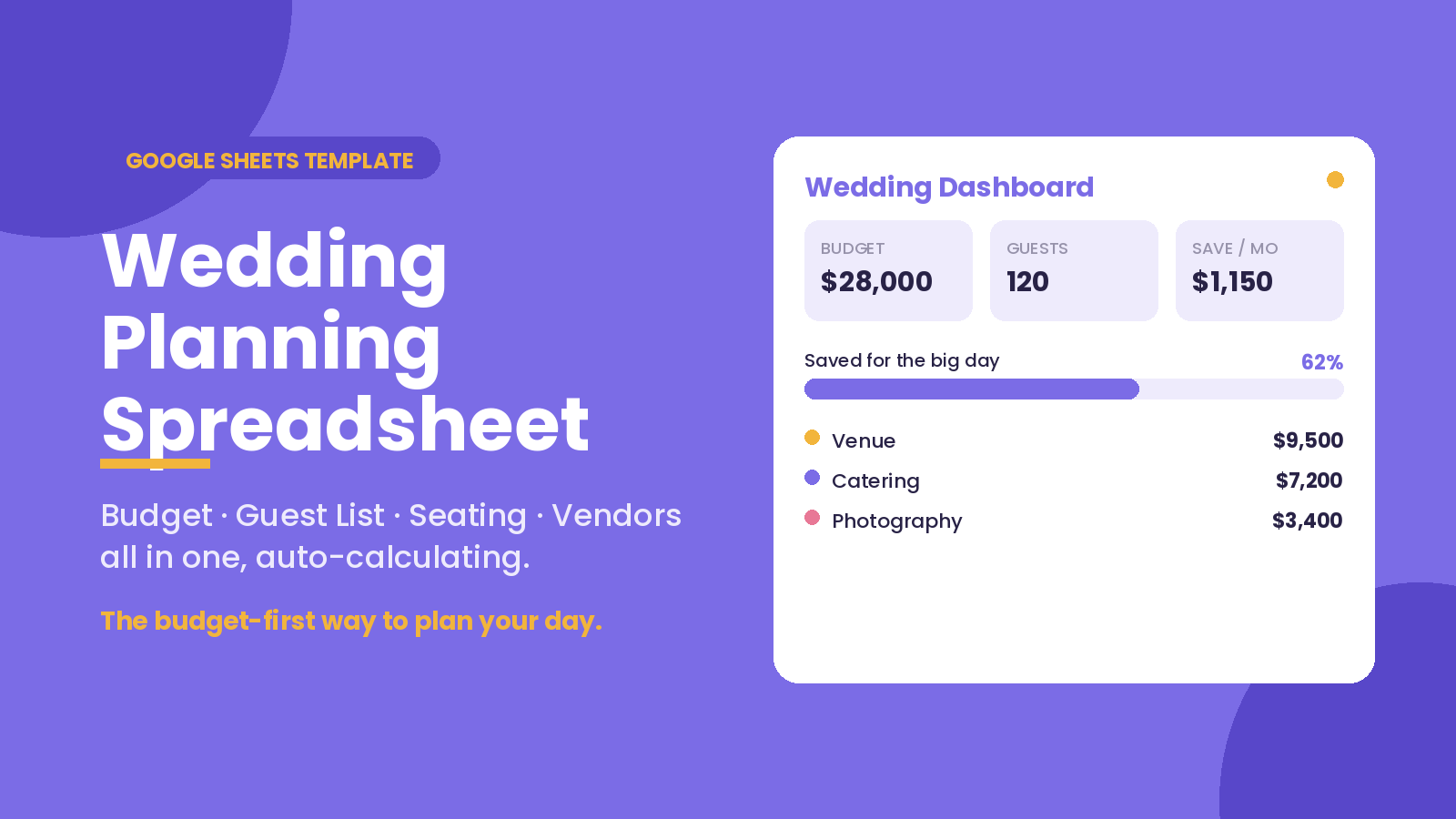
See your dress number before the first fitting
Type your total once and every category gets a suggested amount. Estimates and actuals sit side by side, and the payment schedule counts down the days to each final due date. Seven tabs, works in Google Sheets, no formulas to build.
Get the Wedding Budget Spreadsheet →Are Wedding Dresses Getting More Expensive Right Now?
Federal price data does not show a broad jump in dress prices. The Bureau of Labor Statistics reported that its Consumer Price Index for women’s dresses fell 4.2% in the 12 months ending September 2026, while apparel overall rose 3.4% and all items rose 3.7%. That index covers women’s dresses broadly and not bridal gowns specifically, so treat it as context and not a bridal price tag.
You will still hear that tariffs are pushing gowns up, and for some brands that may be true. One designer told The Knot that brands are paying anywhere from 15% to 50% more on inputs. Our read: that is a reason to get a quote in writing, not a reason to sign today. If a salon tells you the dress will cost more next month, ask what it cost last year and what it will cost in writing. A price that can only be explained out loud is a price you should sleep on.
When Does the Dress Money Actually Leave Your Account?
A wedding dress is usually two payments and not one: a deposit when you order and the balance at pickup. That timing can matter as much as the total, because the balance arrives closer to the wedding, when other vendors may be asking for final payments too. Put both dates in your budget on the day you order.
In The Knot’s article, one designer puts the typical deposit at 30% to 50% of the total. On a $2,100 dress, that is $630 to $1,050 up front and $1,050 to $1,470 at pickup. It is the reason the Payment Schedule in our spreadsheet has Deposit, Balance, and Final Due as separate columns with a Days Until Due count. One vendor, at least two dates. Our wedding payment schedule guide lays out how those dates stack up, and it also covers the dispute window if you put a deposit on a credit card.
Speaking of cards: the Federal Reserve’s G.19 release of November 6, 2026 put the rate on credit card accounts assessed interest at 22.36% for the third quarter of 2026. Carry a $2,100 dress at that rate and you pay about $39 in interest for one month, before a dollar of the balance goes away. Saving $210 a month for ten months gets you to the same dress with none of that. If your wedding is in 2027, our free 2027 budget planner is a place to plan that monthly amount.
Is That Dress Price Normal? Four Quick Checks
Is $2,000 reasonable for a wedding dress?
Yes, $2,000 is close to typical. Couples married in 2025 paid about $2,100 on average, and The Knot’s middle budget tier paid around $2,000. At 6% of your budget, a $2,000 dress fits a wedding of roughly $33,000.
Is $3,000 a lot for a wedding dress?
$3,000 is above the $2,100 average for 2025 weddings and just under the roughly $3,200 paid in The Knot’s high-end budget tier. It fits a total budget of about $50,000 at 6%, or $37,500 if you are treating the dress as your splurge at 8%.
Is $5,000 a lot for a wedding dress?
By the numbers, yes. $5,000 is more than double the $2,100 average for couples married in 2025. At 8% of the budget it fits a $62,500 wedding. If you love the dress and shrink other lines to pay for it, that is a choice and not a mistake, as long as you make the cuts on purpose.
What is the average cost of a good wedding dress?
The Knot’s data measures price, not quality, and its average for 2025 weddings is about $2,100. The Knot lists fabric, design and labor, construction, retailer location, and brand reputation as key cost drivers, so a higher price can reflect a label as much as the sewing.
Not sure what you can set aside each month?
The free monthly template shows what is left after your bills, so your dress savings number comes from your real life and not from a salon’s price list.
Get the free Monthly Budget Template →This article is for general information only and is not financial or legal advice. Dress prices, alteration costs, and shop terms vary by location and change over time. Always confirm figures in your own written contract.