

Quick answer: This guide’s starting split puts about 45% into venue, catering and bar, 12% into photo and video, 9% into flowers and décor, 8% each into attire and entertainment, and keeps 8% back as a buffer. The Knot’s 2026 Real Weddings Study, based on 10,474 couples who married in 2025, puts the average U.S. wedding at $34,200 for 117 guests, or roughly $292 per person walking through the door.
You’ve probably already seen a wedding budget breakdown pie chart. Maybe several. They tend to say roughly the same thing, they look very tidy, and then you sit down with your actual number, the one you and your partner agreed on at the kitchen table, possibly while slightly panicking, and the percentages don’t seem to fit anything real.
That’s not you being bad at math. It’s because a percentage chart is a distribution, not a plan. It tells you how the average couple’s money landed. It doesn’t tell you which of those categories will laugh at you when you try to cut them.
So let’s do both. Real percentages, applied to real totals, and then the part that rarely gets said out loud: which slices actually shrink when your budget does, and which ones just sit there costing about the same.
Key takeaways
- The Knot’s budget breakdown from its 2026 study (couples married in 2025) puts venue, rentals, catering, cake and drinks at about 53% of a wedding budget; this guide’s starting split holds that group to 45% and keeps 8% as a buffer.
- The average wedding in The Knot’s 2026 study (couples married in 2025) cost $34,200 for 117 guests, about $292 a head.
- Using The Knot’s vendor averages from its 2026 study (couples married in 2025), a photographer, videographer, DJ, dress, rings and officiant add up to about $12,460, and those are mostly flat costs that usually don’t change with how many guests you invite.
- Build in an 8% buffer before you book anything. Service charges and tax are not optional surprises.
What Is a Realistic Wedding Budget Breakdown by Percentage?
A realistic starting split, the one this guide uses, allocates 45% to venue, catering and bar, 12% to photography and video, 9% to flowers and décor, 8% to attire and beauty, 8% to music and entertainment, 6% to stationery, favors and transportation, 4% to rings, officiant and the marriage license, and holds 8% in reserve. It’s a planning split, not survey data. The Knot’s budget breakdown, calculated from its 2026 Real Weddings Study of couples married in 2025, puts venue, rentals, catering, cake and drinks at 53% and photography and video at 10%, with no buffer line.
Here’s that breakdown run against two numbers: a $20,000 wedding, and a $34,200 wedding, the average in The Knot’s 2026 study of couples married in 2025.
| Category | Share | $20,000 wedding | $34,200 wedding | Moves with guest count? |
|---|---|---|---|---|
| Venue, catering & bar | 45% | $9,000 | $15,390 | Yes, mostly |
| Photo & video | 12% | $2,400 | $4,104 | No |
| Flowers & décor | 9% | $1,800 | $3,078 | Partly (centerpieces) |
| Attire & beauty | 8% | $1,600 | $2,736 | No |
| Music & entertainment | 8% | $1,600 | $2,736 | No |
| Stationery, favors & transport | 6% | $1,200 | $2,052 | Partly |
| Rings, officiant & license | 4% | $800 | $1,368 | No |
| Buffer (please don’t skip) | 8% | $1,600 | $2,736 | n/a |
Print that, or better, put it somewhere the numbers update themselves when you change one. Watching a category flag itself as over once its actual spending passes the plan is a very different experience from finding out months later.
Why Does Venue and Catering Eat About Half of a Wedding Budget?
This guide allocates roughly 45% to venue and catering because catering, cake and rental costs grow with guest count, and The Knot’s own breakdown from its 2026 study of couples married in 2025 puts venue, rentals, catering, cake and drinks at about 53%. The Knot’s 2026 Real Weddings Study (couples married in 2025) puts the average reception venue alone at $12,900, which is already 38% of the $34,200 average before the first plate of food at about $80 a head. Add the bar, rentals and the service charge, and over half of that average is committed before you’ve picked a flower.
This is why guest count deserves your attention before any percentage does. The Knot’s average-cost guide, based on its 2026 Real Weddings Study of couples married in 2025, puts weddings with more than 100 guests at an average of $43,300, versus $27,200 for 51 to 100 guests, a $16,100 gap. That’s the trade that rarely gets framed clearly: your cousin’s plus-one you’ve met twice, or your photographer.
None of this means you should be miserable about it. It just means guest count is one of the dials with the most torque (The Knot calls it one of the biggest factors in what you’ll spend), and it’s worth turning that one first before you start haggling over centerpieces. We went deep on that trade-off in our guide to how to budget for a wedding. If you’d rather settle the head count first, a wedding guest list template that counts people and households separately keeps your catering count and your postage count right.
How Do You Turn These Percentages Into Your Actual Numbers?
Turning a wedding budget breakdown into real numbers takes four steps: set the total you can genuinely fund, subtract the buffer immediately, split the rest by the percentages above, then adjust two categories: up for what you care about, down for what you don’t. Skipping step two is how a buffer gets spent without anyone deciding to.
- Write down the real total. Cash you have, plus what you can save between now and the date, plus anything family has actually committed in words you could repeat back to them. Hopes are not funding.
- Take the buffer out first. Eight percent, off the top, into its own account. Treat it like a sinking fund for a wedding that hasn’t gone wrong yet.
- Split what’s left using the shares in the table. This is your starting map, not your verdict.
- Pick two winners and two losers. Push your two most important categories up by three or four points each and pull the same amount out of the two you genuinely don’t care about. For some couples, that’s flowers and favors.
Step four is where the whole thing becomes yours instead of the average couple’s. And it’s where a spreadsheet starts to earn its place. Nudging photography from 12% to 16% has to come out of somewhere, and redoing that arithmetic by hand across eight categories each time a quote changes is one way budgets quietly get abandoned partway through.
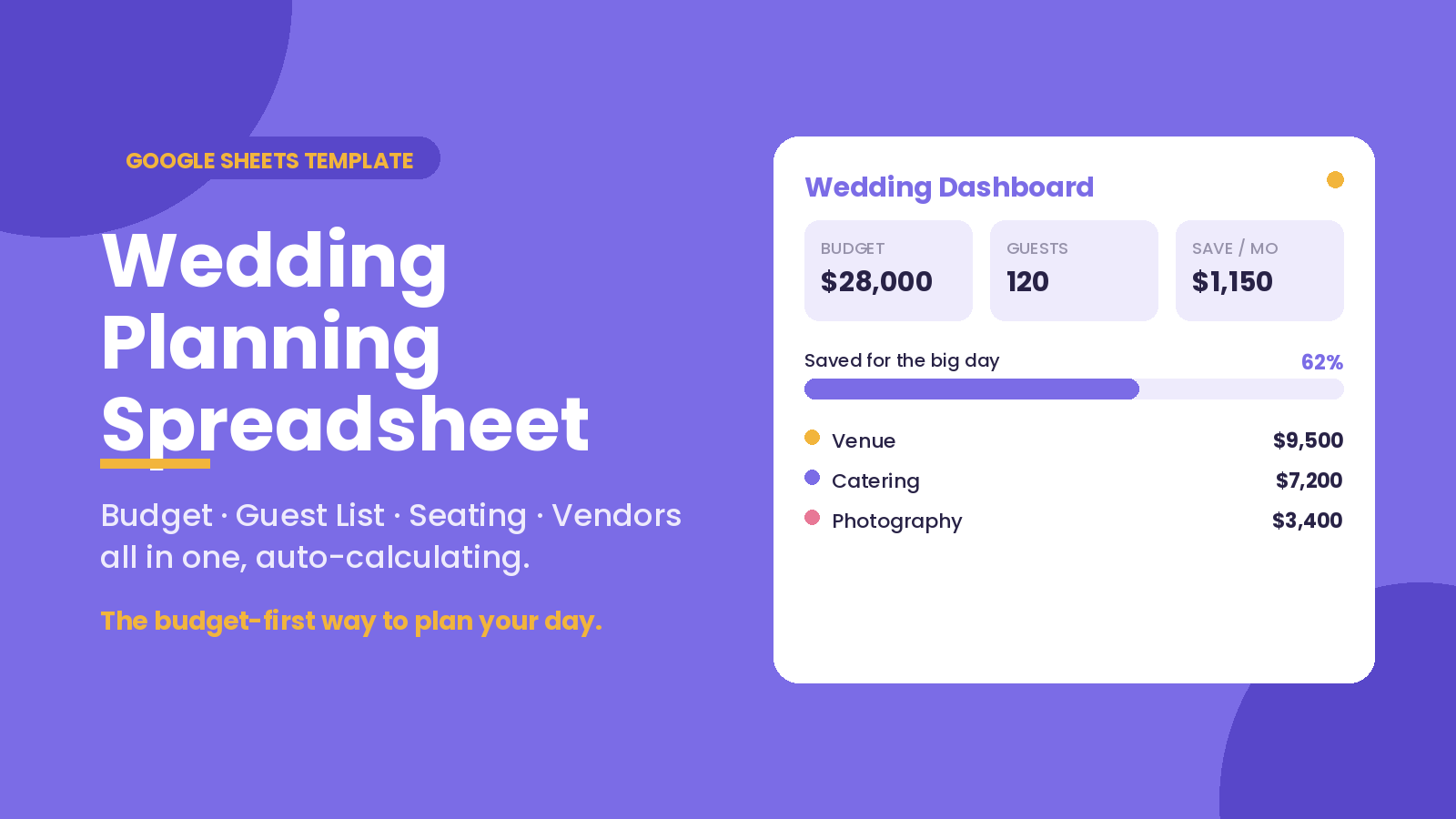
A starting split for every category, already doing the math
Type your total once and every category gets a suggested dollar amount, deposits and final payments track separately, and the buffer has its own line, so you can see what’s left in it as you log spending. No formulas to build, no pie chart to redraw.
Get the Wedding Budget Spreadsheet →Common Misconceptions About Wedding Budget Breakdowns
Three assumptions can lead to wedding budget overruns, and each one sounds reasonable right up until the invoice arrives.
“The quote is the price.” A catering or venue quote may not include a service charge or tax. If your caterer adds a 20% service charge, a $9,000 quote becomes $10,800 before sales tax. Read what the quoted number excludes before you fall in love with it.
“The buffer is padding for people who aren’t organized.” The buffer is for alterations, vendor tips, guest parking, the band playing past its contracted time because the dance floor is still full. These aren’t failures of planning. They’re the wedding. The license fee, which this guide keeps in the rings-and-officiant line, also varies from place to place; this look at courthouse wedding cost compares three local offices’ posted fees.
“We’ll put the overflow on a card and pay it off after.” This is the expensive one. The Federal Reserve’s G.19 release of September 8, 2026 put the average rate on credit card accounts assessed interest at 22.15% in the second quarter of 2026. A $5,000 overflow paid down over two years costs roughly $1,200 in interest, money that bought you nothing, at a party that’s already over.
Why the Percentage Table Falls Apart Under $20,000
A percentage breakdown treats each category as if it shrinks along with the total. A big share of wedding spending doesn’t. Using The Knot’s own category averages from its 2026 Real Weddings Study (couples married in 2025), the photographer ($3,000), videographer ($2,300), DJ ($1,800), dress ($2,100), rings ($3,000) and officiant ($260) come to $12,460, and those costs don’t usually rise or fall with the guest count.
Set against The Knot’s $34,200 average from the same study, that flat block equals about 36% of the total. Perfectly comfortable. But hold those same vendors steady and shrink the total to $20,000, and the block is now 62% of everything you have. At $15,000 it’s 83%. The percentage chart still says “12% for photography,” or $1,800, while the $3,000 photographer average hasn’t moved.
So at smaller budgets, run it backwards. List the flat costs you refuse to compromise on, subtract them from your total first, and percentage-split only what survives. That number, what’s left after the immovable stuff, is your real budget, and it’s the one that should shape your guest list. It’s a less charming exercise than a pie chart, and it can help explain why some smaller weddings look more polished than some bigger ones. If your total is on the tighter end, our walkthrough on how to plan a wedding on a budget picks up from here. Skipping the guest list entirely? See how much does it cost to elope.
This is also the moment the whole thing gets genuinely fun, which doesn’t get mentioned much either. Once the flat costs are locked and the rest is mapped, most decisions after that are smaller and easier to adjust. You stop negotiating with a vague sense of dread and start choosing between real, funded options. That is a very different engagement.
Wedding Budget Questions Couples Actually Ask
How do you break down a $30,000 wedding budget?
A $30,000 wedding budget breaks down to roughly $13,500 for venue, catering and bar, $3,600 for photo and video, $2,700 for flowers and décor, $2,400 each for attire and entertainment, $1,800 for stationery, favors and transport, $1,200 for rings, officiant and license, and $2,400 held as buffer.
How much should a wedding budget buffer be?
Reserve 8% of your total budget as a buffer, moved into a separate account before you book anything. On a $30,000 wedding that’s $2,400. The buffer covers vendor tips, alterations, parking and overtime: costs that are likely to show up but easy to leave out of the first budget.
Does a wedding budget breakdown include the engagement ring and honeymoon?
Not in The Knot’s figures. The Knot lists the engagement ring, rehearsal dinner and honeymoon as costs typically left out of its average wedding cost, so they sit outside the $34,200 average from its 2026 Real Weddings Study of couples married in 2025.
What percentage of a wedding budget goes to photography?
The Knot’s budget breakdown, calculated from its 2026 Real Weddings Study of couples married in 2025, puts photography and videography together at about 10% of a wedding budget; this guide’s split uses 12%. The same study puts the average photographer at $3,000 and videographer at $2,300. Because those are largely flat costs, that percentage climbs sharply at smaller budgets: at $15,000, the same two vendors are 35% of your total.
What is a realistic wedding budget for 100 guests?
The Knot’s average-cost guide, based on its 2026 Real Weddings Study of couples married in 2025, puts weddings with 51 to 100 guests at an average of $27,200 and weddings with more than 100 guests at $43,300. Regional variation is wide, so treat those as reference points rather than targets. Guest count is a quick way to sanity-check a wedding budget before you commit to a venue.
Should you budget by percentage or by priority?
Start with percentages, then adjust by priority. The percentage breakdown helps you avoid obvious blind spots, and the priority pass makes it yours. Move your two most important categories up by three or four points each and take the same amount from two you don’t care about. The total has to stay fixed.
What costs get left out of many wedding budget breakdowns?
Items that are easy to miss include catering service charges, sales tax on top of that, vendor tips, dress alterations, the marriage license, guest parking, overtime rates and cake-cutting or corkage fees. Some are small on their own. Together they can add up fast, which is what the buffer is for.
How do you adjust the breakdown if your parents are contributing?
Add contributions to the total only once they’re confirmed as a specific number, and note whether each is unrestricted or earmarked for one category. Earmarked money, like a parent paying for the bar directly, should not be spread across other categories, because it isn’t actually available to move.
New here? Start free
You don’t have to buy anything to get going. The free Monthly Budget Template puts your income, bills and leftover on one page, and it keeps working whether or not you ever buy another thing.
Get the free Monthly Budget Template →This article is for general information only and is not financial advice. Wedding costs vary significantly by region, season and vendor. Confirm all pricing, service charges and tax directly with your vendors before committing.