

Quick answer
Budget with irregular income by building your plan on your lowest-earning month, not your average. Cover only true essentials with that floor number, then route everything above it into a buffer account you pay yourself from. The Federal Reserve found in May 2026 that 30% of U.S. adults had income that varied at least occasionally in 2025, and 58% of self-employed people did.
You had a $6,000 month in March and felt rich. Then April came in at $2,300 and you were moving money around at 11pm wondering where it all went. Nothing was wasted. Nothing was stupid. The math just changed underneath you.
That whiplash is the actual problem with irregular income, and it rarely gets named: you’re not bad at budgeting, you’re budgeting against a number that doesn’t exist. The “average” month is a statistical ghost. You rarely get paid exactly the average.
So let’s throw the average out and build something that holds up in a bad month and quietly makes the good months feel amazing instead of confusing.
Key takeaways
- Build the budget on your lowest month in the last 12, not the average. That’s your floor.
- Pay yourself a fixed “salary” from a holding account so your spending stays flat while your income bounces.
- Overflow from big months has a job before it arrives: buffer first, then taxes, then goals.
- A one-month buffer is the first milestone. CFPB research suggests roughly one month of savings separates people in danger of financial hardship from those at lower risk.
What counts as irregular income (probably you)
Irregular income isn’t just freelancers. It’s commission sales, tipped work, hourly shifts that shift, seasonal trades, rideshare, online shop sellers, real estate, nurses picking up extra shifts, anyone with a bonus structure, and plenty of people with a side hustle attached to a normal job.
The Fed’s 2025 household survey, published May 2026, put it plainly: 30% of adults had income that varied at least occasionally, and 11% said that variation made it hard to pay their bills. Among self-employed workers it jumps: 58% saw month-to-month swings, and 22% struggled with bills because of it.
Translation: this is normal, it’s just badly served by normal budgeting advice. Many templates assume one number lands on the 1st and the 15th. Yours doesn’t.
Why the lowest-month method actually works
Here’s the uncomfortable arithmetic. If you build your life around your average income, every below-average month comes in short, and when a few big months pull the average up, that can be more than half of them. You’ve designed a budget that fails in every lean month and then blamed yourself for the failures.
Building on your floor flips that. As long as your essentials fit inside that floor, your fixed costs get covered even in the ugly months, so bills don’t have to bounce or land on a card. And the surplus months stop being a spending free-for-all. They become the thing that funds your calm.
The buffer matters more than the discipline. The CFPB’s Emergency Savings and Financial Security report (March 2022) points to a 2016 study (McKernan et al.) finding that consumers with as little as $250–$500 saved come out of a financial shock in better shape than people holding $1–$249. The report itself found that 79% of consumers with no emergency savings had difficulty paying at least one bill in the prior 12 months. Small cushions do outsized work.
If you’ve been stuck living paycheck to paycheck on variable pay, this is usually the missing piece. Not more restriction, just a gap between when money arrives and when it gets spent.
How to budget with irregular income, step by step
- Find your floor. Pull the last 12 months of deposits. Ignore the best month, ignore the average, write down the worst one. That’s your planning number. If you’re newly self-employed and don’t have 12 months, use your worst of the last 6 and shave 10% off for honesty.
- List only what has to happen. Rent, utilities, groceries, insurance, minimum debt payments, transportation, phone. Nothing aspirational. This is the survival layer, and it has to fit inside your floor. If it doesn’t, that’s the real emergency and it’s worth knowing now instead of in your worst month.
- Open a holding account. Every dollar you earn lands here. Not your checking. For variable pay, this one change often does more than a new spending rule.
- Pay yourself on a schedule. On the 1st (and the 15th if you like), transfer your floor amount from holding to checking. That’s your paycheck. Your spending life now runs on a boring, predictable number while your income does whatever it wants.
- Give the overflow a job before it shows up. Anything left in holding at month-end goes in this order: buffer until it holds one full month of expenses → taxes if you’re self-employed (the IRS puts the self-employment tax rate alone at 15.3%, on top of income tax, and the worksheet in Form 1040-ES helps you figure how much to set aside) → sinking fund categories → debt or investing.
- Reset the floor twice a year. Income grows, income shrinks. Check in every January and July and adjust the salary you pay yourself.
That’s it. Six moves. The hard part isn’t understanding it. It’s tracking it month after month without building a spreadsheet from scratch every time your income does something new.
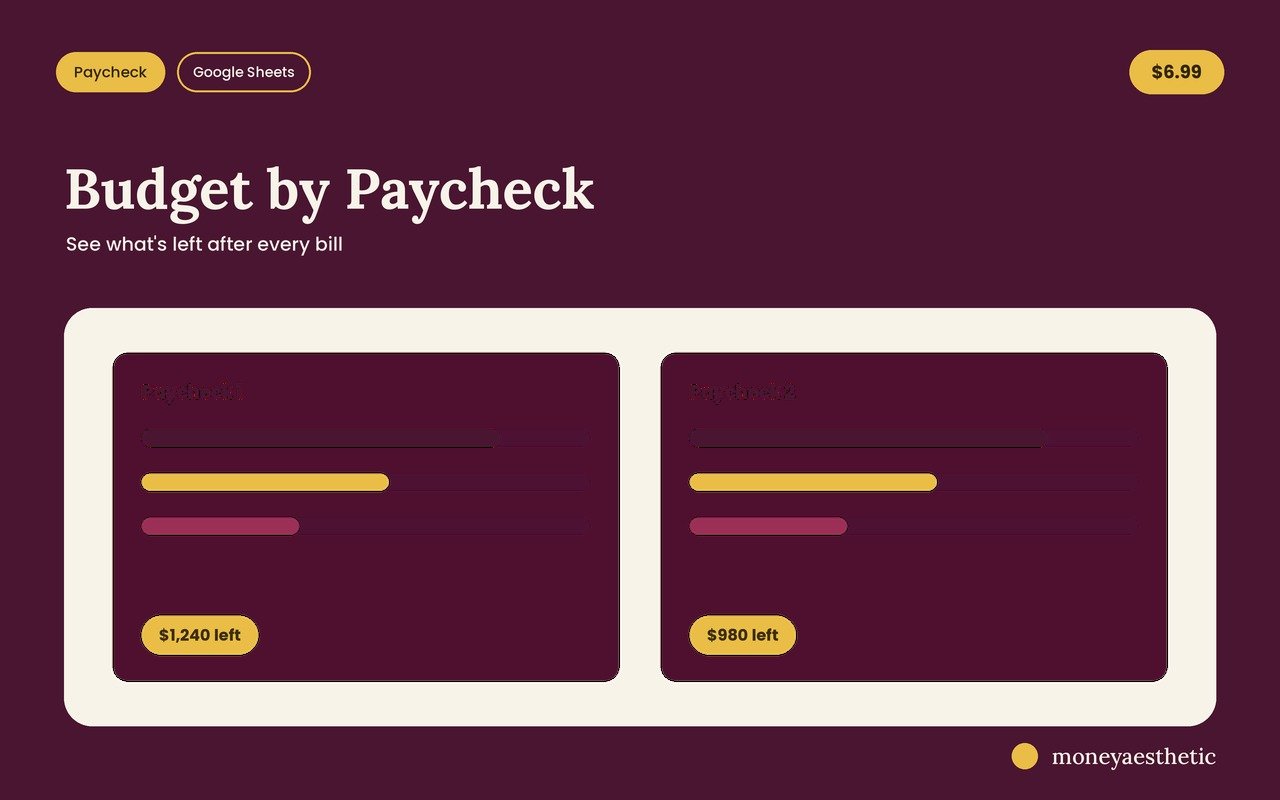
Budget by Paycheck
Type in each income source and how often it pays (weekly, biweekly, semi-monthly or monthly; for uneven pay, enter what actually arrived as a monthly amount). It converts everything to a monthly figure and shows what’s left after your fixed and variable expenses, with a bill calendar and savings goals in the same sheet. No formulas to build, no rebuilding it in March. Five minutes to set up.
Get Budget by Paycheck →Regular vs. irregular income budgeting, side by side
| Steady paycheck | Irregular income | |
|---|---|---|
| Planning number | Your salary | Your lowest month in 12 |
| Money lands in | Checking | A holding account first |
| Spending rhythm | Set by payday | Set by you, on the 1st |
| Goal of a big month | Nice bonus | Fill the buffer, then taxes |
| First savings target | 3–6 months | 1 month of expenses, fast |
| Common pitfall | Lifestyle creep | Budgeting off the average |
Common misconceptions
“I can’t budget until my income is stable.” Backwards. Irregular income is exactly the situation a budget was invented for. Stable income forgives sloppiness; yours doesn’t.
“I should just budget my average month.” The average is a risky number to plan around. It’s not wrong, it’s just rarely a month you actually live through.
“A buffer is the same as an emergency fund.” Different jobs. Your buffer smooths timing: money that arrived in March paying April’s rent. Your emergency fund handles the transmission, the ER visit, the layoff. Build the buffer first; it’s smaller, and it keeps ordinary timing gaps from draining the emergency fund.
“Tracking is pointless when every month is different.” It’s the opposite. Variable income is where tracking pays for itself quickly, because your budget categories stay fixed even when the top-line number swings.
The part advice often skips: map your lean months
A lot of advice stops at “save more in the good months.” It rarely tells you which months are your bad ones, and you may well have a pattern.
Open your last two years of deposits and rank the calendar months from best to worst. The pattern depends on your work. A photographer might find the first weeks of the year slow, a seller might see sales drop right after the holidays, and a consultant might hear less from clients during vacation season.
Now do this: add up how far each lean month falls below your floor, and divide that total by the number of surplus months you get. That’s your pre-funding number: the specific amount each good month owes to the lean ones. Not “save more.” A number.
Once you do this, your slow season can stop feeling like a threat and start feeling like a scheduled quiet stretch. It was already on the calendar. It was just never on the budget. If you want to see the mechanics of assigning every dollar a destination like this, zero-based budgeting is the framework underneath it.
And honestly? That’s the feeling worth buying. Not a spreadsheet. It’s the version of April where the rent is already covered because March handled it. If you’d rather not build the tracking sheet yourself, the Budget by Paycheck template turns each income source into a monthly figure, shows what’s left after expenses, and keeps a bill calendar and savings goals in the same sheet. And if you just want to start somewhere tonight, the free Monthly Budget Template is a fine first step.
Irregular income budgeting questions, answered
How do you budget when your income changes every month?
Base the budget on your lowest-earning month from the past year and cover only essential expenses with it. Deposit all income into a holding account, then transfer that fixed floor amount to checking on the 1st as your paycheck. Everything above the floor goes to a buffer, taxes, then goals.
What is the 50/30/20 rule for irregular income?
Apply the percentages to your floor number, not to each deposit. Fifty percent of your lowest month goes to needs, 30% to wants, 20% to savings and debt, then treat surplus from strong months as extra savings on top rather than extra spending.
How much should I save with an irregular income?
Aim for one full month of expenses as a buffer first, then extend to three to six months. A 2016 study cited by the CFPB (McKernan et al.) found that people with even $250 to $500 saved were better off after a financial shock than people with $1 to $249, so the first small milestone is worth hitting fast.
Should I budget on my average income or my lowest income?
Lowest. Budgeting on the average means every below-average month falls short of the plan, and when a few big months pull the average up that can be more than half of them. That is why variable-income budgets feel like they keep failing. The floor method covers your essentials even in lean months, as long as those essentials fit inside your lowest month.
How do freelancers handle taxes on irregular income?
Set aside a fixed share of every payment the moment it arrives, in a separate account you don’t touch. The IRS puts the self-employment tax rate alone at 15.3%, on top of income tax, and the worksheet in Form 1040-ES helps you figure the share. Self-employed people in the U.S. generally pay estimated tax across four payment periods, so the money needs to be ready several times a year.
What is a holding account and do I really need one?
It’s a separate checking or savings account where all income lands before any of it reaches your spending account. It’s a simple structural fix for variable pay because it separates when money arrives from when money gets spent.
How long does it take to build a one-month buffer?
It depends on how far your good months run above your floor: divide one month of expenses by your typical monthly surplus, and that is roughly how many surplus months it takes. If your income is highly seasonal, one strong season can build the entire buffer at once, which is why the first good month after starting this matters so much.
What if my lowest month doesn’t cover my essential bills?
Then the gap is a real problem worth solving now rather than in your worst month. Shrink fixed costs, add a small predictable income floor such as part-time or retainer work, or use the buffer from strong months to formally subsidize lean ones, and write that subsidy into the plan instead of improvising.
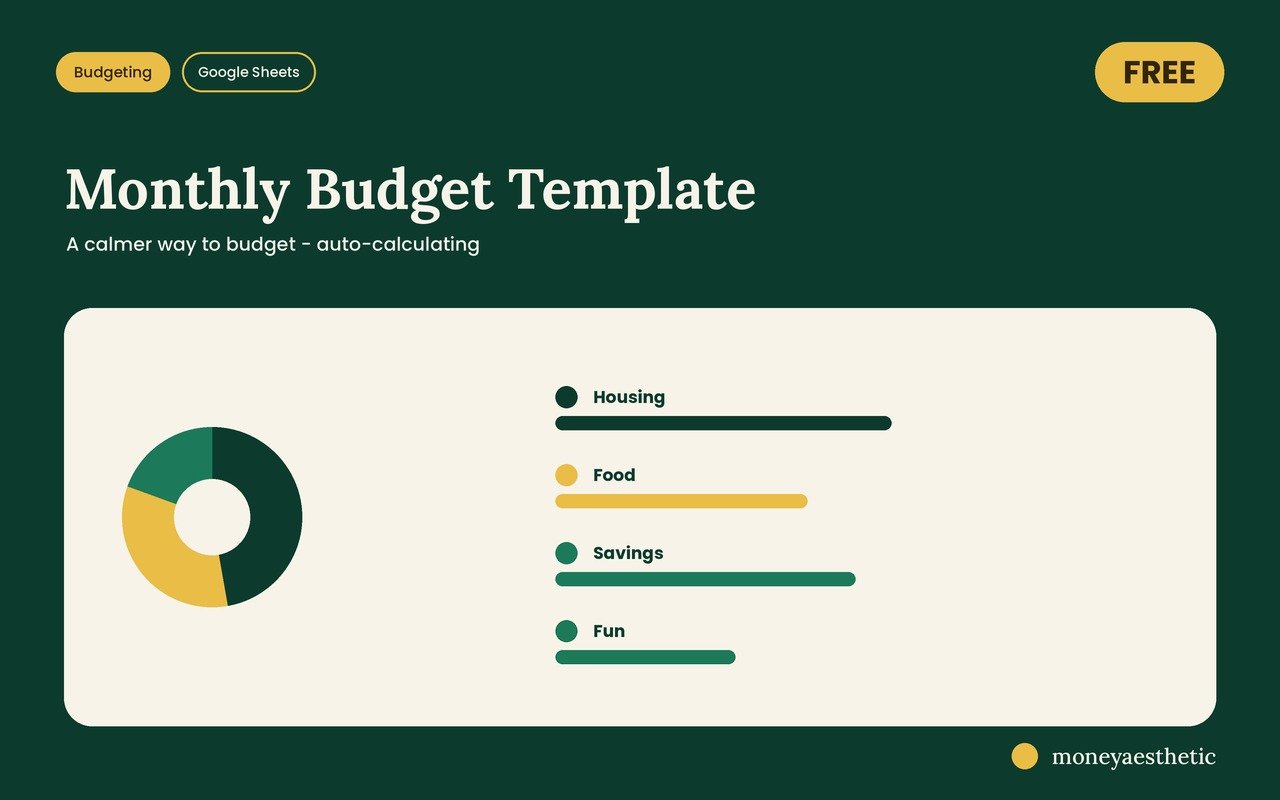
Start with the free one
Every number in this guide has to live somewhere. The free Monthly Budget Template gives it a home: one clean Google Sheet that adds itself up, yours to copy for free.
Get the free Monthly Budget Template →This article is for general education only and isn’t financial, tax, or legal advice. Your situation is your own — talk to a qualified professional before making big money decisions.