

You get paid, and for a few glorious days you feel rich. Then rent hits. Car insurance sneaks in. A few subscriptions you forgot you had renew on the same sad Tuesday. And suddenly you’re back to refreshing your bank app like it might surprise you.
Sound familiar? You’re in very, very good company. And no, it’s not because you’re bad with money. Here’s a part that doesn’t get said enough: living paycheck to paycheck can be a timing problem as much as an income problem. If your bills and your paydays don’t line up, even a budget that looks perfect on paper can leave you short in real life. So let’s fix the timing.
Key takeaways
- Running out before payday is often about timing, not just how much you earn.
- Budgeting by paycheck (not by month) shows you what’s actually safe to spend right now.
- Your first goal isn’t a giant emergency fund. It’s a tiny buffer, then getting one paycheck ahead.
- You can start this week, even if things are tight.
Why you keep running out, even when the math “works”
A monthly budget pretends your money is one smooth pool: this much comes in, that much goes out, done. Real life isn’t that tidy. Money arrives in lumps (paychecks) and leaves in lumps (bills), often on different days. If, say, a $600 bill lands three days before you get paid, it doesn’t matter that “the month” balances out. You’re short right now.
And many of us have a thin cushion to absorb that hit. The Federal Reserve found that only 63% of U.S. adults would cover a surprise $400 expense with cash or its equivalent, meaning more than one in three would have to scramble, and 12% couldn’t cover it at all (Federal Reserve, 2026). Add that Americans saved just 3.0% of their disposable income in July 2026 (BEA, July 2026), and you get the whole trap: a thin cushion plus one mistimed bill equals an overdraft or a credit card. This is exactly why simply seeing “what’s left after this check’s bills” feels like such a relief: the guessing is the part that wrecks you.
The real fix: budget by paycheck, not by month
Here’s the shift that can change a lot. Instead of one big monthly budget, you make a tiny plan for each paycheck: which bills does this check need to cover before the next one shows up? You assign those first. Whatever’s left is your real spendable money. Not a vibe, an actual number.
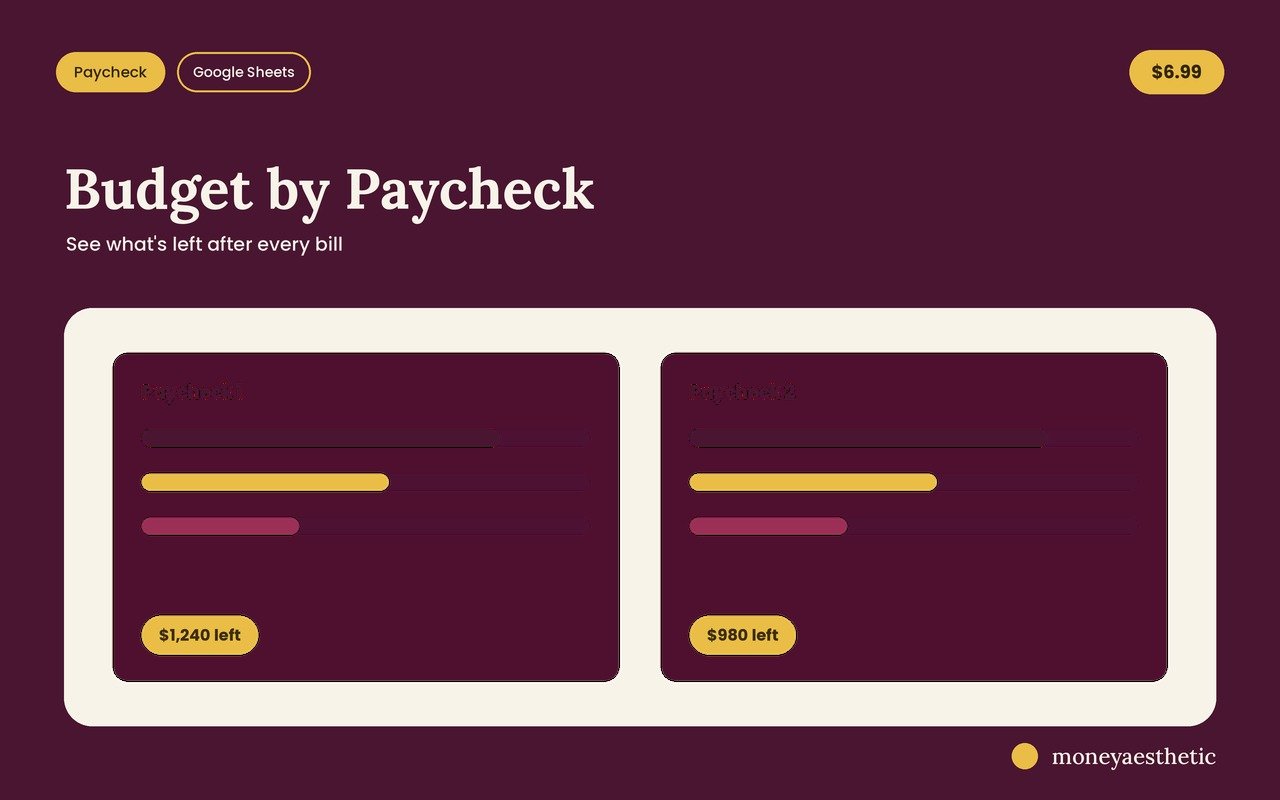
That’s the whole trick. You stop robbing next week to survive this week, because each check already knows its job. Our budget by paycheck spreadsheet helps with the math side: you enter each income with its pay frequency and list your expenses, and it converts your pay to a monthly figure and shows what remains, with a bill calendar to track due dates. No formulas to write, no doing mental math late at night.
How to stop living paycheck to paycheck in 5 steps
- List your paydays for the next month. Circle them on a calendar or a sheet so you can actually see the gaps.
- List your bills and their due dates: rent, utilities, insurance, subscriptions, minimum debt payments. Include the small sneaky ones too.
- Assign each bill to the paycheck that lands before it’s due. For example, rent due early in the month gets covered by your late-month check, not the one after it.
- Subtract those bills from that check. What’s left is that paycheck’s spendable, your “safe to spend” for food, gas, fun, and saving.
- Run it for a few cycles and tweak. The first round can feel a little clunky, and you can adjust as you go.
If steps 3 and 4 sound tedious, doing them by hand can be fiddly. The template takes care of the arithmetic: it converts each income to a monthly figure, totals your bills and expenses, and shows what remains. You still decide which check covers which bill.
Monthly budget vs. budgeting by paycheck
| Monthly budget | Budget by paycheck | |
|---|---|---|
| Question it answers | “Can I afford this… this month?” | “What’s safe to spend from this check?” |
| Handles bill timing | No | Yes |
| Real-life result | Can look fine on paper but run short before payday | Aims to match money in with money out |
| Good fit for | Steady salary, one payday | Biweekly, irregular, or tight cash flow |
Want the math done for you?
The Budget by Paycheck spreadsheet lets you enter your income, pay frequency and bills, then shows what remains each month. It’s auto-calculated and comes with a bill calendar for due dates. It can help you feel more in control of your money.
Get Budget by Paycheck →Money myths keeping you stuck
“I don’t make enough to budget.” Honestly? A plan matters more when money’s tight, because that’s exactly when a mistimed dollar hurts. Budgeting doesn’t shrink your income; it can help you spot the quiet leaks.
“Budgeting means no fun.” Nope. A good paycheck plan can build in guilt-free fun money on purpose, so you can enjoy it without that “should I be spending this?” cloud hanging over you.
“I need to be good with spreadsheets.” You really don’t. If you can type a number into a box, you’re qualified. The template’s formulas are already built in, so it does the math for you.
“I’ll start when I earn more.” More income with no plan can just become a bigger version of the same cycle. A plan can help whether or not a raise ever comes.
The finish line: get one paycheck ahead
Here’s the goal that makes this click: live on last month’s money. First, bank a tiny buffer. Even a few hundred dollars can keep a small surprise bill off a credit card. Then, slowly, save up a whole paycheck so you’re spending money you earned a pay period ago. Once you’re a paycheck ahead, bill timing matters much less. Less countdown, less app-refreshing. And the “remaining” number in your budget by paycheck sheet shows how much you have left over to move into that buffer.
Want to test the waters for free first? Grab our free budget template and just watch where your money actually goes for a little while. Even that can be eye-opening.
FAQ
How do I stop living paycheck to paycheck on a low income?
Budget by paycheck instead of by month: assign each check the bills due before your next payday, then spend only what’s left. Timing your bills to your income can help prevent the mid-month shortfalls that push you toward credit cards, and it can work even when money is tight.
What does it mean to budget by paycheck?
It means planning each paycheck separately instead of lumping everything into one monthly budget. You cover the bills due before the next check first, and whatever remains is your real spendable amount. It keeps your money-in and money-out on the same schedule.
How much should I save first?
Start with a small buffer of a few hundred dollars. In its May 2026 report, the Federal Reserve found that 37% of adults wouldn’t cover a $400 surprise expense with cash or its equivalent, so even a small buffer can keep an emergency like that off a credit card. Build the bigger emergency fund after that.
How long does it take to stop living paycheck to paycheck?
It varies with your income, your bills and how much you can set aside. Budgeting by paycheck targets mid-month shortfalls directly, so you can check whether it’s helping after a few pay cycles. Getting a full paycheck ahead depends on your surplus: divide one paycheck by what you can set aside each check to estimate how many pay periods it will take.
Is budgeting by paycheck better than a monthly budget?
For many people paid biweekly, irregularly, or on a tight cash flow, it can be. It matches each bill to the check that covers it, which helps you avoid running short before payday. A monthly budget can work well when you have one steady payday and a comfortable cushion.
How do I budget when I get paid biweekly?
Map each bill to the paycheck that arrives before its due date. In a typical year with 26 biweekly paydays, two months will have a third paycheck, which is a good chance to build your buffer.
What if my income is irregular?
Budget based on your lowest typical paycheck, cover essential bills first, and treat anything above that baseline as bonus money for savings or debt. Planning per paycheck can be especially useful when your income moves around.
How do I get one paycheck ahead?
Put the leftover money from each check and any windfalls, such as tax refunds, bonuses, or third biweekly paychecks, into a buffer until it equals one full paycheck. After that you spend last period’s money, and bill timing matters much less.
Start with the free one
Your numbers need a place to live. The free Monthly Budget Template gives them a home: one Google Sheet that adds itself up. Check out on Gumroad for free, then use File → Make a copy.
Get the free Monthly Budget Template →This article is for education and organization only and isn’t personal financial advice. Do what fits your own situation.