

Quick answer: Stop spending money with ADHD by shrinking the number you shop against, not by trying harder in the moment. Move savings and bill money out on payday so the balance you can see is already the safe amount, park wants on a 24-hour list, and automate the rest. Overspending is expensive right now: the Federal Reserve’s G.19 release put the average rate on card accounts assessed interest at 22.15% in the second quarter of 2026.
You looked up how to stop spending money with ADHD, which means you have probably already tried the advice. Delete the shopping apps. Wait 30 days. Use cash. Be more disciplined. It works for about nine days, and then a Tuesday goes sideways and there is a package on the porch that you do not fully remember ordering.
Here is what nobody says out loud: almost all of that advice asks you to win an argument with yourself at the exact moment you are least equipped to win it. So let’s flip it. The goal is not to resist better, it is to make the resisting mostly unnecessary, because the money is already somewhere else by the time the urge shows up.
Key takeaways
- Split your money on payday. The balance in your everyday account should already be the amount you can safely spend.
- One visible number beats a detailed budget. If you have to add things up to know where you stand, you will not check.
- A 24-hour list is not a rule, it is a parking lot. Write the thing down, keep the tab closed, decide tomorrow.
- Automate the boring parts so remembering is never the load-bearing step.
Is Overspending Actually a Symptom of ADHD, or Am I Just Bad With Money?
Impulsive spending is a well-documented pattern in adults with ADHD, not a character flaw you invented. In a Dutch community study of 1,292 adults published in PLOS ONE in October 2020, participants in the ADHD group scored significantly higher on impulsive buying measures, and only 19.6% of them were saving for retirement compared with 41.5% of the group without ADHD. Among adults diagnosed later in life, 38.8% saved actively versus 63.3% of the no-ADHD group. The ADHD subgroups there were small, 46 and 57 people, so read those as a direction rather than a precise rate.
That gap is not about intelligence or effort. It shows up in how a purchase feels: the reward is right now, in your hands, and the cost is spread thin across a future that feels theoretical. Most budgeting advice quietly assumes the future feels vivid. When it does not, the plan has to carry the weight instead.
The CDC’s Morbidity and Mortality Weekly Report, published October 10, 2024 using survey data collected in October and November 2023, estimated that 6.0% of US adults had a current ADHD diagnosis, roughly 15.5 million people, and that 55.9% of them were diagnosed at 18 or older. A lot of adults spent decades assuming they were simply bad with money. ADHD also looks different in different people, and none of this is a diagnosis.
Why Does Every “Just Be Disciplined” Tip Stop Working by Week Two?
Because you are shopping against the wrong number. Open your banking app and the figure staring back at you is everything in the account: rent that is not due yet, the car insurance that hits on the 12th, the money you swore was for savings. Your brain reads that number as available. Then a plan that depends on you mentally subtracting four future bills at checkout is doing the hardest part in the worst possible place.
This is the piece missing from nearly every list of ADHD spending tips. They intervene at the moment of temptation, when the deck is stacked against you. The fix that holds is earlier and duller: change the number, and that moment gets a lot less dangerous on its own.
When I built the ADHD Budget Spreadsheet, the Safe-to-Spend figure went at the very top of the single tab and stays pinned while you scroll. That was a deliberate call. Everything under it is a report. Only that one number is a decision, and I did not want it competing with eleven other totals for attention.
Getting this wrong is expensive. At 22.15%, carrying a $200 impulse buy on a card for a year adds more than $40 to its price. The Fed’s June 2026 G.19 data put total revolving credit at $1.35 trillion, so this is not a niche problem.
How Do You Stop Spending Money With ADHD This Week?
Six changes, in the order that makes the next one easier. None of them require you to feel differently about shopping. They change what the money is doing before you get there.
- Split the account on payday. Bills go to one account, savings go somewhere you cannot see from the app you open every day, and what remains is spending money. Now the balance is the answer, not a math problem.
- Put one number where you can see it. Whatever you use, the top of it should say what is safe to spend today. Not seven categories. One number, checked in four seconds.
- Start a 24-hour list instead of a rule. When you want something, write it down and close the tab. It is a parking lot, not a punishment, which is why it tends to outlast the 30-day rule. I built the list into the sheet rather than leaning on a phone reminder, because a notification gets swiped away and a written line has to be crossed off.
- Automate the transfer, not the intention. A standing transfer on payday is pay yourself first in practice, and it never depends on you remembering on a bad week.
- Give yourself real fun money. A budget with no guilt-free spending line is the kind you break once and then stop opening. Name the amount, spend it, feel nothing about it.
- Track the leak, not every transaction. Late fees, forgotten subscriptions, replacing things you already own. That is the ADHD tax, and one column for it will tell you more in a month than logging every coffee.
Notice that none of these ask you to be more vigilant. Vigilance is the resource in shortest supply on a hard week, so a system that spends it first fails exactly when you need it most.
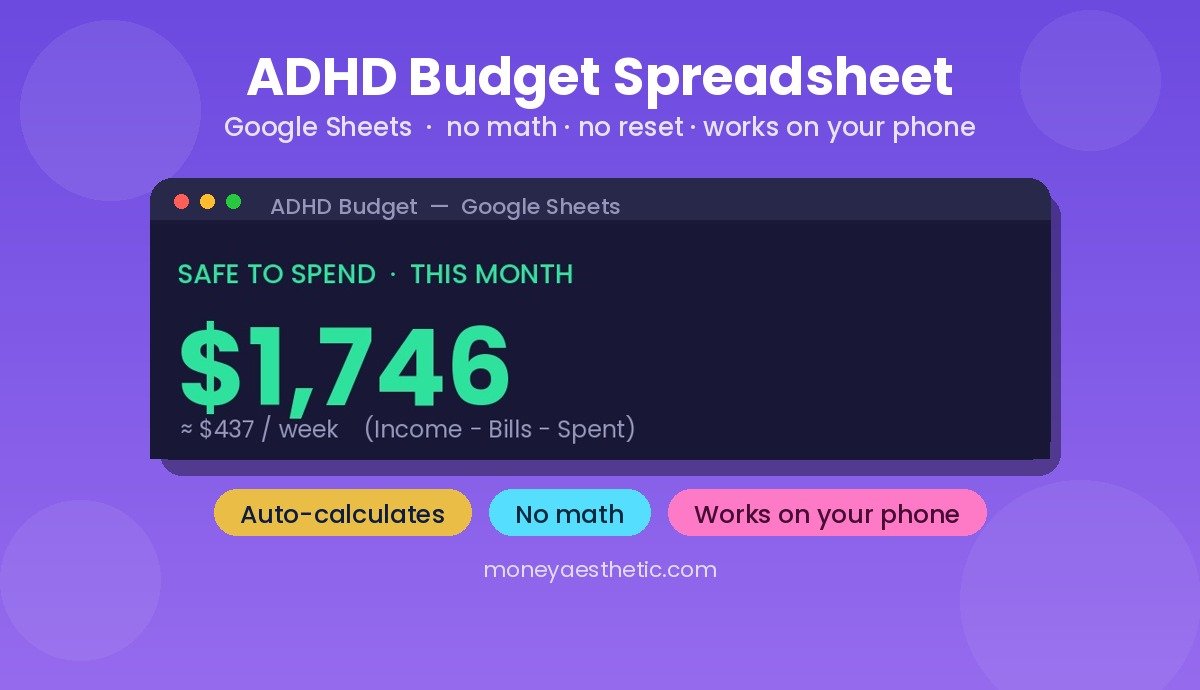
One screen, one number, no monthly reset
The ADHD Budget Spreadsheet keeps Safe-to-Spend pinned at the top of a single tab, sorts a purchase into Needs, Wants or Fun in about ten seconds, and comes with a 24-hour wait list, an ADHD Tax tracker and a no-spend streak already built in. It is undated, so a missed week costs you nothing.
Get the ADHD Budget Spreadsheet →What Budgeting Method Actually Works for ADHD?
The best method is the one you will still open in week six. Detail is not the goal, survivability is. Here is how the common approaches hold up when remembering is the bottleneck.
| Method | What it asks of you daily | Where it usually breaks |
|---|---|---|
| Zero-based budget | Assign every dollar, reconcile often | Falls apart after one skipped week of entries |
| Cash envelopes | Withdraw cash, carry it, split it | Card-only purchases and forgotten envelopes |
| 50/30/20 percentages | Mental math at checkout | You have to know your own running totals |
| Split accounts plus one number | Glance at one figure | Setup day. After that it mostly runs itself |
| App with auto-categories | Review and fix miscategorized items | Notification fatigue, and a subscription cost |
The bottom two rows are the ones that tend to survive, and they combine well. Let a tool do the sorting, but keep the decision number somewhere boring and permanent that does not depend on a free trial. If you want the longer version of this, how to budget with ADHD walks through the setup step by step.
One design choice I will defend forever: the sheet is undated on purpose. A budget that resets on the 1st turns one missed week into a failed month, and the reset date is exactly where people stop opening the file.
ADHD and Money, Minus the Myths
A few beliefs make this harder than it needs to be, and they are worth naming.
“I need a stricter budget.” Strictness is usually the problem. A tight budget with no slack breaks on the first unexpected expense, and those are normal rather than rare: the Federal Reserve’s Survey of Household Economics and Decisionmaking, fielded October 2025 and published May 2026, found 59% of adults had at least one unexpected expense in the prior 12 months.
“I should track every single purchase.” Detailed tracking is a great diagnostic for one month and a terrible permanent habit. Get the baseline, then track the categories that actually move.
“If I just cared more, I would stop.” Caring is rarely the missing ingredient. The same Fed survey found 63% of adults could cover a $400 emergency with cash, which means more than a third could not, across every kind of brain.
“Impulse buying means I am addicted to shopping.” Sometimes the pattern is closer to impulse buying than compulsion. If spending is causing real distress or hiding, that is worth talking to a professional about, and no spreadsheet is a substitute for that conversation.
If You’re the Parent or the Partner, Not the Person Spending
Plenty of people searching this are not asking for themselves. They are a parent watching a teenager burn through a first paycheck, or a partner who has quietly become the household’s finance department. The advice is different from that seat.
Do not become the willpower. If you are the one saying no, every purchase turns into a negotiation with you and the system never gets built. Build the structure together, then let the structure say no. A separate spending account with a fixed weekly transfer does that job without anyone having to be the villain.
Keep the shared view small: one number you can both see, one shared list of things being considered, and a set time to look at it when nobody is annoyed. When a plan does not stick, treat it as a design note rather than proof of anything. It is much easier to look at the same screen together than to relitigate a purchase from last Thursday.
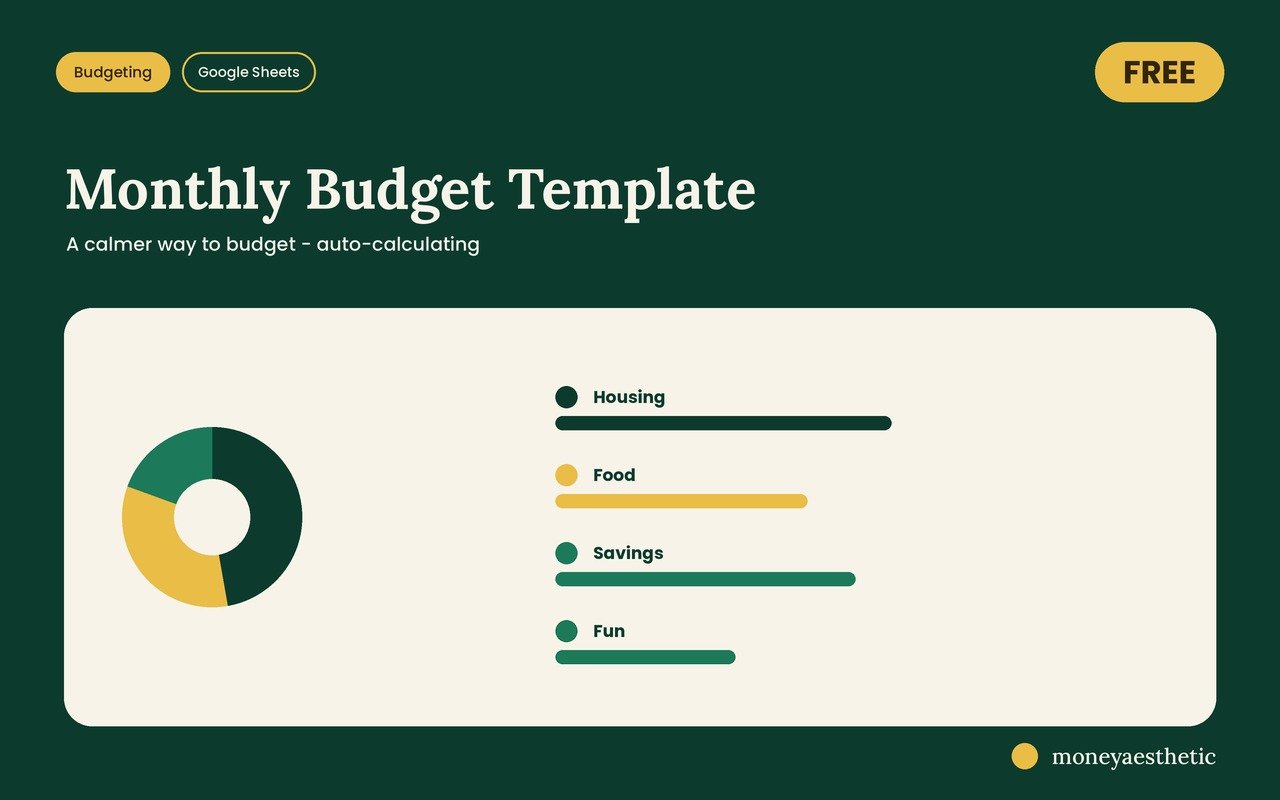
Want to try the split-and-see setup first?
The free Monthly Budget Template is the simplest version of the idea: income at the top, bills next, and what is actually left underneath. No signup gymnastics, and it takes about ten minutes to fill in.
Get the free Monthly Budget Template →How to Stop Spending Money With ADHD: FAQ
Is impulsive spending a sign of ADHD?
It can be one, but on its own it is not diagnostic. Impulsive buying is a documented pattern in adults with ADHD, and the 2020 PLOS ONE study of 1,292 adults found significantly higher impulsive buying scores in the ADHD groups. Plenty of people without ADHD also buy impulsively, so treat it as a signal to build better structure rather than as an answer.
How do people with ADHD struggle with money?
Often through timing rather than amounts: bills paid late, subscriptions nobody cancelled, things bought twice because the first one is missing. The 2020 PLOS ONE study found lower rates of active saving and retirement saving in the ADHD groups, which fits a pattern where future costs feel abstract and present ones feel urgent.
How do I stop being addicted to spending money?
Start by making the money less reachable and the decision less immediate: split accounts, remove saved card details, and use a written 24-hour list. If spending is secretive, causing debt you hide, or driving real distress, that goes beyond budgeting and is worth raising with a doctor or a therapist who works with compulsive behavior.
What is the best budgeting app for ADHD?
The best one is whichever you will still open in six weeks, which usually means fewest taps to one clear number. Automatic categorization helps a lot, but check the annual price before committing, and keep your core setup somewhere you own so a cancelled subscription does not erase it.
How can I save money with ADHD without a strict budget?
Automate a transfer on payday so saving happens before any decision does, then leave the rest genuinely unbudgeted. One automatic transfer and one visible spending number will outperform a detailed plan you stop maintaining by week three.
What budgeting method works best for ADHD?
Split accounts plus a single Safe-to-Spend figure, because it moves the effort to setup day instead of every day. Zero-based budgeting and cash envelopes can work, but both ask for consistent daily upkeep, which is the exact thing most likely to lapse.
This article is general information, not financial or medical advice. ADHD affects people differently, and nothing here is a diagnosis or a treatment plan. For questions about ADHD itself, talk to a qualified clinician.