

Here’s how to budget with ADHD without burning out a few weeks in: stop fighting your brain and design around it. Keep your budget on one screen, let the math calculate itself, make your numbers visual (green = go, red = pause), automate your bills, and build guilt-free fun money right into the plan. About 15.5 million U.S. adults (6.0%) reported a current ADHD diagnosis in a CDC survey run in October and November 2023. A 2020 peer-reviewed study of Dutch adults found that people who met self-reported ADHD symptom criteria reported more impulsive buying and saved money less often than people without ADHD symptoms. That points to a budget design problem, not laziness.
If you’ve started a budget on a Sunday night feeling unstoppable, only to forget it existed by Thursday, welcome. You’re not flaky and you’re not bad with money. A lot of budgeting advice was built for brains that love spreadsheets, remember due dates, and feel a little thrill from logging each latte. That is not the ADHD experience for many people, and pretending otherwise is one reason budgets get dropped a few weeks in.
The good news: budgeting with ADHD is very doable. You just need a system that works the way your brain already does: fast, visual, low-effort, and hard to “fail.” Here’s how to set one up.
Key takeaways
- ADHD budgets fail because of design, not willpower; fix the system, not yourself.
- Keep it to one screen, automate fixed bills, and make spending visual.
- Build fun money in on purpose so impulse buys don’t blow everything up.
- Watch one number (what’s safe to spend) instead of tab after tab of categories.
Why budgeting feels so hard with ADHD
Short version: a budget asks for planning, working memory, consistency, and delayed gratification, skills that ADHD commonly makes harder. That’s not a character flaw. Time blindness can mean “rent’s due soon” doesn’t feel real until it’s due tomorrow. And swiping a card usually carries less of the “ouch” that handing over cash does, so the spend is easier to overlook.
You’re also in very good company. In a 2022 YouGov survey of UK adults commissioned by the bank Monzo, 60% of people with ADHD said it directly affects their finances, 48% said they often impulse spend (vs. 12% without ADHD), and 50% found it hard to stick to a budget (vs. 15%). CHADD, the leading ADHD nonprofit, recommends the same kinds of fixes: automatic bill payments, one regular day a week to review your spending plan, and a savings account without a debit card so spending it takes a second thought. So if normal budgeting hasn’t stuck, the method was the problem, not you.
What an ADHD-friendly budget actually looks like
Forget the sprawling multi-tab spreadsheet and the app covered in buttons. An ADHD budget that survives past Thursday usually has these traits:
- One screen. Your whole money picture in one place. Each extra tab you have to click is one more chance to wander off.
- No math. If you have to do arithmetic to know if you can afford lunch, you won’t. The totals should calculate themselves.
- One number to watch. Not a pile of category balances, just “what’s safe to spend right now.” Green means go, red means pause.
- Automated bills. Anything that repeats (rent, utilities, subscriptions) goes on autopay so you don’t have to rely on memory to avoid a late fee.
- Fun money, on purpose. A budget that bans spontaneous spending entirely is one you’re likely to rebel against. Give yourself a guilt-free amount and spend it freely.
- No monthly reset, no shame. Miss a few days? You just pick it back up. The system shouldn’t make you feel like you failed a test.
That last one matters more than people admit. Many budgets are built around a perfect month. Real months are rarely perfect. The whole game is having something you can walk away from for a week and come straight back to.
Want this already built for you?
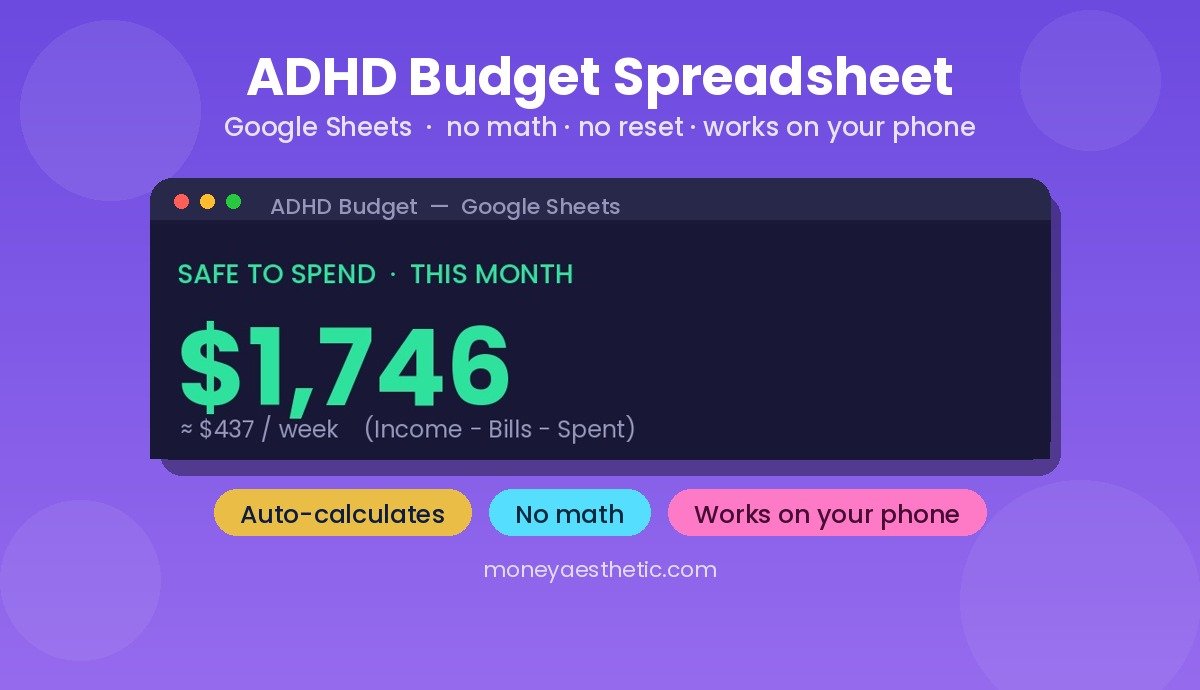
The ADHD Budget Spreadsheet is a one-screen Google Sheet built around these ideas: Safe-to-Spend up top, the math on autopilot, a quick Money Dump spend log, and no monthly reset. Made for the way your brain actually works.
Get the ADHD Budget Spreadsheet →How to budget with ADHD, step by step
Here’s the whole thing, one low-effort step at a time. Set it up once and the system carries a lot of the weight after that.
- Find your real take-home number. Not your salary, but the amount that actually lands in your account each month. That’s your starting line.
- Put fixed bills on autopay. Rent, utilities, phone, subscriptions. If it’s the same each month, autopay means you don’t have to remember it. This move can head off a lot of late fees.
- Set one “safe to spend” number. Take-home, minus bills, minus what you’re saving. Whatever’s left is yours to spend; that’s the main number to glance at.
- Log spending fast. Don’t agonize over categories. Dump the amount in, move on. Fast and messy usually beats accurate and abandoned.
- Give yourself fun money. Decide on an amount you can blow with zero guilt. Counterintuitively, planning to be impulsive is what keeps impulse buys from torching the rest.
- Do a quick weekly check-in. Set a recurring phone alarm: same day, same time. Glance at your number, adjust, done. A fixed routine asks less of your motivation.
If pen-and-paper helps you focus, the old-school cash envelope system can work well with ADHD too: it’s visual, physical, and has a built-in hard stop. Some people run a digital version of it on the exact same one-screen idea.
ADHD money challenges and the fix for each
| The ADHD struggle | The budget-system fix |
|---|---|
| Impulse buying | A built-in fun-money amount + a 24-hour wait on big wants |
| Time blindness (forgotten bills) | Autopay fixed bills; one weekly alarm to check in |
| Overwhelm / too many steps | One screen, one number to watch, not a stack of tabs |
| Hating math | A sheet that calculates the totals for you |
| “I missed a week, it’s ruined” | An undated system with no reset; just pick it back up |
ADHD budgeting myths worth unlearning
- “I just need more willpower.” A budget that leans on willpower tends to crack first. Good design (automation, visuals, one screen) takes over work that would otherwise fall on willpower.
- “I need a powerful app with every feature.” More features means more buttons to ignore. The simplest tool you’ll actually open beats the powerful one you won’t.
- “I’ll never stop impulse buying.” You don’t have to. You just plan for it: a guilt-free fun-money amount turns impulse spending from a budget-killer into a normal line item.
- “Miss a week and the budget’s blown.” Not if the system is built to forgive it. An undated, no-reset budget doesn’t care that you ghosted it for a while.
The ADHD tax: the money your brain quietly leaks
There’s a name for the extra money ADHD costs you when it goes untracked: the ADHD tax. It’s the late fee because you forgot the due date. The second charger because you couldn’t find the first one. The subscription you meant to cancel months ago. The rush shipping, the impulse store run, the food that spoiled because you over-bought.
Each one feels small in the moment, but they add up. In that 2022 UK survey, people with ADHD whose finances were affected put the average cost at an estimated £1,600 a year, and people with ADHD were twice as likely as people without it to say managing money caused them mental health issues (76% vs. 38%). The cruel part is that the ADHD tax is invisible until you put it somewhere you can see it.
That’s why a visible, one-screen budget can help so much with ADHD. When your late fees and impulse buys are sitting in front of you instead of hiding across scattered transactions, they’re easier to catch and cut. A free reference like the government’s CFPB Your Money, Your Goals toolkit (spending tracker, bill calendar, and cash flow budget) can help you map categories, and if you’d rather not build your own, the ADHD Budget Spreadsheet even has a built-in ADHD Tax tracker that tallies it for you. (Prefer something free first? Start with our free Monthly Budget Template and upgrade when you’re ready.) If purchases rather than late fees are the bigger leak, how to stop spending money with ADHD is the companion piece.
Frequently asked questions
How do you budget with ADHD?
Build a system that doesn’t rely on memory or willpower: keep it to one screen, automate your fixed bills, watch a single “safe to spend” number, log spending quickly, and build in guilt-free fun money so impulse buys don’t derail you. Then do one short weekly check-in on a recurring alarm.
Why is budgeting so hard with ADHD?
Budgeting leans on planning, working memory, consistency, and delayed gratification, executive-function skills that ADHD often makes harder. It’s not a willpower problem; standard budgets are simply built for a different kind of brain.
What is the best budgeting method for ADHD?
A good starting point is the simplest method you’ll actually use. For many people with ADHD that means a visual, one-screen system with automatic math and a single number to watch, rather than a complex multi-tab spreadsheet or a feature-heavy app.
What is the “ADHD tax”?
The ADHD tax is the extra money ADHD costs you through late fees, impulse buys, duplicate purchases, forgotten subscriptions, and rush shipping. It’s easy to miss because it’s spread across many small charges, so tracking it in one place makes it easier to cut back.
How do I stop impulse spending with ADHD?
Don’t try to eliminate it, plan for it. Give yourself a set fun-money amount you can spend guilt-free, and add a 24-hour wait before any big purchase. Keeping savings in a separate, slightly inconvenient account also adds helpful friction.
What is the best budget template or app for ADHD?
Look for visual, low-effort, and hard to “fail.” A one-screen Google Sheet like the ADHD Budget Spreadsheet is one option built this way: it auto-calculates, shows a clear safe-to-spend number, and has no monthly reset, so missing a few days doesn’t break it.
Does ADHD really affect money management?
Yes. A 2020 peer-reviewed study of Dutch adults in PLoS One found that people who met self-reported ADHD symptom criteria reported significantly more impulsive buying and saved money less often than people without ADHD symptoms. The fix is structural: budgeting tools designed around how ADHD actually works.
How often should I check my budget with ADHD?
A quick check once a week is a good place to start; CHADD suggests picking one regular day each week to review your spending plan. Put it on a recurring alarm so it becomes routine rather than something you have to remember. Daily check-ins can be hard to sustain, and a monthly one is easy to forget.
Don’t have a budget sheet yet?
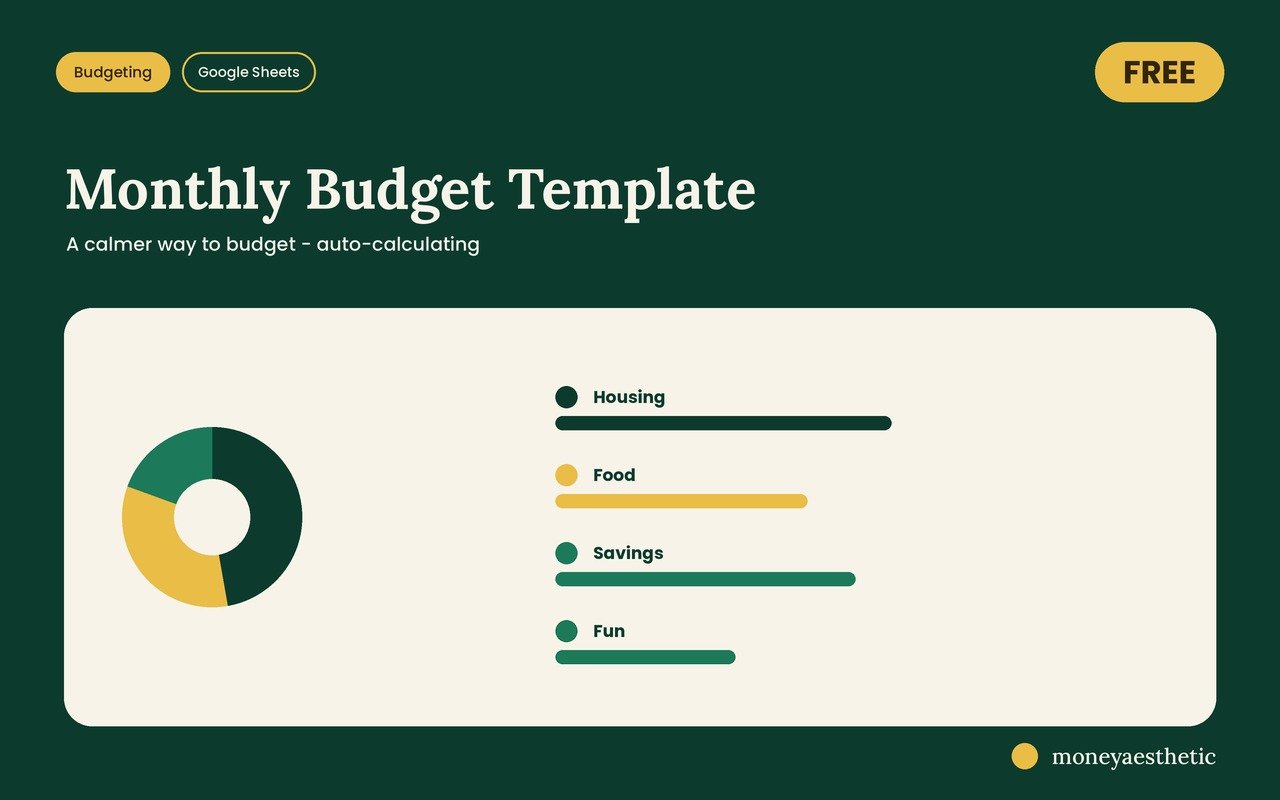
The free Monthly Budget Template is an easy place to start: one tab, income near the top, bills underneath, and the totals already wired in. No formulas to write, and it costs nothing.
Get the free Monthly Budget Template →Money Aesthetic shares educational information, not personalized financial or medical advice. ADHD affects people differently; consider your own situation (or talk to a professional) before making money or health decisions.