

Quick answer: To stop impulse buying, add friction instead of willpower: delete saved card details, unsubscribe from sale emails, use a 48-hour rule for anything over your set dollar limit, and keep one visible “safe to spend” number you can check at a glance. The cost of skipping this is real: the average rate on credit card accounts assessed interest was 22.15% in May 2026, per the Federal Reserve’s G.19 release of September 8, 2026.
You didn’t wake up planning to buy a fancy candle. But there it was, sitting in the checkout page late at night, and somehow your thumb had already moved. A couple of days later it’s on a shelf and you feel a small, weird sting each time you walk past it.
That sting is the actual problem. Not the candle. Wanting to stop impulse buying doesn’t mean you’re reckless. Often you’re just making money decisions in moments when it’s hard to think clearly: tired, bored, stressed, or a few reels deep into someone else’s beautiful kitchen.
And it adds up quietly. The Bureau of Labor Statistics’ Consumer Expenditures release (December 19, 2025) found the average U.S. consumer unit (roughly, a household) spent $3,609 on entertainment, $2,001 on apparel and services, and $978 on personal care in 2024. That’s roughly $550 a month across those three categories alone. That spending isn’t wrong. But if a chunk of it is going to stuff you don’t remember buying, that’s money you could be sending somewhere that actually feels good.
Key takeaways
- Impulse buying is a visibility problem more than a discipline problem, because you can’t feel a number you can’t see.
- Friction beats willpower. Removing saved cards and one-click checkout puts a pause in place without relying on self-talk.
- A planned “fun money” line can help break the binge-restrict cycle that makes impulse spending worse.
- Run a 30-day regret audit to spot your personal triggers, with no generic advice required.
Why you impulse buy (and why “just stop” rarely works)
Here’s what’s really happening. An impulse buy is a fast trade: a quick hit of relief right now, against a vague cost later. The first part is easy to feel, and the second part is easy to ignore.
Retailers design for this. Saved payment info, one-tap checkout, low-stock warnings, free returns that make a bad decision feel low-risk, buy-now-pay-later splitting $80 into a harmless-sounding $20. Those features shorten the gap between wanting and owning.
So when you tell yourself to just have more self-control, you’re bringing a pep talk to an engineering problem. The lever here isn’t more discipline. It’s making the impulse slower and the number visible.
If you’ve ever wondered why you can hold the line for weeks and then blow it in one big shopping trip, that’s often a binge-restrict loop. Which is why the fixes below leave room for you to buy things on purpose.
What impulse buying actually costs
Let’s put a real number on it, because vague guilt is useless and a number is motivating.
If an impulse buy lands on a credit card you don’t pay off in full, it stops being a $60 purchase. According to the Federal Reserve’s G.19 Consumer Credit release (published September 8, 2026), the average rate on card accounts assessed interest was 22.15% in May 2026, the latest quarterly reading, and Americans were carrying about $1.36 trillion in revolving credit as of July 2026. At that rate, a $60 impulse buy you carry for a year, with interest compounding monthly, costs about $75. Make that a habit and you’ve quietly signed up for a subscription you didn’t choose.
And the cost isn’t just interest. It’s the vacation fund that doesn’t fill, the sinking fund you keep raiding, the month where your paycheck disappears and you genuinely cannot account for a chunk of it. Naming the pot gives that money a job, which is the whole point of a vacation fund.
How to stop impulse buying: 7 fixes worth trying
- Delete your saved cards. Clear them out of Amazon, big-box store accounts, that boutique app. If buying requires walking to your wallet, some impulse purchases won’t survive the trip. It takes no willpower.
- Set a dollar threshold, then a 48-hour rule. Pick your number (for example, $40). Anything over it goes on a list and waits two days. You’ll probably still buy some of it, and skip the rest.
- Unsubscribe ruthlessly. Sale emails aren’t information, they’re prompts. A round of unsubscribing removes a lot of future decisions you’d otherwise have to win.
- Give your fun money a real line. Not “whatever’s left,” but an actual amount you’re allowed to blow with zero guilt. Feeling deprived can set up the blowout. See budget categories if you want a starting split.
- Know your safe-to-spend number. This one ties the others together. Not your account balance, but the amount left after the bills that haven’t cleared yet. If you can check it quickly on your phone, the urge is easier to ride out.
- Name your trigger out loud. “I’m buying this because I’m tired,” can help. You’re not forbidding the purchase, just labeling it. Often the wanting fades once it’s named.
- Give yourself a hard reset when needed. A short no spend challenge isn’t punishment. It’s a way to find out how much of your spending was habit rather than need.
Notice how few of these require you to be strong. That’s on purpose. And notice that steps 4 and 5 both depend on knowing one number, which is where it’s easy to get stuck, because working it out by hand each week is a chore that’s easy to let slide.
Match the trigger to the fix
Generic advice can miss because your triggers aren’t the same as your sister’s. Find yours in the left column and start with that row:
| Your trigger | What it looks like | The friction that stops it |
|---|---|---|
| Late-night scrolling | Cart fills late at night | Log out of shopping apps; phone charges outside the bedroom |
| Stress & bad days | “I deserve this” | Pre-funded fun money line, capped at a set amount |
| Sale emails | You didn’t want it until it went on sale | Unsubscribe; filter promos out of your main inbox |
| Boredom in-store | Went for milk, left with a bag of extras | Written list, and a basket instead of a cart |
| Buy-now-pay-later | Four easy payments, several active plans | Uninstall the app; count the full price, not the installment |
| No idea what’s actually left | Balance looks fine, then rent hits | A safe-to-spend number you can see at a glance |
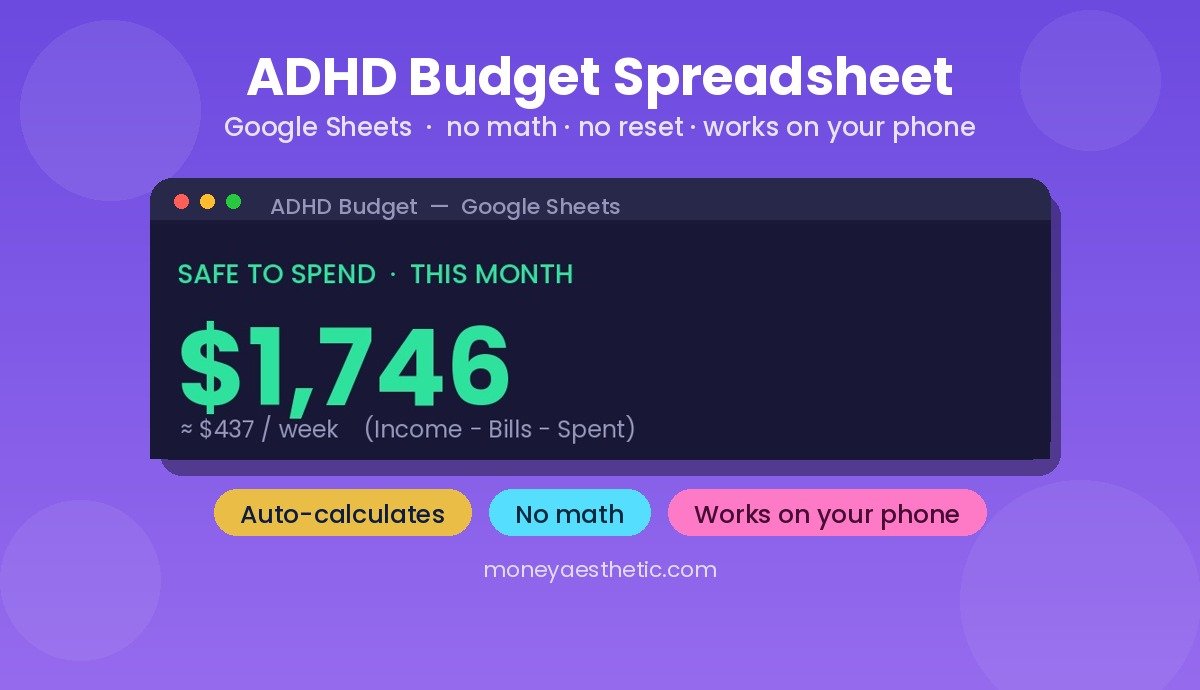
See your safe-to-spend number at a glance
Built for anyone who hates doing budget math or forgets to check. One tab, no formulas to touch: type in your paychecks, bills and spending, and Safe to Spend shows the income you’ve entered minus your bills and what you’ve already spent. The totals calculate themselves. You just type your own numbers in.
Get the ADHD Budget Spreadsheet →It’s called the ADHD Budget Spreadsheet because it was designed around impulsivity and executive-function stuff, but honestly, you don’t need an ADHD diagnosis to want a budget that doesn’t need babysitting. If you want to test the idea first, the free monthly budget template covers the basics.
Common misconceptions about impulse spending
“I need more willpower.” Probably not. Relying on willpower means winning the same argument over and over, and a system doesn’t need you to win.
“I should cut all fun spending.” This often backfires. A budget with zero room for fun is hard to keep, and the pressure tends to come out as a splurge. Planned fun money can help make the rest of the budget survivable. Gear-heavy hobbies are one place this bites, and the fix can be a number rather than a ban: once a session tracker shows you what an outing really costs per hour, “should I?” turns into something you can check instead of argue with.
“Buy-now-pay-later isn’t debt if it’s interest-free.” It’s still a payment obligation on a future paycheck, and stacked plans make it easy to lose track of what’s truly available. Missed payments can also carry fees. If a few plans are already running, here is how to pay off buy now, pay later debt without opening another one.
“It’s just small purchases, it doesn’t matter.” Small and frequent can quietly add up to more than big and rare, because a small purchase rarely feels like a decision.
“Cash-back and rewards make it fine.” Two percent back on something you didn’t need still leaves 98% of the price spent. The reward doesn’t change that math.
The 30-day regret audit (do this once)
Here’s the step that’s easy to skip, and it’s worth doing because it replaces generic advice with your data.
Pull up the last 30 days of transactions. Skip rent, groceries, gas, bills. For each remaining purchase, mark it with one of three tags:
- Still glad: you’d buy it again today.
- Neutral: fine, forgettable.
- Regret: you’d take it back.
Now add up the regret column and divide it by your total discretionary spending. That percentage is your regret rate, a simple way to track your impulse spending over time. There’s no official benchmark, so the number to beat is your own.
Then look at the regret items and write down two things next to each: the time of day, and how you felt. Do this for a batch of purchases and a pattern often shows up: Sunday-night dread, or the mid-afternoon work slump, or trips to one specific store. You don’t need to fix everything after that. You need to fix one window.
Re-run it in a few months. Watching your regret rate drop (say, from 28% to 9%) can be more motivating than a rule, and it’s where this can stop feeling like restriction and start feeling like taste. If you want more on the broader habit side, here’s how to stop spending money across the board, and if focus and follow-through are your real obstacle, how to budget with ADHD goes deeper.
Frequently asked questions
What is impulse buying?
Impulse buying is making an unplanned purchase driven by emotion or opportunity rather than a decision you made in advance. It typically happens fast, in response to a trigger like a sale, stress, or boredom, and it can make spending totals surprising at the end of the month.
What is the 30-day rule for impulse buying?
The 30-day rule means writing down any non-essential item you want and waiting a full month before buying it. The wait gives a temporary urge time to fade before you spend. If 30 days feels unrealistic, a shorter wait, such as 48 hours on anything above a set dollar threshold, still adds a pause with far less friction.
Why do I impulse buy when I’m stressed?
Shopping can feel like a quick way to get some relief or a sense of control on a hard day, so it’s easy to reach for when you’re stressed. In that moment the purchase is doing a coping job more than a shopping one, which is why the fix is usually a different fast reward plus a pre-funded fun money line, not stricter rules.
How much should I budget for fun money each month?
There’s no official benchmark. Pick a fixed amount you can afford after bills and savings, try it for a month, and adjust. What matters is that it’s decided in advance and kept separate from bills and savings, because an unnamed amount is easy to overspend.
Does deleting saved credit cards really help?
It can. Saved cards and one-click checkout remove the pause between wanting and buying, so adding that step back gives your judgment time to catch up. Once the cards are deleted, there’s nothing to keep up.
Is buy-now-pay-later making my impulse buying worse?
For many people, yes. Splitting a purchase into small installments can make the price feel smaller than it is, and running several plans at once makes it hard to see how much of your next paycheck is already committed. Counting the full price rather than the installment gives you a more accurate picture.
How do I stop impulse buying on Amazon specifically?
Remove saved payment methods, turn off one-click ordering, and delete the app from your phone so purchases require a browser. Moving items to a saved list instead of the cart can also help, because you can review the list once a week and buy what still appeals.
How long does it take to break an impulse spending habit?
Friction changes like deleting saved cards work right away, so you may notice a difference within your next billing cycle. Lasting change takes longer and varies from person to person, especially while you’re still identifying your personal triggers and adjusting for them.
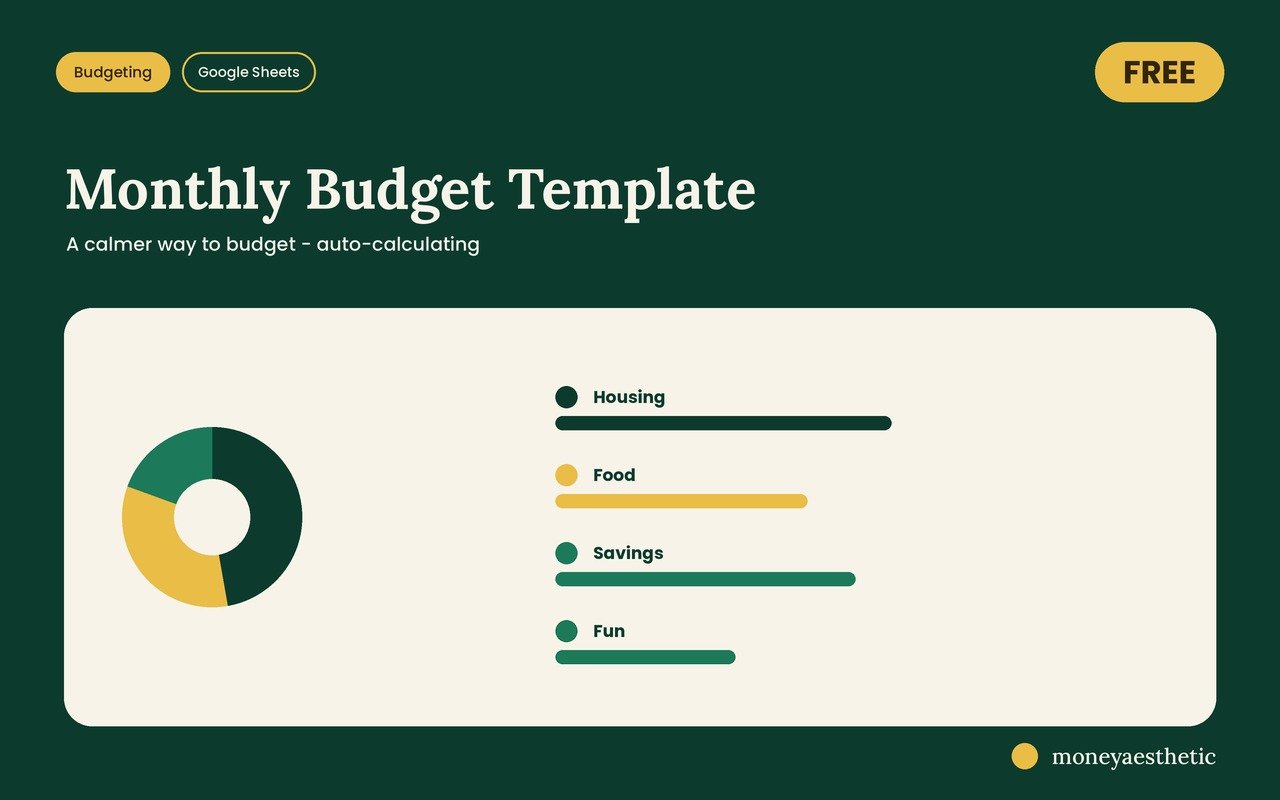
Start with the free one
The numbers in this guide need somewhere to live. The free Monthly Budget Template gives them a home: one clean Google Sheet tab that adds itself up. Grab it free through Gumroad checkout, then use File → Make a copy.
Get the free Monthly Budget Template →This article is for general education only and is not financial, tax, or legal advice. Your situation is unique — consider speaking with a qualified professional before making financial decisions.