

Quick answer: To avoid overdraft fees, cancel debit card overdraft coverage so one-time card purchases get declined instead of quietly cleared, then spend from a safe-to-spend number instead of your bank balance. Many banks and credit unions charge $30 or more per overdraft, according to the CFPB, and Congress repealed the federal rule that would have limited those fees at large banks in May 2025, so no federal cap is holding the price down.
You know the sequence. Card taps, coffee happens, life continues. Two days later there’s a line on your statement that costs more than the coffee, the sandwich and the parking put together, and the worst part isn’t even the money. It’s the feeling that your own bank account went behind your back.
Here’s the thing nobody at the bank will say out loud: you didn’t overdraft because you’re bad with money. You overdrafted because the number on your banking app is not the number you actually have, and nobody ever taught you the difference. Let’s fix that, and let’s get your last fee refunded while we’re at it.
Key takeaways
- Opting out of debit card overdraft coverage is free, takes one phone call, and makes one-time card purchases and ATM withdrawals decline instead of charging you. Checks, autopays and recurring card charges can still overdraft.
- Overdraft fees are priced per transaction, so a short day with three small purchases can cost more than a short day with one big one.
- Your available balance can’t see what hasn’t hit the account yet. Scheduled autopays and uncashed checks are already spent, and it doesn’t know that.
- Fewer than 9% of account holders pay nearly 80% of these fees, according to CFPB research, which means overdrafting is a system problem, not a character flaw.
What Is an Overdraft Fee, and What Does One Cost in 2026?
An overdraft fee is what a bank charges to pay a transaction you didn’t have the money for. Many banks and credit unions charge $30 or more per transaction, according to the CFPB. A non-sufficient funds (NSF) fee is a different charge: the bank refuses the payment instead of covering it.
Averages hide a lot, though. Bankrate’s 2025 Checking Account and ATM Fee Study put the average overdraft fee at $26.77 per item and the average NSF fee at $16.82, and 94% of the accounts it surveyed still charged an overdraft fee. Some big banks charge far less: Bank of America charges $10 per item under its fee schedule effective August 7, 2026, and Capital One and Citibank have eliminated overdraft fees entirely. So the number that matters isn’t the industry average. It’s whatever your specific bank charges, multiplied by however many transactions slipped through while you were short, up to any daily cap.
Why Didn’t the $5 Overdraft Cap Ever Happen?
Because Congress cancelled it. The CFPB finalized a rule in December 2024 that would have required banks and credit unions with more than $10 billion in assets to cap overdraft fees at $5, charge only enough to cover their costs and losses, or disclose overdraft like a loan, starting October 1, 2025. A Congressional Review Act resolution killed the rule before that date, and it was signed into law on May 9, 2025. If you have a vague memory that overdraft fees got capped, that memory is real. The cap just never took effect.
What happened next is the part worth knowing. A June 2026 issue brief from the National Consumer Law Center estimated that overdraft and NSF fees still pulled more than $12 billion out of household accounts in 2025, and that overdraft revenue at the top 20 consumer banks rose 6.2% between 2023 and 2025. Overdraft revenue climbed much faster at some banks over that stretch: up 40% at Huntington, 36% at M&T, 24% at Citizens and 22% at TD. The federal pressure came off, and some banks have started raising their fees again. Nobody is coming to rescue your checking account, which is annoying, but at least it’s clarifying.
Why Do You Overdraft When Your Balance Said You Had Money?
Because your available balance only reflects what has already reached the account. It subtracts card purchases that are posted or still pending, but it does not subtract the autopays scheduled for Thursday or the rent check nobody has cashed yet. All of that money is already promised. The banking app simply hasn’t caught up, and it won’t warn you on its own. Installment plans that pull from checking on a fixed schedule are one version of this, and the guide on how to pay off buy now, pay later debt lays those payments out by week.
So the balance says $180 and buying groceries feels perfectly reasonable, while $164 of that $180 belongs to a car payment clearing tomorrow morning. You weren’t reckless. You were reading a number that wasn’t built to answer the question “what can I actually spend today?”
The number that does answer that question is safe-to-spend: everything in the account, minus every bill and autopay due before your next deposit lands. Write it down once and the guessing stops. This is also why paydays and due dates need to live in the same place: a budget calendar makes the collisions visible before they happen, and if your paydays float around the month, our guide to what a pay period is explains why last quarter’s plan quietly stops matching reality.
How Do You Avoid Overdraft Fees in One Afternoon?
You can cut a lot of your overdraft risk in one sitting, and almost none of it depends on willpower. Work through these in order:
- Cancel debit card overdraft coverage. The CFPB’s guidance is blunt: you avoid debit card overdraft fees by declining to opt in, or by cancelling the coverage if you already opted in. Without it, a one-time card purchase that would overdraw generally gets declined. Mildly embarrassing at the register; free.
- List every autopay with its date. Subscriptions, insurance, utilities, the gym you keep meaning to quit. The ones you forget are often the ones that cause the fee. A bill tracker printable works fine for this if you’d rather do it on paper.
- Write your safe-to-spend number. Balance minus everything due before the next deposit. Recalculate it on payday. That’s the whole job: one number, once a week.
- Turn on a low-balance alert. Set it well above zero, at roughly the total of your two largest recurring bills, so the warning arrives while you can still do something about it.
- Call and ask for your last fee back. Some banks will waive a fee as a courtesy if you ask, especially if you rarely overdraft. Worst case they say no and you’re out a few minutes.
A word on what the banks recommend instead, because their advice isn’t wrong so much as conveniently incomplete:
| Option | What actually happens | What it costs you |
|---|---|---|
| Opt out of debit card coverage | One-time card purchases and ATM withdrawals decline when funds are short | Nothing on one-time card purchases and ATM withdrawals (autopays and checks can still trigger fees) |
| Link a savings account | Bank sweeps money over to cover it | Often a transfer fee, usually smaller than an overdraft fee |
| Overdraft line of credit | Bank lends you the shortfall | A fee plus interest, and you have to qualify |
| Leave coverage on and hope | Transactions may clear, quietly | Often $30 or more, per item |
Notice that the first row is the only one that is free at every bank.
Common Misconceptions About Overdraft Fees
“Overdraft protection means I won’t be charged.” Overdraft protection is a product name, not a promise. Standard coverage means the bank pays the transaction and charges you for the privilege. The linked-account and line-of-credit versions usually cost less.
“One overdraft equals one fee.” Not even close, and this is the expensive misunderstanding. See the next section.
“An overdraft will wreck my credit score.” A single overdraft doesn’t touch your credit report, because the big three credit bureaus typically don’t include checking account information. It usually becomes a credit problem only if the account stays negative long enough to be closed and the balance goes to a debt collector, which may report it.
“Fees got capped at $5, so this doesn’t matter anymore.” That cap was nullified in May 2025 and never took effect. Overdraft revenue at the top 20 consumer banks was higher in 2025 than in 2023.
Why a $4 Coffee Can Cost More Than Your Rent Payment
Here is the part almost nobody explains, and it changes what you should do on a tight day. Overdraft fees are priced per transaction, not per dollar. The CFPB puts it plainly: banks and credit unions can charge you for each overdraft, which means you can collect several overdraft fees in a single day. At banks that charge per item, the size of the shortfall doesn’t set the price, though some banks skip the fee on small overdrafts and some cap fees per day.
Run the math. You’re $300 short and one rent payment clears: one fee, roughly $27 at Bankrate’s 2025 average. You’re $19 short and a coffee, a parking app and a streaming renewal all clear: three fees, roughly $80, for being short by less than a pizza. Small purchases are what multiply the damage. At a bank with no small-overdraft cushion and no daily cap, a day that barely dips negative can cost more than a genuinely bad day.
So on a day you know is tight, the big payment isn’t the only thing to watch. Freeze the little ones too (the taps, the renewals, the two-dollar convenience charges), because each one can trigger its own fee.
And if you’re thinking “I’d have to know the day was tight before it started” — yes. Exactly that. Which is why this belongs in a system rather than in your memory. In research the CFPB published in 2017 and cited again in April 2024, fewer than 9% of account holders, the ones overdrafting more than ten times a year, pay nearly 80% of all overdraft and NSF fees. That is not 9% of people being careless. It is the same small group getting hit again and again through the year, which points to a system problem.
Keep your Safe to Spend number in view
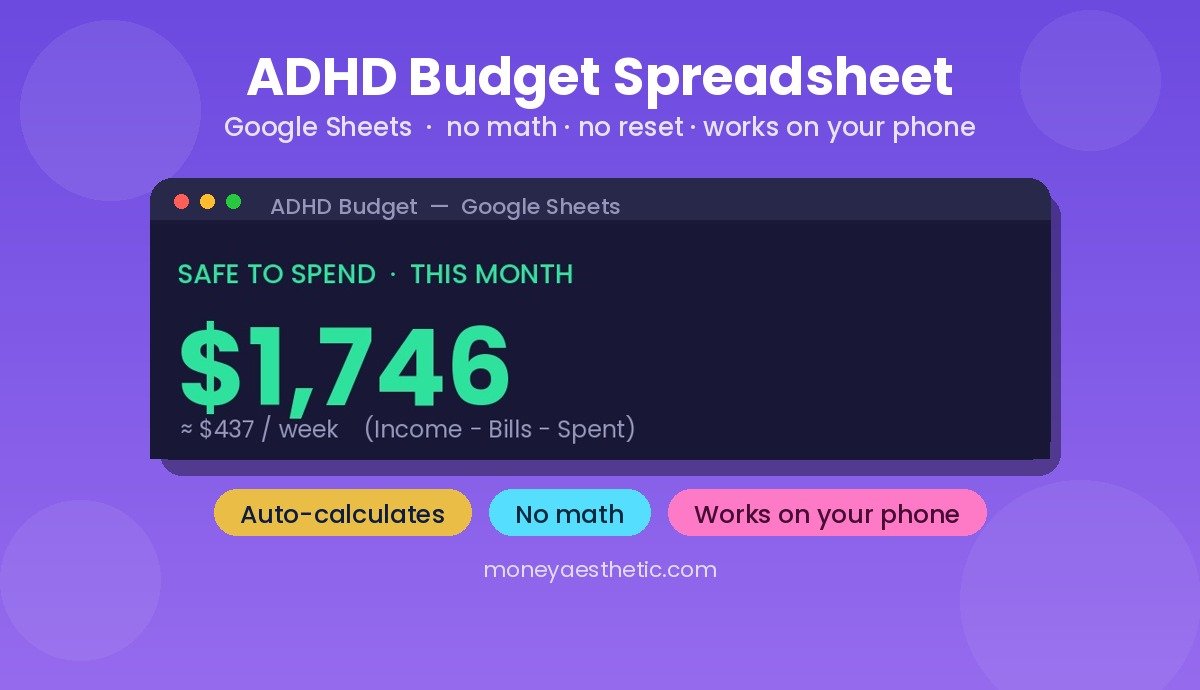
The ADHD Budget Spreadsheet keeps one number pinned at the top of a single tab: Safe to Spend, which is the income you’ve entered minus your listed bills and what you’ve already spent. Log paychecks, bills and spending in one place and it does the subtracting for you, with no formulas to write and no mental math. Built for brains that wander, $7.99.
Get the ADHD Budget Spreadsheet →If you’d rather start free, the monthly budget template gets every bill out of your head and onto one page, which is honestly most of the battle. And if this pattern feels familiar in a bigger way, how to budget with ADHD goes deeper on building a system that survives a distracted week.
Frequently Asked Questions
Can I opt out of overdraft coverage at any time?
Yes. Overdraft coverage for ATM and one-time debit card transactions requires your opt-in, and you can cancel it whenever you want by calling your bank or changing the setting in your banking app. There is no fee to opt out, and the bank must process your request as soon as reasonably practicable.
Will my debit card be declined if I opt out?
Yes, and that is the point. When you have not opted in, an ATM withdrawal or one-time card purchase you cannot cover is generally declined, and you pay no overdraft fee for it. Checks, ACH autopays and recurring card payments are not covered by that choice, so the bank can still pay them and charge an overdraft fee, or return them unpaid, which can bring an NSF fee at banks that still charge one.
Do overdraft fees hurt my credit score?
Not directly, because the big three credit bureaus typically do not include checking account information in traditional credit reports. It usually becomes a credit issue only if the account stays negative long enough for the bank to close it and the balance goes to a debt collector, which may report it to the credit bureaus.
What is the difference between an overdraft fee and an NSF fee?
An overdraft fee is charged when the bank pays a transaction you could not cover; an NSF fee is charged when the bank returns it unpaid. Many large banks, including Bank of America, JPMorgan Chase and Wells Fargo, have dropped NSF fees, according to a 2024 CFPB report, though the merchant may still add a returned-payment charge of their own.
Can I get an overdraft fee refunded?
Sometimes. Some banks will consider a courtesy waiver if you call and ask, especially for a first occurrence. Call the number on your card, be specific about the date and the amount, and ask directly for a courtesy refund.
How many overdraft fees can a bank charge in one day?
It depends on the bank. Fees are charged per transaction, so several can land on the same day, though some institutions set a daily maximum. Check your account’s fee schedule for the exact cap, because it varies widely between banks.
Does overdraft protection from a linked savings account cost anything?
Usually a small transfer fee, and some banks now waive it entirely. It is almost always cheaper than a standard overdraft fee, but it is not automatically free, so confirm the amount with your bank before you rely on it.
Which banks do not charge overdraft fees at all?
Several major institutions have eliminated the fee entirely, including Capital One, Citibank and Ally, while others such as Bank of America have cut it to around $10. If you overdraft regularly, switching banks may save you more money than any budgeting change.
Don’t have a budget sheet yet?
The free Monthly Budget Template is the simplest place to start — one page, income at the top, bills underneath, and every total already wired in. Set up in minutes, no formulas, and it costs nothing.
Get the free Monthly Budget Template →This article is general information, not personalized financial advice. Fee amounts and account terms vary by institution and change often — always check your own bank’s current fee schedule before making a decision.