

Quick answer: A debt tracker printable is a one-page sheet where you list every debt and mark off each payment by hand. Paper sounds primitive next to an app, but a meta-analysis of 138 studies found that monitoring progress lifts goal attainment, and the effect gets bigger when the progress is physically recorded. With card rates averaging 22.15 percent in Q2 2026, that motivation has to last a while.
You have made the plan. You know the order, you know the payment, you have promised yourself this is the year. Then February shows up and the plan lives in a banking app you open twice a month, mostly to check whether the direct deposit landed.
Nothing dramatic went wrong. The plan just stopped being visible, and a plan you never look at is indistinguishable from no plan at all. That is the gap a paper tracker fills, and it is a smaller, dumber tool than most people expect.
Key takeaways
- A printable tracker is a motivation device, not a calculator. It shows you movement. It cannot tell you when you finish.
- The research on progress monitoring is unusually strong, and the effect was larger when the information was physically recorded rather than just noticed.
- Put the payment date, the amount, and the new balance on the sheet. Leave interest rates off, because a paper page cannot do anything with them.
- Pair the sheet with something that does the math once, and you get both the feeling of progress and an actual finish date.
What Counts as a Debt Tracker Printable?
A debt tracker printable is a single printed page, one section per debt, where you record each payment as you make it and write the balance that is left. Some versions use rows. Some use a grid of small boxes you color in, one box per hundred dollars paid. Both do the same job: they turn an invisible balance into something on your wall or your fridge that changes shape as you go.
What separates a good one from clip art is whether it has room for the balance after each payment. A tracker that only records what you paid tells you about effort. A tracker that records what is left tells you about progress, and those are very different feelings by month four.
That column is also why I stopped giving the payment amount the biggest box. On my sheets the balance-left cell is the widest one on the row and carries the heaviest number, and everything else shrinks around it. It is a small typographic choice, but on a page taped to a wall it decides what your eye lands on first.
Why Does Filling In Paper Beat Tapping an App?
Because recording progress yourself is a different act from glancing at a number somebody else updated. In 2016 a team led by Benjamin Harkin published a meta-analysis in Psychological Bulletin covering 138 studies and 19,951 participants, all of them randomized comparisons of progress monitoring against a control. Monitoring progress promoted goal attainment with an effect size of d+ = 0.40, with a 95 percent confidence interval of 0.32 to 0.48. For a behavior-change intervention that is a solid, real effect, not a rounding error.
The part that matters for a printable is the moderator. The authors found that progress monitoring had larger effects on goal attainment when the outcomes were reported or made public, and when the information was physically recorded. The comparison in the studies was recorded versus not recorded, not paper versus app, so read this carefully: an app that makes you log the payment yourself counts too. What does not count is the passive version, where your balance updates silently whether or not you look. A printable is simply the cheapest way to force the recording, and it has the side benefit of being visible to the rest of the house.
None of that requires you to believe paper is magic. It is not. The act of writing is just a small deliberate ritual, and rituals survive February better than intentions do.
Which Numbers Belong on the Sheet, and Which Ones Lie?
Keep the printable to what a piece of paper can honestly hold: dates, amounts, and balances. The moment you add a field the page cannot compute, the sheet starts implying a precision it does not have.
This is a design decision I made deliberately. Early versions of my printable tracker had an APR column, because every finance template seems to have one. It looked authoritative and it did nothing. An interest rate on paper is decoration. It cannot project a payoff date, it cannot split a payment between principal and interest, and it quietly suggests the page is doing math it is not doing. I took it out, and the sheet got more useful by getting smaller.
| Box on the page | What you write | Why it earns the space |
|---|---|---|
| Creditor | The card or loan name, one section each | Separate sections beat one long list. You finish things one at a time. |
| Starting balance | The number on the day you start | This is the only fixed reference point you get. Write it in pen. |
| Date paid | The actual date, not the due date | Shows your real rhythm, including the months you paid late. |
| Amount paid | What left your account | Effort, recorded. This is the line that makes a bad month look less bad. |
| Balance left | The new number after the payment posts | Progress, recorded. This is the column your brain is actually tracking. |
| Extra payment | Anything above the minimum, circled | Makes the choice visible so you can repeat it next month. |
Notice what is missing: no interest rate, no projected payoff date, no total interest saved. Those belong somewhere that can recalculate them when a balance changes.
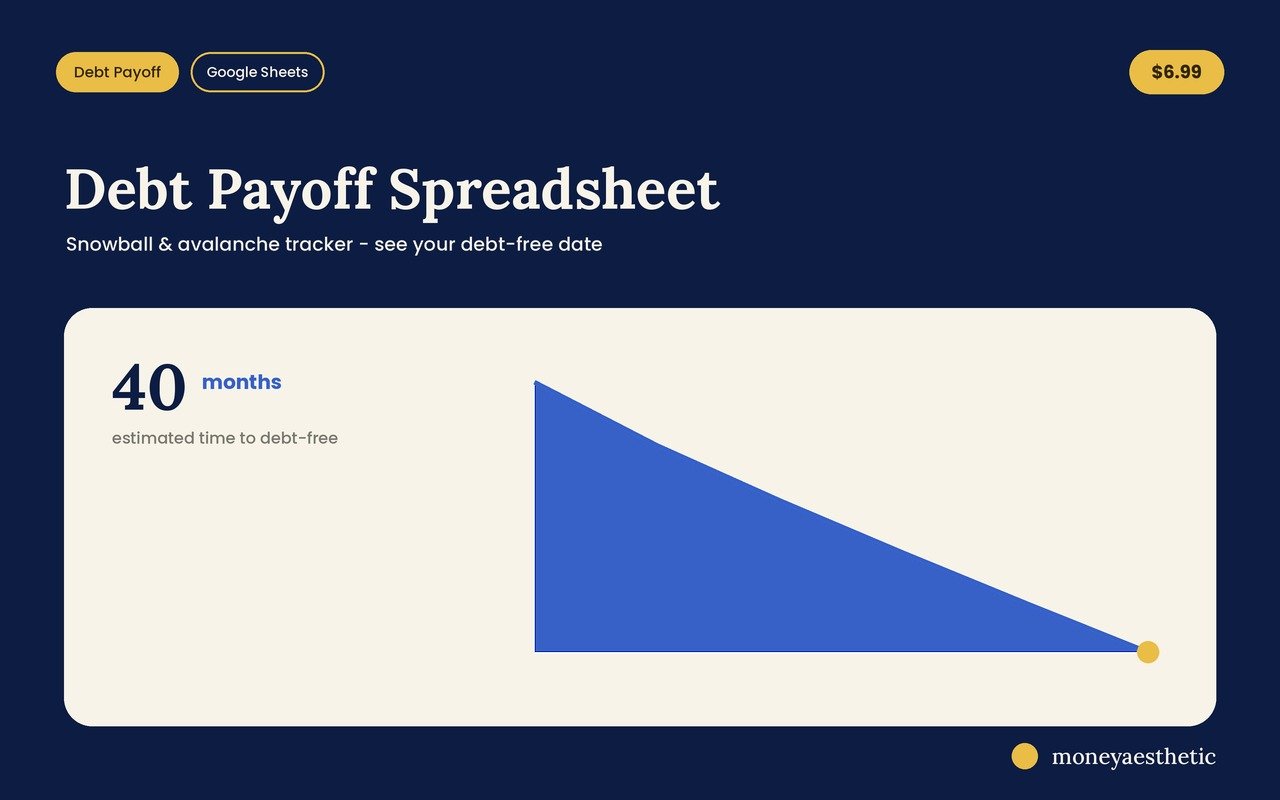
Let the sheet do the math, let the paper do the motivation
The Debt Payoff Spreadsheet takes your balances, rates, and payments once and gives you back the two numbers a printable never can: the order to pay in, and the month you finish. Then you go print the tracker and start coloring. Five minutes of setup, no formulas to touch.
Get the Debt Payoff Spreadsheet →How Do You Fill In the First One Tonight?
Setting one up takes about fifteen minutes, most of which is looking up balances. Do it in one sitting, because a half-filled tracker is worse than none.
- Print two copies. One for the wall or the fridge, one for the folder. The visible copy is the one doing the work, and the research on public reporting is the reason you hang it somewhere annoying.
- Write today’s balance for every debt. All of them, including the small embarrassing one. A tracker that hides a debt will feel dishonest every time you look at it.
- Pick your order before you write anything else. Smallest balance first for momentum, highest rate first for math. If you have not settled this, our guide on which debt to pay off first walks through both.
- Mark the minimums. Every debt gets its minimum every month. Only one debt gets the extra. Writing this on the page stops the monthly renegotiation with yourself.
- Set one calendar reminder for the day after payday. Not a reminder to pay. A reminder to write it down. The payment is usually automatic; the recording is the part that gets skipped.
- Fill in the first row now, even if it is last month’s payment. A page with one entry on it is a page in progress. A blank page is a chore.
If tracking anything at all is the thing you keep failing at, start smaller than this. A bill tracker printable asks for one checkmark a month and builds the habit that makes a debt tracker stick.
When Does a Printable Stop Being Enough?
A printable is enough while the question is “am I moving.” It stops being enough the moment the question becomes “when does this end,” or “which of these two should get the extra hundred dollars,” because both of those are arithmetic problems and paper does not do arithmetic.
Here is the honest split, and it is not close:
- One or two debts, steady payments, you just need to keep going. Print the tracker. That is the whole system. Adding a spreadsheet would be ceremony.
- Three or more debts at different rates. You need a payoff order and a projection, and you need it to update when a balance changes. Use a debt snowball worksheet that recalculates, then print the tracker for the wall.
- You are not sure the plan is survivable at all. Before tracking, check the ratio. Our guide on how much credit card debt is too much gives you a five-minute test.
The scale of the problem is worth naming, because it explains why the finish date matters so much. The Federal Reserve Bank of New York’s Quarterly Report on Household Debt and Credit, released on August 11, 2026, put US credit card balances at $1.26 trillion in the second quarter of 2026, a $21 billion increase over the quarter. In the same report, 6.97 percent of credit card balances transitioned into serious delinquency, up slightly from 6.93 percent a year earlier. And the Federal Reserve’s G.19 consumer credit release put the average rate on card accounts assessed interest at 22.15 percent for the second quarter of 2026.
At that rate, interest is not a footnote, and a payoff plan is rarely a one-season project. The steps for building that debt payoff plan are worth reading before you print anything. Whatever your own timeline turns out to be, you will be looking at this page for a while, which is exactly why it needs to be pleasant to look at and honest about what it can tell you.
One more design note from building these. On my printable tracker the largest thing on the page is not the balance, it is the row of boxes. On the spreadsheet the largest number is the payoff date, sitting above the balances rather than below them. Balances tell you where you are, and after a hard month that number can be genuinely discouraging. The date tells you when it ends. If you like the format, the fillable budget planner uses the same one-page logic for the rest of the month, and the savings tracker printable guide covers the version for money going the other direction.
Frequently Asked Questions
What is the best free printable debt tracker?
The best one is whichever you will actually hang up, which usually means the simplest. Look for one section per debt, a balance-after-payment column, and enough blank rows to cover a full year. Skip anything with an interest rate field or a projected payoff column, because a printed page cannot recalculate either one, and a stale projection is worse than no projection.
How do you make a debt tracker from scratch?
Take a blank sheet, draw one block per debt, and give each block five columns: date paid, amount paid, extra paid, balance left, and a small box to check. Write the starting balance at the top of each block in pen so it stays fixed. That is the entire format. The design work is in what you leave out, not what you add.
Can you make a debt payoff tracker in Excel or Google Sheets instead?
Yes, and you should if you have more than two debts, because a spreadsheet can do the part paper cannot: order your debts by rate or balance, roll a finished payment into the next debt, and project a finish date that updates itself. Many people run both, using the spreadsheet for decisions and printing a tracker for the wall.
Does coloring in a debt tracker really help you pay off debt faster?
It helps you keep going, which is usually the binding constraint. The Harkin meta-analysis of 138 studies found progress monitoring improved goal attainment with an effect size of 0.40, and the effect was larger when progress was physically recorded and when results were reported or made public. Coloring does not change your interest rate. It changes how likely you are to still be paying extra in month fourteen.
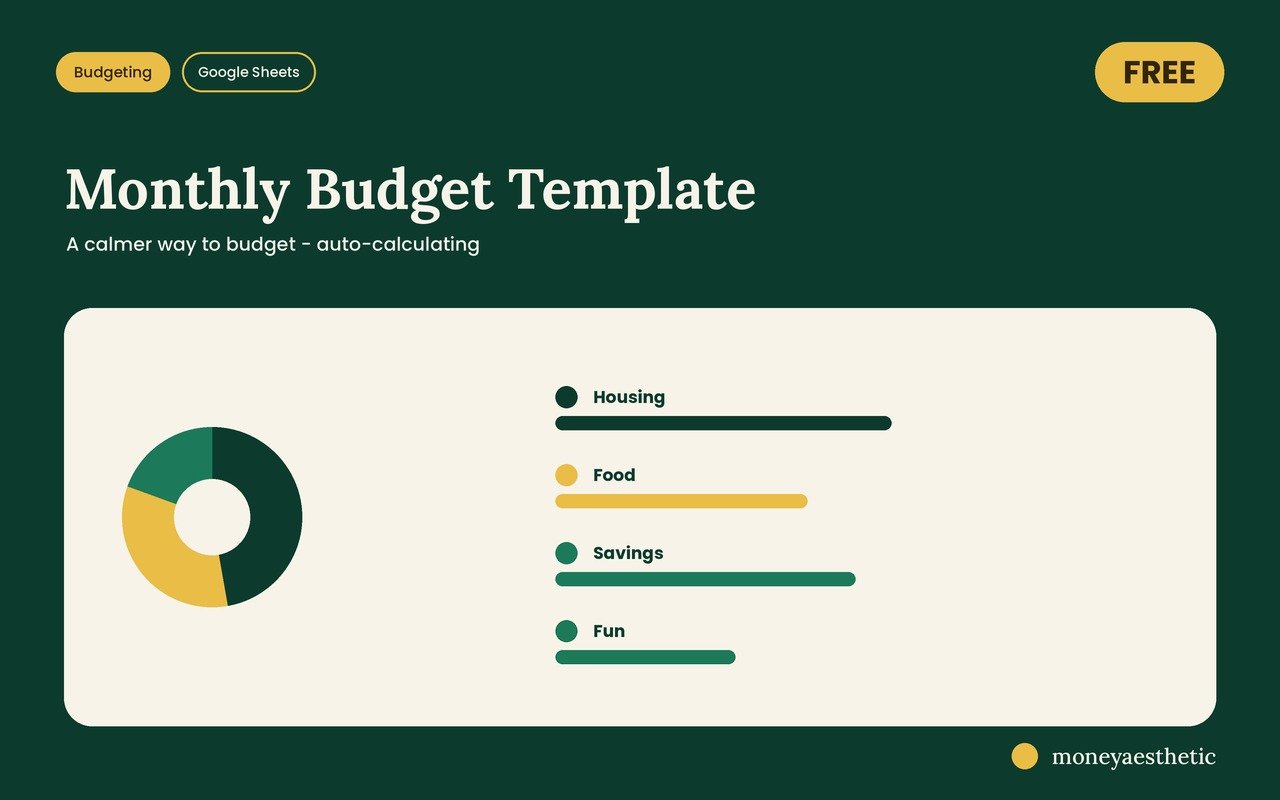
The extra payment has to come from somewhere
Every debt tracker eventually runs into the same question: where does the extra hundred dollars come from? The free Monthly Budget Template lays your month out on one tab so the answer is visible instead of theoretical. No email gymnastics, no upsell.
Get the free Monthly Budget Template →This article is general educational information about budgeting and debt repayment, not financial advice. Interest rates, minimum payment formulas, and lender terms vary. Check your own statements and confirm any repayment decision against your actual account terms.