

Quick answer: The 50/30/20 rule says to send 50% of your take-home pay to needs, 30% to wants, and 20% to savings and debt. It’s a genuinely great starting point, but it’s showing its age. With 49% of U.S. renters spending more than 30% of their income on rent and utilities in 2024 (Harvard Joint Center for Housing Studies, March 2026), “needs” often blow past that 50% line, so it’s smartest to treat the split as a flexible target you tune to your life, not a hard law. Prices are still climbing too: consumer prices were up 3.4% over the year ending August 2026, per the Bureau of Labor Statistics.
The 50/30/20 rule is popular for one very good reason: it fits on a sticky note. No spreadsheets with 40 tabs, no envelopes, no app that pings you every time you buy a coffee. Just three buckets (needs, wants, savings) and three percentages. For a lot of people it’s the first budget that ever actually made sense.
Here’s the catch, and it’s a big one in 2026: the rule dates to 2005. When rent alone eats 40% of your paycheck, keeping all your needs under 50% stops adding up. The bones are good; the specifics need a refresh. So let’s do that: what the rule is, how to run the numbers, when it stops working, and the small tweak that makes it fit real life again.
Key takeaways
- The 50/30/20 rule splits your after-tax income into 50% needs, 30% wants, 20% savings and debt. Simple on purpose.
- It came from a 2005 book, All Your Worth, by Elizabeth Warren and Amelia Warren Tyagi.
- It often breaks at the “needs” line: 49% of renters were cost-burdened in 2024, so 50% frequently isn’t enough.
- The fix isn’t to quit the rule. It’s to customize the percentages to your actual numbers and, ideally, let a template do the math for you.
What the 50/30/20 rule actually is
The idea comes from Senator Elizabeth Warren and her daughter Amelia Warren Tyagi, who laid it out in their 2005 book All Your Worth. Take your income after taxes (the money that actually lands in your account) and divide it into three chunks:
- 50% Needs. The non-negotiables: rent or mortgage, utilities, groceries, insurance, transportation to work, minimum debt payments. If skipping it breaks your life, it’s a need.
- 30% Wants. The stuff that makes life fun but you’d survive without: dining out, streaming, hobbies, that third pair of sneakers, travel.
- 20% Savings & debt. Your emergency fund, retirement, debt payoff beyond the minimums (the CFPB’s version files debt payments, including credit card payments, here), and money set aside for planned expenses.
That’s the whole thing. The reason it caught on is the reason it still works as a teaching tool: it’s impossible to forget. You don’t need to track 27 categories to know whether you’re roughly in the right zone. And honestly, “roughly in the right zone” beats a perfect budget you abandon in week two.
How to calculate your 50/30/20 split
No math degree required. Four steps and you’ll have your numbers.
- Find your monthly take-home pay. Add up what actually hits your bank account after taxes, health insurance, and retirement withholding. If your income bounces around, average your last three months.
- Multiply for each bucket. Take-home × 0.50 for needs, × 0.30 for wants, × 0.20 for savings.
- List your real expenses under each. Be honest about which “wants” have been sneaking into the “needs” column (looking at you, daily takeout).
- Compare and adjust. See where you actually land versus the targets, then nudge one number at a time.
Here’s how it shakes out on a $4,000 monthly take-home:
| Bucket | Share | Monthly amount | What lives here |
|---|---|---|---|
| Needs | 50% | $2,000 | Rent, utilities, groceries, insurance, minimum debt, commute |
| Wants | 30% | $1,200 | Dining out, streaming, hobbies, travel, fun money |
| Savings & debt | 20% | $800 | Emergency fund, retirement, extra debt payoff, sinking funds |
Doing this by hand once is a great gut-check. Doing it every single month by hand is how budgets quietly die. This is exactly the part worth handing to a template: you type in your numbers once and the totals add themselves up, so “am I actually at 50/30/20?” becomes a quick check instead of a Sunday-night math session. Our free monthly budget template totals your income, expenses, and savings for you and updates as you edit, which is the difference between a budget you check and one you avoid.
When the 50/30/20 rule doesn’t work (the 2026 reality)
Time for the honest part. The 50/30/20 rule assumes your genuine needs can fit inside half your income. For a growing share of people, that assumption quietly fell apart, and the data is pretty blunt about it.
Start with housing. In Harvard’s America’s Rental Housing 2026 report, a record 22.7 million renter households (49% of all renters) spent more than 30% of their income just on rent and utilities in 2024, and 12.1 million of them spent more than half their income on housing. When housing alone eats 30% to 50% of take-home pay, fitting groceries, insurance, transportation, and minimum debt payments into the rest of a 50% needs cap gets very hard, and once housing reaches half of take-home pay it can’t be done. The rule isn’t wrong; the rent is.
Then there’s the slow grind of everything else. Consumer prices rose 3.4% over the year ending August 2026, per the Bureau of Labor Statistics’ August 2026 CPI release, with gasoline up 27.4% and food-at-home prices up 2.2%, while inflation-adjusted average hourly earnings fell 0.3% over the same year. And the cushion many people have for the gap? Thin. The Federal Reserve found only 63% of adults could cover a $400 emergency with cash in its 2025 report, released May 2026.
So the rule tends to break in a few specific situations: you live in a high-cost city, you’re early-career on a lower income, you’re carrying heavy debt, or you’re supporting a family on one income. In all of those, forcing a 50% needs cap just makes you feel like you’re failing at a math problem that was rigged from the start. You’re not failing. The template numbers just need to match your zip code. If you’re stuck living paycheck to paycheck, this is usually why, and it’s fixable without pretending your rent is lower than it is.
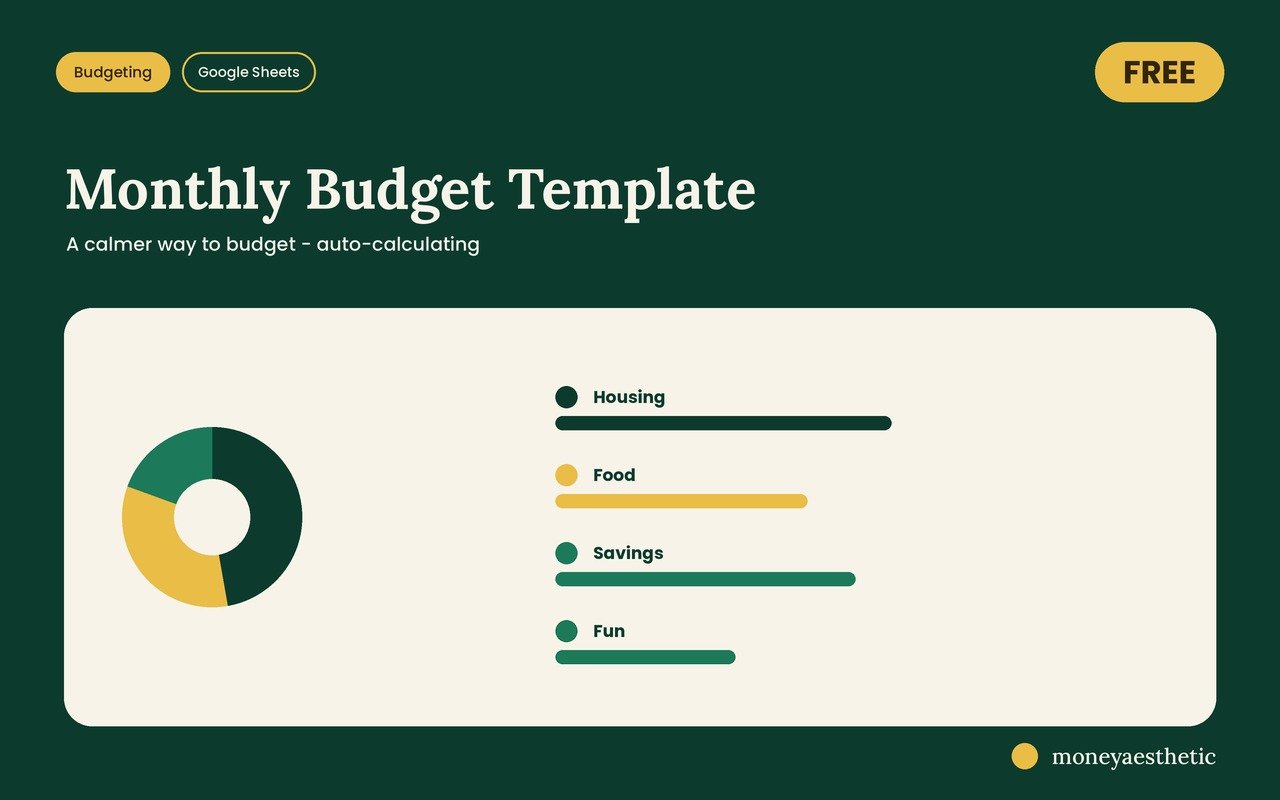
Check your 50/30/20 numbers with a lot less math
Guessing whether you’re at 50/30/20 is exhausting. This free Google Sheets budget does the adding up for you. Type in your income, what you planned to spend in each category, what you actually spent, and what you saved, and it totals your income, expenses, savings, and leftover on its own, with a budgeted-vs-actual difference for every category. Name your categories as needs or wants, divide each total by your take-home, and your split is right there. No formulas to build, no tabs to wrangle. It’s free, it’s pretty, and it turns “I think I’m okay?” into “I know exactly where my money goes.”
Get the free Monthly Budget Template →Common misconceptions about the 50/30/20 rule
“The percentages are sacred.” They’re not. Even the Consumer Financial Protection Bureau calls 50/20/30 a “common rule of thumb” and says you can decide on your own personal rule that works for your financial situation. 50/30/20 is a nice round default, but 60/30/10 or 70/20/10 can be the honest version of the same idea when your cost of living is high. The three buckets matter more than the exact numbers on them.
“Needs and wants are obvious.” This is where it’s easy to fudge it. A basic phone plan is a need; the premium unlimited tier is partly a want. Groceries are a need; the $16 smoothie run is a want wearing a need’s coat. Sorting honestly is the entire game, and it’s uncomfortable on purpose. Hobbies live in the same bucket and can be hard to size honestly, which is why a session tracker that logs cost per session beats guessing at a monthly figure.
“The 20% is just savings.” That bucket also covers debt payoff. The CFPB’s version of the rule counts credit card payments here; if you file required minimums under needs, the extra payments beyond them go here. If you’re attacking a credit card balance, that counts toward your 20%, which is great news, because it means paying off debt and saving aren’t competing for the same slot. Not sure where to aim first? Here’s how to decide which debt to pay off first.
“If I can’t hit 20%, it’s pointless.” Saving 8% beats saving 0% every single month. Start where you actually are and raise the number by a point or two as bills allow. A rule you bend is worth infinitely more than a rule you quit.
A better fix: build the rule around your real numbers
Plenty of 50/30/20 articles stop at “here are the percentages, good luck.” The problem is they hand you their numbers instead of helping you find yours. So here’s the move that actually works when the standard split won’t budge.
Pull your last three months of bank and card statements and sort every dollar into needs, wants, and savings. Add each bucket up, divide by your take-home, and there’s your current split. Maybe it’s 62/30/8, maybe it’s 70/25/5. That’s not a failing grade. That’s your honest starting line, and you can’t improve a number you refuse to look at.
Now do two things. First, flip the order: decide your savings number first and automate it the day after payday, even if it’s only 10%, so “pay yourself first” happens before wants can nibble it away. Second, aim your energy at the biggest bucket. Needs at 65%? That’s a housing, insurance, or transportation conversation (the big rocks), not a coffee problem. Trimming the giant category moves your split far more than guilt-tracking every latte.
This is the part where a template quietly earns its keep. When your real numbers live in one place and the totals recalculate the second you change one, you stop budgeting from a stranger’s rule and start budgeting from your own life. If you’d rather build it yourself from scratch, our walkthrough on how to make a budget in excel shows you the formulas; if you’re paid weekly, every other week, or twice a month, the budget by paycheck version converts each paycheck to a monthly figure so your buckets start from what you actually bring home. Either way, the goal is the same: a split that’s yours, not a poster’s.
The 50/30/20 rule, answered
What is the 50/30/20 rule in simple terms?
The 50/30/20 rule is a budgeting method that divides your after-tax income into three parts: 50% for needs, 30% for wants, and 20% for savings and debt payments. It’s designed to be simple enough to follow without tracking dozens of categories, which makes it a common starting point for beginners.
How is money divided using the 50/30/20 method?
You split your monthly take-home pay by multiplying it by 0.50, 0.30, and 0.20. On $4,000 a month, that’s $2,000 for needs like rent and groceries, $1,200 for wants like dining out and hobbies, and $800 for savings and extra debt payoff. The percentages always apply to income after taxes, not gross pay.
When might the 50/30/20 rule not be the best strategy to use?
The 50/30/20 rule works poorly when your essential costs already exceed 50% of your income, which is common for people in high-cost cities, early-career earners, and those with heavy debt. With 49% of U.S. renters spending over 30% of income on rent and utilities in 2024, many households can’t fit all their needs under the 50% cap and are better off customizing the percentages.
Is the 50/30/20 rule outdated?
The framework isn’t outdated, but its exact numbers can be. It dates to the 2005 book All Your Worth, and in 2024, 49% of U.S. renters spent more than 30% of their income on rent and utilities. Today the three-bucket structure is still useful, but many people need to adjust the ratios, such as 60/30/10 or 70/20/10, to reflect higher rent, insurance, and grocery costs.
What counts as a “need” versus a “want”?
A need is something you can’t reasonably skip without disrupting your life or work: housing, utilities, groceries, insurance, transportation, and minimum debt payments. A want is anything that improves your life but isn’t essential, like dining out, streaming, travel, and upgrades to basic services. When something falls in between, split it: a basic plan is a need, the premium tier is a want.
Does the 20% include paying off debt?
Yes. The CFPB’s version of the rule puts savings and debt payments together in the 20% bucket, including credit card payments. You can also count required minimum payments as needs and put only the extra payoff in the 20%; either way works as long as you’re consistent. This means aggressive debt payoff and building savings both come from the same slice of your budget.
What can I use instead of the 50/30/20 rule?
If the standard split doesn’t fit, try adjusting the ratios to your real spending, using a zero-based budget where every dollar gets a job, or the pay-yourself-first method where you automate savings before anything else. The best approach is usually to calculate your current percentages from recent statements and improve from there rather than forcing a preset ratio.
How do I track my 50/30/20 budget each month?
The easiest way is a spreadsheet or budgeting template that sorts your spending into the three buckets and calculates the percentages automatically. That turns tracking into a quick glance rather than a monthly math session, which makes it easier to stick with long enough to see results.
This article is for general educational purposes only and isn’t financial advice. Your situation is unique, so consider consulting a qualified financial professional before making decisions about budgeting, saving, or borrowing.