

Here’s how much to save on each of your 26 paydays in 2027, starting Friday, January 8, plus a $6.99 Google Sheets tracker that adds it up for you.
Quick answer: A biweekly savings challenge ties one deposit to every payday. Start on Friday, January 8, 2027 and you get 26 paydays, ending December 24. Save $25, add $5 each payday, and you’ll have $2,275. The Federal Reserve’s May 2026 report found 63% of adults would cover a $400 emergency with cash or its equivalent, and this plan passes $400 on April 30, 2027.
Weekly challenges are cute until you notice your money doesn’t arrive weekly. If you’re paid every other Friday, a weekly plan means two deposits for every paycheck, and by March you’re moving money around just to keep the chart honest.
Saving on payday fixes that. The money leaves before it has a chance to get spent on takeout, and the plan finally runs on your real calendar. Below is the whole 2027 schedule, date by date, with the amount for every payday.
Key takeaways
- First payday January 8, 2027: 26 paydays, the last on December 24.
- First payday January 1, 2027: 27 paydays, because the 27th falls on December 31.
- $25 plus $5 each payday adds up to $2,275. A flat $50 adds up to $1,300.
- On the January 8 schedule, April and October each bring three paydays.
How does a biweekly savings challenge work?
A biweekly savings challenge is a plan where you move a set amount into savings every time you get paid every two weeks, and the amount usually grows a little each payday. Because most pay schedules land 26 biweekly paydays in a year (27 on some, more on that below), most versions run for 26 deposits. You pick two numbers: what you save on payday 1 and how much you add after that.
That second number does most of the work. A $5 raise per payday sounds tiny in January, but on the $25 plan you’re putting away $150 per paycheck by December, which is why the total climbs so fast. It also means the plan gets harder as the year goes on, right when the holidays show up. Worth knowing before you pick your starting number.
Biweekly pay is common enough that this isn’t a niche plan. In the BLS table on pay period frequency for February 2023, 43.0% of private establishments paid biweekly, ahead of weekly at 27.0%, semimonthly at 19.8% and monthly at 10.3%.
How much will you save? Five plans, side by side
The quickest way to choose a plan is to look at what payday 26 asks of you, not just the year-end total. The total is the fun number. The last deposit is the one you actually have to pay in December. All five plans below assume 26 paydays.
| Plan | Payday 1 | Payday 26 | Total after 26 paydays |
|---|---|---|---|
| Flat $50 | $50 | $50 | $1,300 |
| $10, then +$5 | $10 | $135 | $1,885 |
| $25, then +$5 | $25 | $150 | $2,275 |
| Flat $100 | $100 | $100 | $2,600 |
| $10, then +$10 | $10 | $260 | $3,510 |
If your budget is already tight, a flat amount is underrated. $50 every payday is $1,300 with zero surprises, and you never hit a scary December deposit. If you’d rather start small and build the habit first, $25 plus $5 is a comfortable middle: small at the start, $2,275 by the end.
Not sure what share of each check to aim for? Our guide on how much of your paycheck to save walks through it.
The 2027 biweekly savings challenge chart, payday by payday
Here’s the full 2027 biweekly savings challenge chart for the $25 plus $5 plan, starting Friday, January 8, 2027. Every row is a Friday, 14 days after the one before. The running total shows what’s in savings after that payday, so you always know where you stand.
| Payday | Date (2027) | Save | Saved so far |
|---|---|---|---|
| 1 | Jan 8 | $25 | $25 |
| 2 | Jan 22 | $30 | $55 |
| 3 | Feb 5 | $35 | $90 |
| 4 | Feb 19 | $40 | $130 |
| 5 | Mar 5 | $45 | $175 |
| 6 | Mar 19 | $50 | $225 |
| 7 | Apr 2 | $55 | $280 |
| 8 | Apr 16 | $60 | $340 |
| 9 | Apr 30 | $65 | $405 |
| 10 | May 14 | $70 | $475 |
| 11 | May 28 | $75 | $550 |
| 12 | Jun 11 | $80 | $630 |
| 13 | Jun 25 | $85 | $715 |
| 14 | Jul 9 | $90 | $805 |
| 15 | Jul 23 | $95 | $900 |
| 16 | Aug 6 | $100 | $1,000 |
| 17 | Aug 20 | $105 | $1,105 |
| 18 | Sep 3 | $110 | $1,215 |
| 19 | Sep 17 | $115 | $1,330 |
| 20 | Oct 1 | $120 | $1,450 |
| 21 | Oct 15 | $125 | $1,575 |
| 22 | Oct 29 | $130 | $1,705 |
| 23 | Nov 12 | $135 | $1,840 |
| 24 | Nov 26 | $140 | $1,980 |
| 25 | Dec 10 | $145 | $2,125 |
| 26 | Dec 24 | $150 | $2,275 |
Notice the halfway point. After payday 13 on June 25 you’ve saved $715, less than a third of the total. The back half of the year does the heavy lifting, so a slow start isn’t a sign you’re failing.
Will you get 26 or 27 paydays in 2027?
In 2027 you get 27 biweekly paydays if your first one is Friday, January 1, and 26 if your first one is Friday, January 8. Counting 14 days at a time from January 1 lands the 27th payday on Friday, December 31, 2027. Start from January 8 and the 26th payday is December 24, with the next one spilling into 2028.
One catch with the January 1 schedule: Friday, January 1, 2027 is New Year’s Day, a federal holiday. Ask payroll whether that check is paid early, in late December 2026, instead. If it does, you’ll count 26 paydays in 2027, not 27.
Many challenge charts assume 26. If you’re on the January 1 schedule, that extra payday is a gift. You can treat it as payday 27 and keep the raise going, or skip the challenge that day and send the whole deposit somewhere fun. Both are fine. Just decide now so it doesn’t get eaten by December.
Our tracker’s biweekly tab holds 26 paydays, so on a 27-payday year the last one sits outside the plan. We’d count that one as a bonus deposit rather than squeezing it into the chart.
Which months in 2027 bring three paydays?
On the January 8, 2027 schedule, April and October each bring three biweekly paydays: April 2, April 16 and April 30, then October 1, October 15 and October 29. On the January 1 schedule, the three-payday months are January, July and December. Those extra checks can make those months easier to stay on track.
If your bills are built around two paychecks a month, the third one is room to breathe. You could use it to cover that month’s challenge deposits in one go. We walk through the idea in more detail in our post on 3 paycheck months, and the same logic carries into 2027.
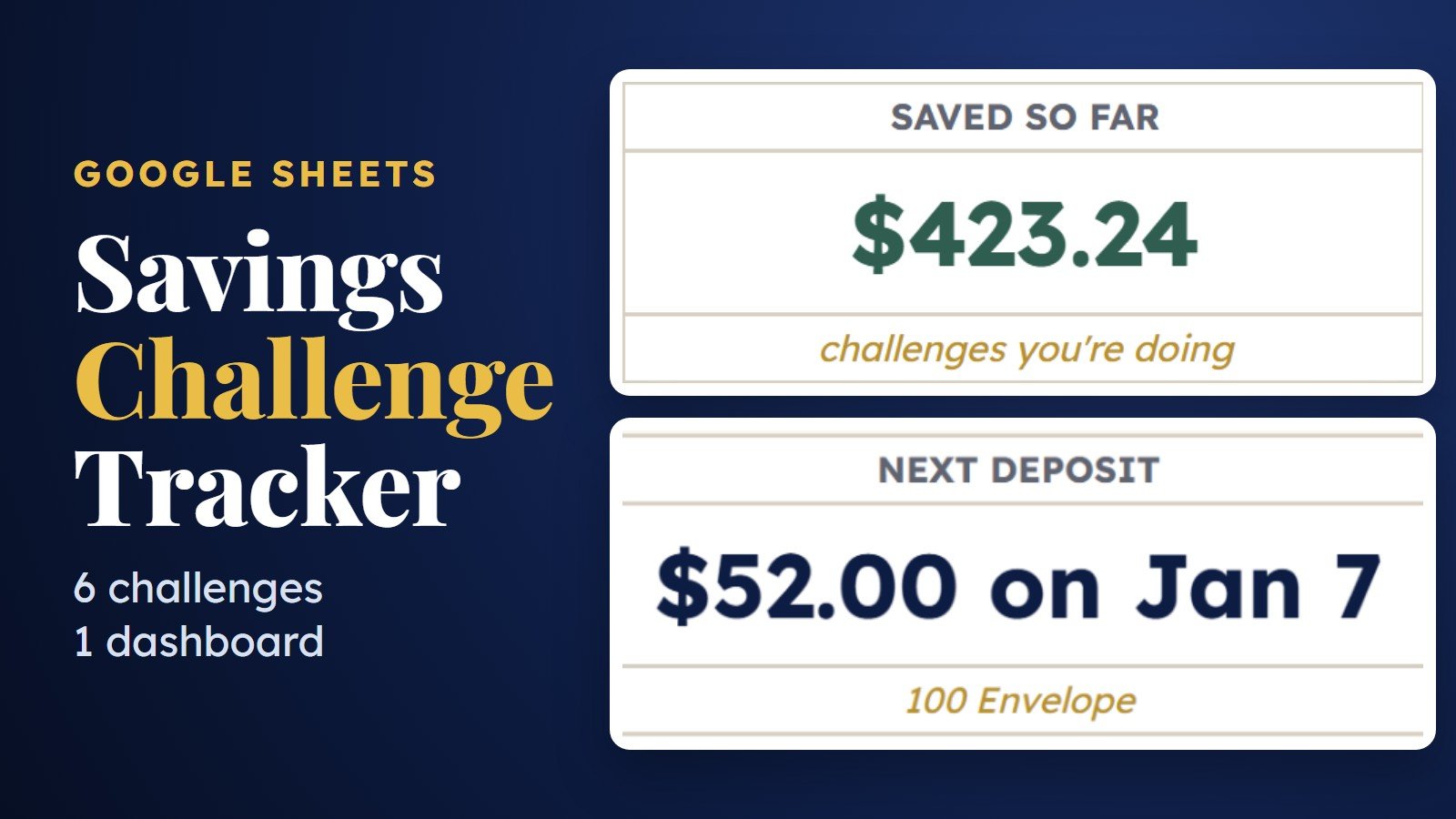
Let the sheet do the payday math
Pick your first 2027 payday from a calendar, type your first deposit and your raise, and all 26 paydays fill in. Tick a box on payday and the dashboard shows what you’ve saved and your next deposit. $6.99 for six savings challenges in one Google Sheet.
Get the Savings Challenge Tracker →Setting it up so payday does the work
A biweekly savings challenge is easier to stick with when you don’t have to remember it. Set the transfer for payday, or the day after, so the deposit happens before the weekend does. Then track it somewhere you’ll actually look.
- Pick your first 2027 payday. Check your last pay stub and count forward in 14-day steps. If it lands on January 1, plan for 27.
- Choose your plan from the table above. Look at payday 26, not just the total.
- Open a separate savings account. It keeps challenge money from blending into spending money.
- Schedule the transfer. If the amount changes every payday, set a reminder to bump it.
- Tick it off. Paper chart, notes app or a spreadsheet, as long as you see it every two weeks.
Where should the money sit? Keep it somewhere boring. The FDIC’s national rates as of October 19, 2026 put the national average savings rate at 0.38% and money market accounts at 0.63%, so shop around if you want your challenge money earning something while it waits.
When we built the biweekly tab, we made the first payday a date you pick from a calendar instead of a fixed January 1, because your first payday depends on your employer’s schedule. We also gave the raise its own cell: type 0 and the plan turns into a flat amount every payday. Small choices, but they’re the difference between a chart that matches your life and one you quietly abandon.
And if you miss a payday? It happens. In the tracker, a row turns amber once its date passes without a tick, and the dashboard shows “Behind” with the dollar amount you’re short. Seeing the actual number is a lot less dramatic than staring at a blank row and guessing.
Want more ways to save on a schedule? Our roundup of savings challenge ideas compares the popular ones, and the biweekly budget guide shows how to plan every paycheck, not just the savings part.
Biweekly savings challenge questions
How much will I save with a biweekly savings challenge?
It depends on your starting amount and your raise. Starting at $25 and adding $5 each payday saves $2,275 over 26 paydays, while a flat $50 every payday saves $1,300.
What if I get paid 27 times in 2027?
If your first 2027 payday is Friday, January 1, your 27th payday falls on Friday, December 31. Keep the raise going for one more deposit or treat it as a bonus, but decide before December.
Can I do a biweekly savings challenge with irregular pay?
Yes. Use a flat amount instead of a growing one, and on short paychecks save what you can, then catch up on a bigger check. The goal is the yearly total, not a perfect row of ticks.
Is a biweekly or a 52 week challenge better?
If you’re paid every two weeks, the biweekly version is usually easier because each deposit matches a paycheck. Weekly plans like the 52 week savings challenge suit people paid weekly or anyone who likes smaller, more frequent deposits.
One last nudge. A $2,275 cushion matters more than it sounds. In the Federal Reserve’s May 13, 2026 report on household finances, 63% of adults said they’d cover a $400 emergency expense with cash or its equivalent. On the $25 plus $5 plan, you pass $400 on April 30, 2027, payday 9.
This article is for general education, not personalized financial advice. Dates assume Friday paydays every 14 days in 2027; check your own pay schedule. Rates are national averages and change often.