

Quick answer: A wedding guest list template is a spreadsheet that gives every invited person their own row, with columns for household, RSVP, meal, and plus-one. It matters more than it sounds: The Knot’s 2026 Real Weddings Study put the average cost at $292 per guest. Your list is a pricing sheet. Count people for catering, count households for postage.
You sit down to write the guest list and it feels like the easy part. Names. You know these people. Twenty minutes, tops.
Then your mom adds four cousins, your fiancé’s boss becomes a maybe, and somebody’s college roommate is bringing a date whose name nobody has. Six weeks later you are standing in a post office line buying stamps with no idea whether you need sixty or a hundred and twenty, because the only number on your spreadsheet is a headcount.
That is the whole problem in one sentence. Most free templates hand you one column of names and one total at the bottom, and then you use that single total for two things that are priced completely differently.
Key takeaways
- The average US wedding cost $34,000 in 2025 across about 117 guests, roughly $292 a head. Every name you add carries a price tag.
- Catering prices per person. Invitations, save-the-dates, and stamps price per household. A list with one total will get one of those two wrong.
- A B-list only works if your RSVP deadline lands far enough before your caterer’s final count, and that window is usually one to two weeks.
Why Does a Wedding Guest List Need Two Totals, Not One?
A wedding guest list needs two totals because your vendors do not all charge the same way. Catering, bar, rentals, and favors are priced per person. Save-the-dates, invitations, and postage are priced per envelope, which means per household. One list, two denominators. If you only track headcount you will guess at stationery, and if you only track envelopes you will guess at dinners.
Here is the size of the gap. The Knot’s 2026 Real Weddings Study, which collected responses from 10,474 US couples married in 2025, put the average cost per guest at $292, up $8 from 2024, with an average guest count of 117. Run that: 117 people at $292 is about $34,000, which is exactly what the same study reported as the average wedding cost. Per-guest pricing is not a detail of the budget. It essentially is the budget.
Now the other denominator. Those 117 people probably live in 60 to 75 households. A First-Class Forever stamp rose from 78 cents to 82 cents on July 12, 2026, and the additional-ounce price held at 29 cents. A thick invitation suite with a reply card often needs both, plus a stamp on the return envelope. That is real money you cannot estimate from a headcount, because two spouses in one house get one envelope and one guest with an unnamed plus-one also gets one envelope. Same envelope count, very different dinner count.
And per-person costs are still climbing. The Bureau of Labor Statistics food away from home index rose 3.4 percent over the 12 months ending July 2026. Catering is not going to quietly get cheaper between your booking and your final count.
What Columns Does a Wedding Guest List Template Actually Need?
A working wedding guest list template needs eight columns, and each one exists to answer a question a vendor will eventually ask you. One row per person, always. Households get handled with an ID number rather than by cramming two names into one cell, because a formula can add up a column of numbers and cannot parse “Mr. and Mrs. Alvarez plus guest.”
| Column | What goes in it | What it pays for |
|---|---|---|
| Guest name | One real person per row | Nothing on its own |
| Household ID | A number shared by everyone at one address | Invitations, stamps, save-the-dates |
| Side | Yours, theirs, or shared | Settles the “who cut whom” conversation |
| Tier | A or B | Decides who gets invited in round two |
| Plus-one | Yes or no, as its own field | Catering, seating, bar |
| RSVP | Pending, yes, or no | The final count you send the caterer |
| Meal | Entrée choice or dietary note | Per-plate pricing and allergies |
| Address | Full mailing address | Mail merge and thank-you notes |
When I built the Guest List and RSVPs tab in our wedding budget spreadsheet, I made the plus-one its own yes-or-no field instead of letting people type “+1” beside a name. That was a deliberate call. A spreadsheet can count a field. It cannot count a plus sign buried in a text string, and the moment your headcount stops being countable you are back to counting names by hand at eleven at night.
How Do You Build the List in About Twenty Minutes?
Building a wedding guest list takes about twenty minutes if you do it in a fixed order and resist the urge to debate anyone while you type. The order matters because every decision you make later is cheaper when the structure is already right.
- Set your ceiling first. Divide your catering budget by the per-plate quote. That number is your guest cap, and it is not negotiable by feelings. If you have not set the budget yet, our wedding budget breakdown gives you the percentages to start from.
- Dump every name in, unfiltered. Do not edit yet. You cannot cut a list you have not seen.
- Assign household IDs. Everyone at one address shares a number. This is the step people skip and then redo in October.
- Mark Side. Yours, theirs, shared. This makes the cutting conversation about a column instead of about a person.
- Tier everyone A or B. A-list until you hit your cap. Everyone else is B, and B is not an insult, it is a queue.
- Add plus-one flags and meals. Both feed the catering number, so they belong in the list, not in your head.
One more structural choice worth copying: I wired the seating chart to read from the guest list instead of giving it its own name column. Two lists means two versions of the truth, and the one you forget to update is always the one the venue prints.
Who Actually Makes the Cut? Three Questions That Settle It
Cutting a guest list is a filter problem, not a taste problem. Run every borderline name through three questions in this order and the list mostly sorts itself, which is much kinder than arguing name by name at the kitchen table.
Have we spoken to them in the last year? Not seen their post. Spoken. This single question removes more names than any other, and nobody has ever noticed they were removed by it.
Would we invite them if they lived far away? Proximity is not a relationship. If the answer is no, they are on the list because they are convenient, and convenience costs $292.
Will one of us regret their absence in the photos? This is the override. If either of you says yes, they go on the A-list and you find the money somewhere else. Some names are worth more than the arithmetic, and pretending otherwise is how people end up sad at their own wedding.
If parents are contributing, the cut list gets political fast. Settle that before you send anything, because a contribution often arrives with names attached. Our guide on who pays for the wedding walks through how to have that conversation.
When Does a B-List Actually Work?
A B-list works only when the calendar allows it, and most couples never check. The sequence is: A-list invitations go out, RSVPs come back by your deadline, declines free up seats, B-list invitations go out, and those guests reply before your caterer’s final count is due. Five steps, and the last two usually have one to two weeks to happen.
So do the arithmetic before you rely on it. Caterers typically want the final headcount 10 to 14 days out. If your RSVP deadline is the standard three to four weeks before the wedding, you have roughly one to two weeks to mail a second round and get answers back. Tight, but survivable. If you set the RSVP deadline at two weeks out, which plenty of couples do, your B-list is decorative. Move the deadline to five weeks out instead and the whole thing breathes.
The other half is meal counts. I let the meal totals recalculate straight off the RSVP column rather than asking anyone to retype a headcount somewhere else. Retyping the same number in two places is exactly where the numbers quietly stop matching, and you find out at the tasting.
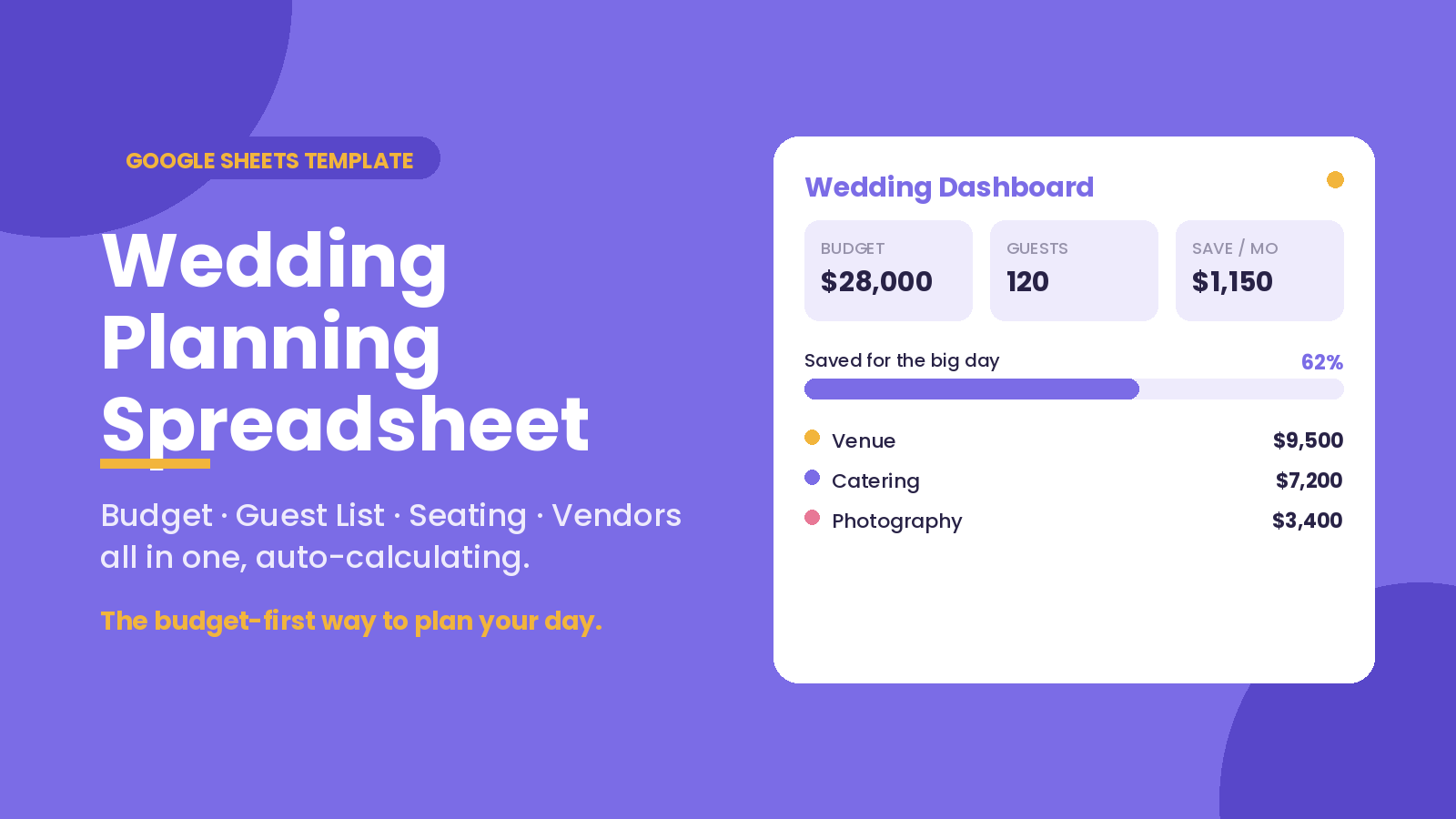
Your guest list and your budget should be the same document
The Guest List and RSVPs tab tracks invites, RSVPs, meals, plus-ones and thank-yous, and it feeds the meal count and the seating chart automatically. Change one RSVP and your catering number moves with it. No retyping, no second list, no formulas to build.
Get the Wedding Budget Spreadsheet →Frequently Asked Questions
How many people should we invite to get 100 guests?
There is no universal decline rate, so build it from your own list instead of a rule of thumb. Tag each household as likely, unsure, or long shot, assume the long shots decline and half the unsures do, and see where you land. Destination and out-of-state guests decline far more often than local ones, so a list heavy on travel needs more invitations to reach the same room.
Should a wedding guest list template be one row per person or per couple?
One row per person, always. Catering, bar, seating, and favors are all priced per head, so a couple sharing a row breaks every count you need. Group them with a shared household ID column instead. That way one formula gives you your dinner count and another gives you your envelope count, from the same list.
Who gets a plus-one?
Pick a rule and apply it to everyone rather than deciding case by case. The common ones are anyone married, engaged, or living with a partner, plus anyone who will not know a single other guest. Write the rule down before you start flagging names, because the moment you make exceptions you will be defending them for months.
How much does each wedding guest actually cost?
The Knot’s 2026 Real Weddings Study put the 2025 average at $292 per guest, up $8 from the year before, based on 10,474 US couples. Your own number will differ, and it is easy to find: divide every per-person cost you have quoted, which is mostly catering, bar, rentals, and favors, by your current headcount.
What should the RSVP deadline be if we want a B-list?
Five weeks before the wedding, not the standard three or four. Caterers usually want a final count 10 to 14 days out, so an earlier deadline is what creates room to send a second round of invitations and still hear back. With a two-week deadline there is no time to use a B-list at all.
Do we need a separate spreadsheet for the seating chart?
No, and a separate one causes problems. A seating chart with its own name column is a second copy of your guest list, which means two places to update every time somebody declines. Link the chart to the guest list so names and meal choices flow through automatically and there is only one version of the truth.
One last thing worth saying out loud: the guest list is the single biggest lever you have on what this wedding costs. Not the flowers, not the dress. Cutting ten names saves close to three thousand dollars at the national average, which is more than most couples find by shopping vendors for a month. If you want the full picture of where the rest of the money goes, how to budget for a wedding covers the categories in order.
Still working out what you can put toward the wedding each month?
Start with the free Monthly Budget Template. Fill in what comes in and what goes out, and the leftover number at the bottom is your honest monthly savings rate. That is the figure your whole wedding timeline runs on.
Get the free Monthly Budget Template →This article is general educational information about budgeting and planning, not financial advice. Vendor pricing, postage rates, and per-guest costs vary by region and by contract. Always confirm figures with your own vendors before committing.