

Zero-based budgeting means you give every dollar of your take-home pay a job, so your income minus everything you assign lands at exactly zero. It’s not “spend nothing.” It’s “plan all of it,” so no money slips off into the mysterious “miscellaneous” pile. It’s especially useful in 2026: prices rose 3.4% over the 12 months ending in August 2026, and the personal saving rate was just 3.0% in July 2026, so knowing where every dollar goes matters a lot more.
Let’s start with the feeling, because you know it. You make okay money, the bills get paid, you’re not out here buying yachts. And yet a few weeks into the month you check your account and go: wait, where did it go? Not to anything you can name. Just… gone. A few dollars at a time, a little “treat,” a subscription you forgot existed.
That vanishing act has a boring cause: money you never gave a job to tends to find its own, usually something you don’t remember agreeing to. Zero-based budgeting is the fix, and it’s gentler than it sounds: no tracking every latte forever, just deciding where your money goes before it goes there. Here’s how it works, why it hits different in 2026, and the tweak that helps it survive an irregular paycheck.
Key takeaways
- Zero-based budgeting gives every dollar a job until your income minus your plan equals zero. “Zero” means zero unassigned dollars, not an empty bank account.
- It works by dragging your money out of vague buckets and into named ones, which is exactly where the hidden leaks tend to live.
- It can work on a steady or a changing income, but if your pay is irregular or biweekly it needs a small tweak (there’s a whole section on this below).
- The math is the tedious part, so a template that auto-calculates can take the arithmetic off your plate.
So what is zero-based budgeting, really?
Zero-based budgeting is a method where you assign a purpose to every dollar of income until there’s nothing left to assign. Income at the top, jobs for the money underneath, and the two match. If you take home $4,000, you plan all $4,000 (rent, groceries, savings, debt, fun, the works) until the leftover reads $0.00.
The name trips people up, so let’s kill the confusion: “zero” doesn’t mean spend down to nothing. Saving part of your paycheck this month? That money has a job called “savings,” and it still counts. The goal is zero dollars sitting around unnamed, because unnamed dollars tend to be the ones that evaporate. Every dollar gets a task, and you’re the one assigning it instead of finding out after the fact.
If that clicks with you, you’ve basically met the digital cousin of the cash envelope system. Envelopes give every dollar a job with physical cash; zero-based budgeting does the same thing on paper or a spreadsheet, which is handier when a lot of your bills auto-pay from a card. Same core idea, different container. You can also run it in a Notion budget template if giving every dollar a job feels better in a database than in a grid.
Why zero-based budgeting works (especially in 2026)
The magic isn’t the math. It’s that naming a job for each dollar quietly removes a lot of tiny decisions. When your money already has instructions, you’re not doing checkout-line mental gymnastics about whether you can afford this. You just check the plan. Decision fatigue can sink a budget; this sidesteps a lot of it.
Then there’s the timing. Prices rose 3.4% over the 12 months ending in August 2026, per the Bureau of Labor Statistics’ August 2026 CPI release. Your paycheck has to cover higher prices overall, so each dollar that leaks out of a loose budget is harder to spare.
And people are feeling it. The personal saving rate was just 3.0% in July 2026, per the Bureau of Economic Analysis’ July 2026 release. Meanwhile the Federal Reserve’s survey of household finances in 2025 found 63% of adults would cover a surprise $400 expense with cash or its equivalent, and 12% said they couldn’t pay it by any means. Zero-based budgeting can help you carve out that buffer without earning more: it points you at money that was already there, just wandering around unassigned. A 2019 CFPB budgeting post starts in a similar place: get a complete picture of where your money comes from, then build a working budget.
How to build a zero-based budget in 5 steps
You don’t need a finance degree for this. It’s five moves, and the first month is usually the slowest.
- Start with your real take-home. Not your salary, but the actual number that hits your account after taxes and deductions. That’s the pool you’re assigning from. If your income bounces around, hang on for the irregular-income fix below.
- List everything you actually spend on. Fixed bills first (rent, utilities, insurance, minimum debt payments), then the variable stuff (groceries, gas, fun), then the sneaky once-in-a-while costs people often forget: car registration, birthdays, the vet.
- Give every leftover dollar a job. Subtract your expenses from your income, then assign whatever’s left (to savings, extra debt payments, a sinking fund for future known costs, or guilt-free fun money) until you hit zero left over.
- Track as you go, and move money around. Overspent on groceries? Pull it from fun money. Shuffling between categories isn’t failing at the budget. It is the budget. The total just has to stay balanced.
- Rebuild from zero next month. Don’t photocopy last month. Each month starts from a blank slate, so December’s holiday spending and July’s summer costs each get their own honest plan. That fresh start is the whole point of the method.
Here’s an example of a finished one on a $4,000 month, so “give every dollar a job” stops being abstract:
| Category | Amount | Its job |
|---|---|---|
| Rent | $1,300 | Keep a roof on |
| Groceries | $500 | Feed the house |
| Utilities & phone | $250 | Lights on, phone alive |
| Gas & transport | $220 | Get to work |
| Insurance | $200 | Cover the what-ifs |
| Minimum debt payments | $180 | Stay current |
| Emergency fund | $300 | Beat the next $400 surprise |
| Sinking funds (car, gifts) | $250 | Pre-fund known costs |
| Fun money | $400 | Spend with zero guilt |
| Savings / retirement | $400 | Future you says thanks |
| Left unassigned | $0 | That’s the whole point |
Notice fun money is right there in the plan. Zero-based budgeting isn’t a punishment. It just insists that your fun is a decision, not an accident.
Zero-based budgeting vs. the 50/30/20 rule
People often ask how this stacks up against the 50/30/20 rule, so here’s the honest version. The 50/30/20 rule is guardrails: roughly half your money to needs, 30% to wants, 20% to savings and debt. It’s fast, forgiving, and great if you want a loose framework you can eyeball.
Zero-based budgeting is a scalpel. Every dollar is placed on purpose, which can turn up more hidden money, but it asks for more attention each month. Neither is “better”: if your money keeps disappearing and you want to know exactly where, zero-based wins; if detail exhausts you and you just want a sane split, start with percentages. You can also run a hybrid: percentages for the big buckets, zero-based precision inside “wants,” where leaks often hide.
Let the template do the “equals zero” math
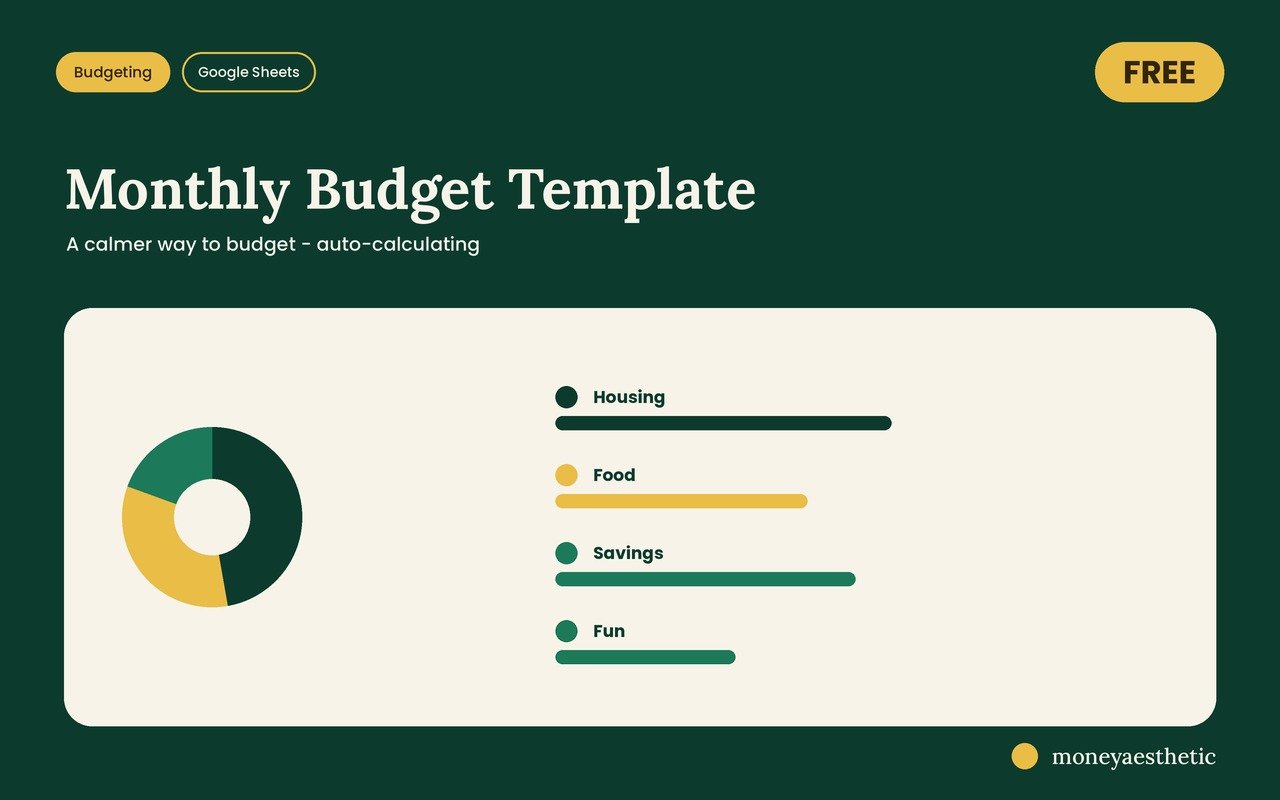
The tedious part of zero-based budgeting is usually the arithmetic. Balancing every dollar to zero by hand gets old fast. The free Monthly Budget Template does it for you: type in your income and expenses, and it shows your leftover number updating live until you’ve given every dollar a job. No formulas to build. It’s a simple way to go from “where did it go?” to “I know exactly where it went.”
Get the free Monthly Budget Template →Common misconceptions about zero-based budgeting
“Zero-based means I spend down to zero dollars.” Nope, that’s a really common mix-up. Zero means zero unassigned dollars. Your savings, your emergency fund, your investments all count as jobs. A fully funded budget can leave plenty sitting safely in savings and still be perfectly “zero-based.”
“It’s only for people who are broke or in debt.” Not even close. Higher earners can lose money to vague categories too, since there’s more slack to lose. Giving every dollar a job can help a good income actually build something instead of just cycling through.
“I have to track every purchase forever.” You track during the month to stay balanced, but it’s not a lifetime sentence of logging coffees. Over time your numbers tend to get more predictable and the check-ins get quicker. The plan does the heavy lifting; you just glance at it.
“My income changes, so this can’t work for me.” It can. It just needs an adjustment, which is exactly what the next section is about.
The tricky part: zero-based budgeting on an irregular or biweekly paycheck
Here’s the honest gap in a lot of guides. They walk you through a tidy example on a steady monthly salary, then wave vaguely at “it’s harder with variable income” and move on. If you freelance, work hourly, earn tips, or just get paid every two weeks instead of monthly, that’s not helpful. So let’s actually fix it.
If your income is irregular, budget last month’s money, not this month’s guess. Instead of predicting what you’ll earn, you assign the money you already made. At the start of the month you look at what landed in your account last month, and that’s the pool you give jobs to. No forecasting, no crossing your fingers. You’re budgeting real dollars that already exist. Getting started means building a buffer so last month’s income can cover this month, and after that there’s much less guessing.
If you’re paid biweekly, budget by the paycheck instead of the calendar month. Rather than one big monthly plan, you zero out each check: this one covers these bills, the next covers those. It lines your money up with your actual pay dates, which can help break the paycheck-to-paycheck cycle. If juggling bills across paychecks sounds like a headache, the budget by paycheck template can help: its Paycheck Budget tab converts weekly, biweekly, or semi-monthly pay into a monthly figure, and its Bill Calendar tracks each bill’s due date and paid status.
One more human thing: you’ll end up with weird leftover dollars, a few here and a few there, that don’t fit anywhere. Don’t leave them unassigned out of laziness; that’s often how the leak restarts. Sweep them somewhere on purpose: round up a debt payment, top off a sinking fund, fling them at savings. Ugly little numbers still need a job. That’s the whole philosophy in miniature.
Zero-based budgeting: FAQ
What is zero-based budgeting?
Zero-based budgeting is a method where you assign every dollar of your take-home income a specific job (spending, saving, or paying off debt) until the money left unassigned equals zero. It doesn’t mean spending down to nothing; savings and investments count as jobs. The point is that no dollar is left without a purpose.
How do I start a zero-based budget?
Start with your real take-home pay, list all your expenses (fixed, variable, and occasional), then assign every remaining dollar to a category such as savings, debt, or fun until nothing is left over. Track your spending through the month and move money between categories as needed, then rebuild the budget from scratch next month.
What does “zero” actually mean in zero-based budgeting?
Zero refers to the dollars left unassigned, not the balance in your bank account. When income minus every assigned job equals zero, your budget is balanced. You can still have plenty of money sitting in savings; it simply has a job called “savings” rather than floating around unplanned.
Is zero-based budgeting good for beginners?
Yes, though it takes a little more effort up front than a percentage method. The first month is usually the slowest as you figure out your categories, but it shows you where your money goes, which helps a lot when you’re new to budgeting. A template that auto-calculates the math can make it friendlier for beginners.
Zero-based budgeting vs. 50/30/20: which is better?
Neither is universally better. The 50/30/20 rule is a loose framework that splits income into needs, wants, and savings, which is fast and forgiving. Zero-based budgeting is more precise and can turn up more hidden money, but asks for more attention each month. Choose zero-based if you want to know where every dollar goes.
Can I do zero-based budgeting with an irregular income?
Yes. The trick is to budget the money you earned last month rather than guessing this month’s income. At the start of each month you assign the dollars that already landed in your account, so you’re planning real money. You need a buffer to get ahead at first; after that there’s much less guessing.
How does zero-based budgeting work if I’m paid biweekly?
Instead of one monthly budget, you zero out each paycheck: assign every dollar of each check to bills and goals as it arrives. This lines your spending up with your actual pay dates and can help break the paycheck-to-paycheck cycle.
What are common mistakes with zero-based budgeting?
One common mistake is leaving small leftover amounts unassigned. Those stray dollars can easily leak away, so sweep them into a debt payment, a sinking fund, or savings on purpose. Another common mistake is copying last month’s budget instead of building a fresh one, which ignores each month’s real costs.
Money Aesthetic shares general educational information, not financial advice. Your situation is your own, so take what’s useful and leave the rest, and check with a qualified professional before any big money decision.