

Quick answer: It depends on three numbers: your balance, your APR, and the fixed amount you pay each month. At the 22.36% average APR the Federal Reserve reported for accounts paying interest in the third quarter of 2026, a $5,000 balance takes about 21 months at $300 a month, but about 12 years at $100. Your monthly statement already prints the minimum-payment version of this estimate.
You open the app, see the balance, and do the quick mental math. Then you close the app, because the quick mental math is never the real answer. Whenever the card charges interest, dividing the balance by what you send each month comes out too rosy.
The good news: this is a math problem, not a mystery. Once you have three numbers, you get an actual date. And a date you can see on a calendar is a lot easier to stick with than a balance that barely seems to move.
Key takeaways
- Balance, APR, and a fixed monthly payment decide your payoff date, as long as no new charges go on the card.
- Your card statement has a legally required box that already estimates the minimum-payment timeline.
- Paying the same fixed amount every month, instead of the shrinking minimum, is what cuts years off.
Your Statement Already Answers Part of This
Most credit card statements in the US carry a box headed “Minimum Payment Warning.” Federal rules under Regulation Z, section 1026.7(b)(12) require card issuers to print how long it would take to pay off the balance if you pay only the minimum, plus the total you would pay along the way. That is your worst-case timeline.
The same box usually shows a second line: the monthly payment that would clear the balance in 36 months, and how much you would pay in total at that pace. Issuers can skip that 36-month line when paying only the minimum already rounds to 3 years or less.
Two details in that box are easy to miss. First, the estimates assume you make only minimum payments and add nothing new to the balance. Every new charge quietly pushes the date back. Second, the box lists a toll-free number for credit counseling information, which is worth knowing about if the minimum-only estimate made your stomach drop.
What the statement cannot show you is your own plan. It only shows the two scenarios the rule requires: the minimum and the 36-month pace. The rest of this guide fills the gap in between.
How Long Does It Take to Pay Off a Credit Card at Today’s Rates?
At a 22.36% APR, the Fed’s G.19 average for accounts assessed interest in Q3 2026, a fixed $300 payment clears $2,000 in about 8 months and $5,000 in about 21 months. Drop that payment to $150 and the $5,000 balance stretches past four years. The table below shows how sharply the timeline bends when the payment shrinks.
| Balance | $150 a month | $300 a month | $500 a month | Payment to finish in 36 months |
|---|---|---|---|---|
| $2,000 | 16 months, $321 interest | 8 months, $156 interest | 5 months, $98 interest | $76.75 |
| $5,000 | 53 months, $2,886 interest | 21 months, $1,043 interest | 12 months, $585 interest | $191.88 |
| $7,000 | 111 months, $9,549 interest | 31 months, $2,271 interest | 17 months, $1,188 interest | $268.64 |
| $10,000 | Never (interest is higher than the payment) | 53 months, $5,771 interest | 26 months, $2,629 interest | $383.77 |
These are our own estimates, not quotes from any lender. They assume the APR stays at 22.36%, interest is charged monthly at one-twelfth of the APR, no new charges go on the card, and the last partial month counts as a month. Many issuers calculate interest using daily balances, so your statement will be a little different. The shape of the answer will not.
Look at the $7,000 row. Going from $150 to $300 a month does not just halve the timeline. It cuts it from roughly nine years to under three, and the interest falls from $9,549 to $2,271. The first extra dollars you add do the most work.
Why Does a Small Payment Take So Many Years?
A small payment takes years because most of it goes to interest first. On a $5,000 balance at 22.36%, one month of interest is about $93.17. Send $100 and only $6.83 reaches the actual balance. At that pace, paying off $5,000 takes about 12 years and costs roughly $9,535 in interest, more than the original balance.
Bump the same balance to $200 a month and the math flips. Now about half of the first payment hits the balance, the interest shrinks every month, and the whole thing is gone in under three years.
This is the exact reason the Debt Payoff Spreadsheet has a minimums-only baseline built in. We designed it so the sheet runs your debts at the minimum in the background and sets that next to your real plan, because seeing how many months sooner your own plan finishes than the minimums-only path does more than any lecture about interest ever could.
What If My Payment Never Catches Up?
If your payment is smaller than the interest charged each month, the balance never gets paid off. On $7,000 at 22.36%, a month of interest runs about $130.43, so a $100 payment loses ground every month even if you never swipe the card again. If the minimum payment itself is below the monthly interest, Regulation Z requires a special statement warning: the issuer must say it estimates you “will never pay off the balance” by paying only the minimum.
If you see that sentence on your statement, the fix is not a better spreadsheet. The fix is a bigger payment, a lower rate, or both. Even getting the payment just above the monthly interest turns “never” into a real, finite date.
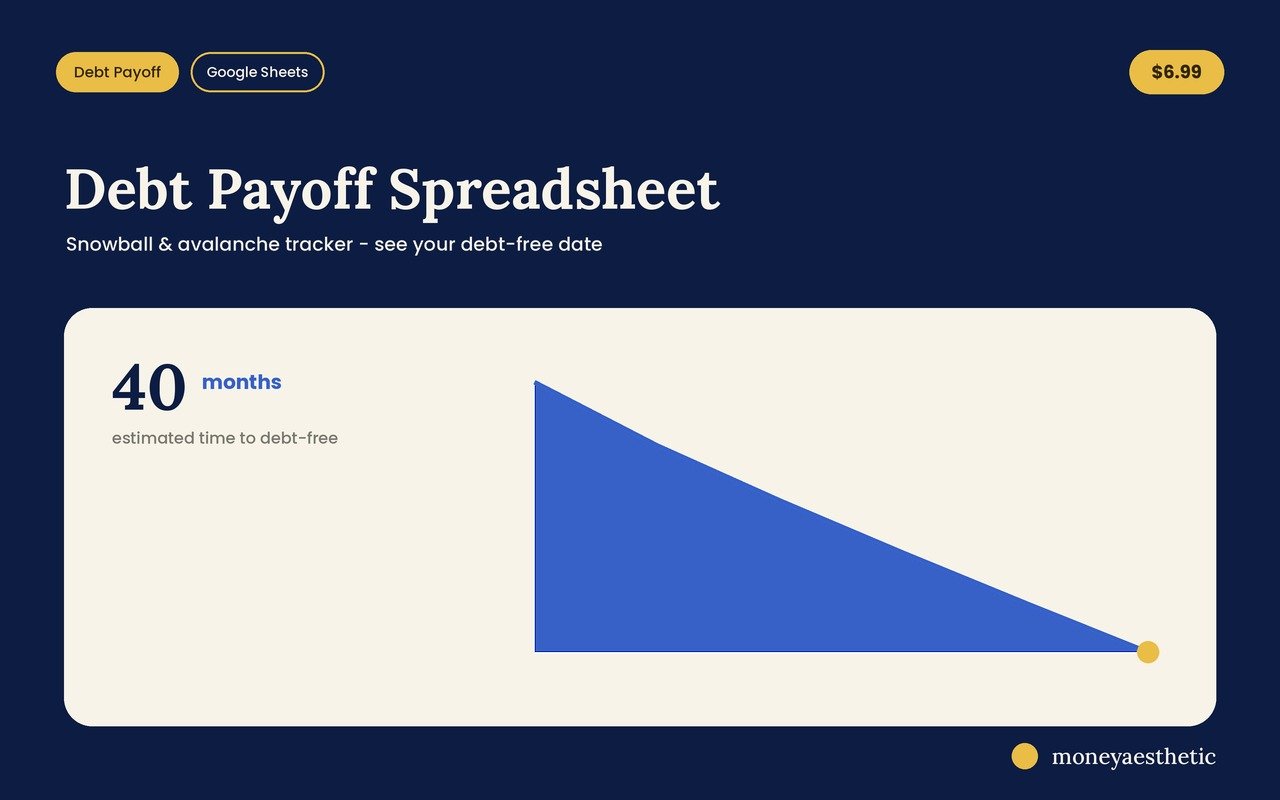
See your actual debt-free date
Type in each card’s balance, APR, and minimum. The dashboard shows your debt-free date and the interest you save against paying minimums, and one extra-payment cell on the Setup tab recalculates everything live. Google Sheets, nothing to build.
Get the Debt Payoff Spreadsheet →Where Does the 36-Month Rule of Thumb Come From?
Plenty of bank calculator pages call 36 months a good rule of thumb for paying off a card. ANB Bank’s calculator page says to “try to pay off any card balance in 36 months” without saying where that number comes from. What they rarely mention is where the number shows up in real life: the 36-month payment printed on your statement under Regulation Z.
That makes 36 months a useful benchmark, not a law you have to follow. If the 36-month payment on your statement fits your budget, it is a solid default. If it does not, a 48-month plan you actually keep beats a 36-month plan you drop in February. The point is a fixed number you send every single month, no matter what the minimum says.
The minimum shrinks as the balance shrinks, which feels like relief but is really the trap. A fixed payment does the opposite. Every month, a bigger slice of the same payment goes to the balance.
Working Out Your Own Payoff Date, Step by Step
You can get a real payoff date with your latest statements and one honest look at your budget. Calculators answer one card at a time. If you carry more than one balance, the order you pay them in changes the date too, so it helps to see everything in one place.
- Collect three numbers per card. Balance, APR, and the current minimum, straight from the statement.
- Pick your fixed monthly total. Start with the 36-month payment from the statement box, then adjust to what your budget can really carry.
- Choose an order. Highest APR first usually saves the most interest. Smallest balance first gives you quicker wins. Our guide on which debt to pay off first walks through both.
- Roll payments forward. When one card hits zero, its whole payment moves to the next card. The debt avalanche spreadsheet guide shows why that rollover column matters.
- Freeze new charges on those cards. Every estimate here, including the one on your statement, assumes nothing new is added.
Doing this by hand works for one card. With three cards and a rollover, it gets messy fast, which is why the debt payoff spreadsheet does the date math for you. We put the extra-payment input in a single cell on the Setup tab on purpose, so testing “what if I add $50?” means changing one cell instead of hunting through formulas.
We also gave it a Payment Log tab, because an estimate is only a starting point. Log each payment there, then update the card’s current balance on My Debts, and your progress and projection refresh from what you actually owe instead of what you hoped to pay in January.
And if you are not sure whether your total is a normal amount to be carrying, our guide on how much credit card debt is too much is a good gut check before you set the payment.
How long does it take to pay off a $2,000 credit card?
At a 22.36% APR with no new charges, $2,000 takes about 16 months at $150 a month and about 8 months at $300. Paying $100 a month stretches it to about 26 months with roughly $526 in interest.
How long does it take to pay off $7,000 in credit card debt?
At 22.36% and no new charges, $7,000 takes about 31 months at $300 a month and about 17 months at $500. At $200 a month it takes about 58 months and roughly $4,440 in interest.
How long does it take to pay off $10,000 in credit card debt?
At 22.36%, $10,000 takes about 53 months at $300 a month and about 26 months at $500, while $150 a month never pays it off. Our guide on how to pay off $10,000 in credit card debt breaks the plan down further.
Do new charges change the payoff estimate on my statement?
Yes. The minimum-payment estimate on your statement assumes you make only minimum payments and add nothing new to the balance. Any new purchase on that card pushes the real payoff date later than the printed estimate.
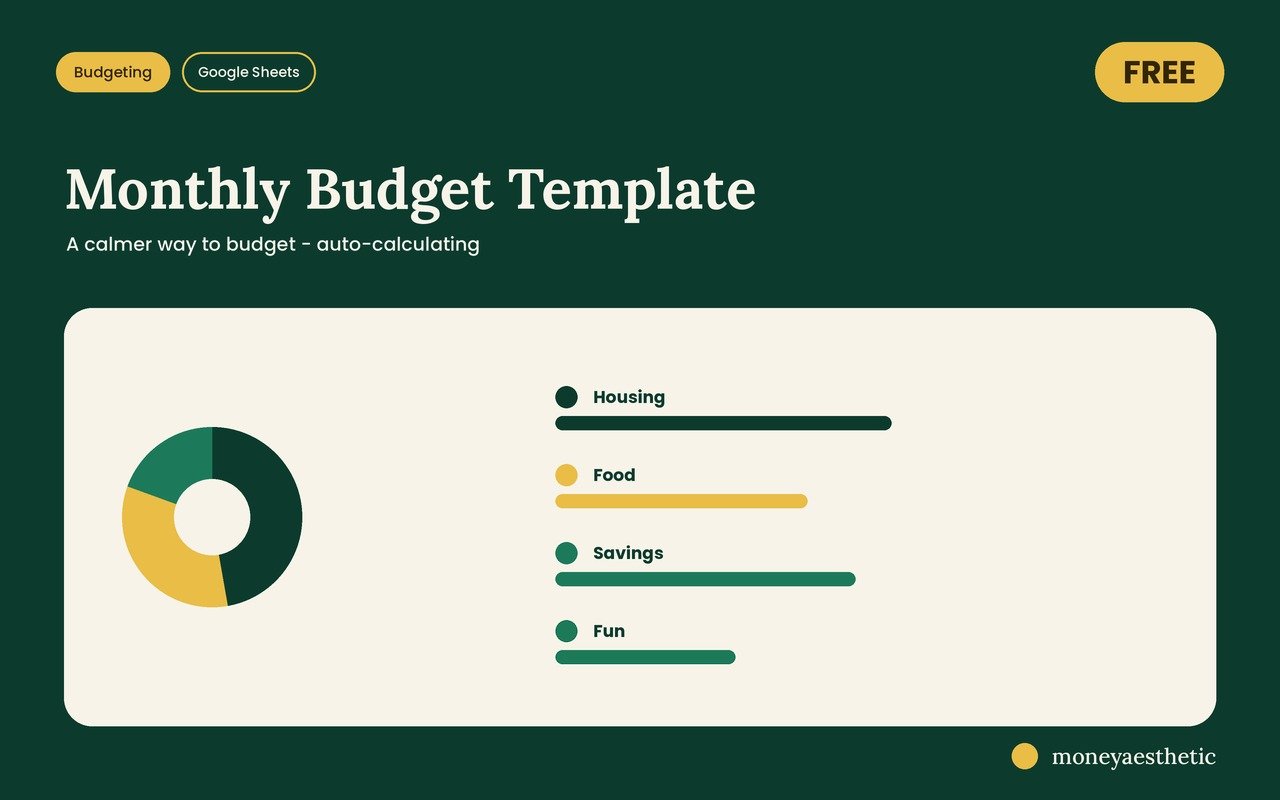
Find your fixed payment first
The payoff date only moves when the monthly payment does. The free monthly template shows what is truly left after bills, so the number you pick is one you can keep sending.
Get the free Monthly Budget Template →This article is for general information only and is not financial advice. The payoff estimates are illustrations based on a single average rate; interest rates, minimum payment rules, and statement disclosures vary by card issuer. Always check the numbers on your own statements.