

Quick answer: The digital 100 envelope challenge works like the cash version, but each “envelope” is a transfer into a separate savings account and a box you tick in a tracker. Fill all 100, from $1 to $100 in any order, and you’ve saved $5,050. Keeping it in an FDIC-insured bank means it’s protected, and it can earn interest (the FDIC’s national average savings rate was 0.38% in October 2026).
Cash envelopes look great on camera. They’re less fun when they live in a kitchen drawer, you need $20 for pizza, and envelope 47 is right there. The digital version keeps the game and loses the drawer.
You still pick an envelope, you still put that exact amount away, and you still get the little hit of crossing it off. The money just goes somewhere you can’t spend it on a whim, and a sheet does the counting so you always know how close you are to $5,050.
Key takeaways
- Swap paper envelopes for a separate savings account plus a tracker with 100 boxes.
- Fill envelopes in any order; match big numbers to paydays and small ones to tight weeks.
- On a biweekly paycheck, about 4 envelopes per payday finishes in 25 paydays.
What is the digital 100 envelope challenge?
The digital 100 envelope challenge is the classic savings game without the cash. You number 100 “envelopes” from $1 to $100, pick one whenever you can, move that amount from checking into a separate savings account, and mark it done in a tracker. When every envelope is filled you’ve moved $5,050, because 1 + 2 + 3 and so on up to 100 adds up to exactly that.
The “envelopes” are just rows or boxes on a screen. That’s the whole trick: the commitment stays the same, but the money sits in a bank instead of a shoebox. If you’ve never done the original, our guide to the 100 envelope challenge walks through the classic cash version.
Why go digital instead of cash?
Going digital protects the money and makes the challenge easier to finish. Savings at an FDIC-insured bank are covered up to at least $250,000 per depositor, per ownership category, at each insured bank, so a full $5,050 sits well inside that limit. Cash in envelopes has no such protection and is one quick grab away from becoming takeout.
There’s also interest. The FDIC’s national rates table for October 2026 lists 0.38% for savings and 0.63% for money market accounts. Those are averages across banks, which is a polite way of saying plenty of accounts pay more. A shoebox pays 0%.
And honestly? Tapping a box on your phone is easier than finding a pen, a marker and the right envelope. Fewer steps means you actually keep going in March.
How do you set it up without cash?
Setting up the digital version is quick. You need a separate place for the money, a tracker with 100 boxes, and a start date. Once those three exist, every envelope after that is one transfer and one tick.
- Give the money its own home. Open a separate savings account, or a savings “bucket” if your bank has them. Keeping it apart from checking is what stops envelope money from quietly paying for groceries.
- Get a tracker with 100 boxes. A notes app works. A spreadsheet works better, because it adds everything up for you.
- Pick your start date. January 1 is the obvious one, but any day works.
- Choose an envelope that fits today. Payday? Take a big number. Tight week? Take a small one.
- Transfer first, then tick. Move the money, then mark the box. Ticking before the transfer is how the tracker and the bank stop matching.
When we built our free tracker, we put a checkbox under every envelope instead of asking you to type amounts or dates, because we wanted logging an envelope to take one click. The sheet adds up what you’ve saved, what’s left to reach $5,050 and how many envelopes are still empty.
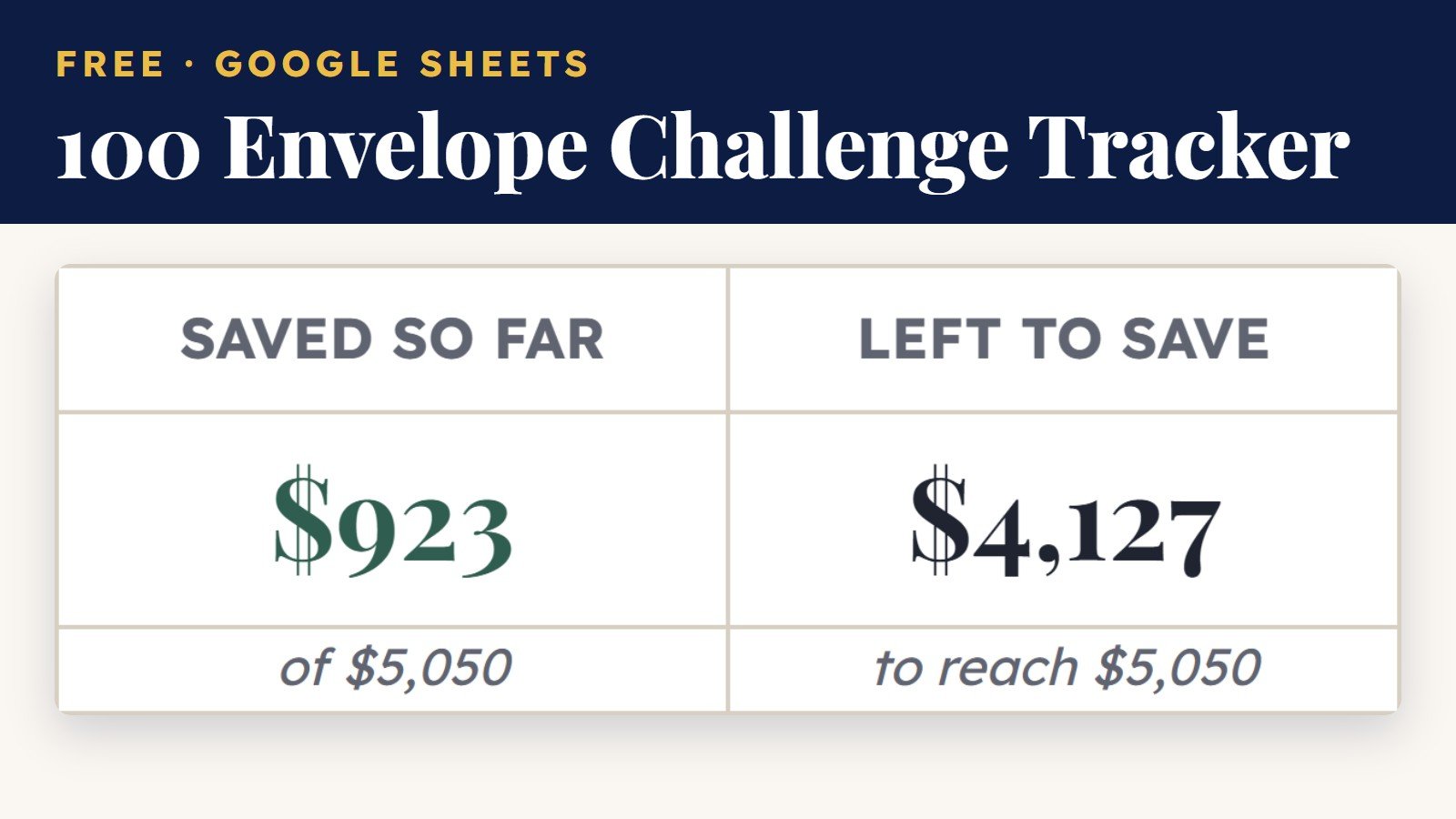
Skip the shoebox. Tick the box.
All 100 envelopes in one Google Sheet, with your savings, what’s left and a progress bar adding up on their own. Free, set up for 2027.
Get the free tracker →How many envelopes per paycheck?
One simple way to stay on track is to tie envelopes to your paydays. Divide 100 envelopes by the number of paychecks you get in a year and round up. On a biweekly schedule that’s about 4 envelopes per payday, which finishes in 25 paydays. The average envelope is $50.50, so 4 envelopes average about $202 per paycheck.
| How you’re paid | Paychecks a year | Envelopes per payday | All 100 done in |
|---|---|---|---|
| Weekly | 52 | 2 | 50 paydays (about a year) |
| Every two weeks | 26 | 4 | 25 paydays (just under a year) |
| Twice a month | 24 | 5 | 20 paydays (10 months) |
| Monthly | 12 | 8 or 9 | 12 months |
Those are averages, not rules. Mix a $90 envelope with a $4 one on the same payday if that’s what your budget allows. If your income moves around, our guide on savings challenge ideas has gentler options that bend with your paycheck.
A 2027 start plan, step by step
If you want to start on New Year’s Day, January 1, 2027 falls on a Friday. At one envelope a day you’d finish on April 10, 2027. If you’re paid every other Friday starting January 8, 2027, filling 4 envelopes per payday gets you to 100 on your 25th payday, December 10, 2027, with time to spare before the holidays.
We set our tracker’s default start date to January 1, 2027 for exactly this reason: a New Year’s start needs zero setup, and the finish date at one envelope a day fills in on its own. Change the date by double-clicking it and picking a day from the calendar. If the whole year needs a plan, the free 2027 budget planner pairs with it.
Small slips that stall the digital version
The digital challenge rarely fails because of math. It stalls on small habits.
- Saving into checking. If the “envelope” never leaves checking, it gets spent. A separate account fixes this.
- Doing the big ones last. Envelopes 51 through 100 hold $3,775, about three quarters of the total. Spread them across paydays instead of saving them for the end.
- Ticking ahead. Mark the box after the transfer goes through, not when you plan it.
- Deleting instead of unticking. In our own testing, the slip we kept making was pressing Delete to clear a box in Google Sheets. Delete removes the checkbox itself. Click the box again to untick it, and if a box disappears, Ctrl+Z (Cmd+Z on a Mac) brings it back.
Want to run more than one challenge at once? The savings challenge tracker PRO ($6.99, also Google Sheets) holds six challenges, including a biweekly plan and a no-spend calendar, and its 100 envelope tab adds half and double envelope sizes.
FAQ
Can you do the 100 envelope challenge with a savings account?
Yes. Each envelope becomes a transfer of that amount into a separate savings account, and you tick it off in a tracker. You still save $5,050 when all 100 are done.
Is the digital 100 envelope challenge safe?
Keeping the money at an FDIC-insured bank means it’s insured up to at least $250,000 per depositor, per ownership category, at each insured bank. Cash at home has no such coverage.
How much is each envelope on average?
The average envelope is $50.50, because $5,050 spread over 100 envelopes works out to $50.50 each. Real amounts range from $1 to $100.
Can I do the digital 100 envelope challenge with a partner?
Yes. Share one tracker in Google Sheets and both of you can tick envelopes from your phones, so you always see the same total.
This article is for general education, not financial advice. Rates and account terms change, so check current details with your bank before opening an account.