

Quick answer: Budget billing is a utility payment plan that charges you a set amount each month based on your average usage over about 12 months, instead of billing you for what you actually used. At the end of the budget year the company compares what you paid to what you used and settles the difference. It smooths your cash flow. It does not lower your costs, and electricity is not getting cheaper: EIA data released August 26, 2026 puts the average U.S. residential price at 18.34 cents per kilowatt-hour for June.
You already know the two months. The August bill that shows up looking like a car payment, and the March one that is so small you assume something is broken. Same house, same family, wildly different numbers, and your budget takes the hit both times.
So your power company offers you a deal: pay the same thing every month, all year. No spikes. It sounds like the fix. Sometimes it is. But there is a mechanic buried in it that catches a lot of people at exactly the wrong moment, and almost nobody explains that part before you sign up.
Key takeaways
- Budget billing spreads your average usage across equal monthly payments. It is a cash-flow tool, not a discount.
- The variance does not disappear. It gets stored up and handed to you once a year as a true-up.
- It works beautifully if you bank the difference in the cheap months. It backfires if you spend it.
What is budget billing, exactly?
Budget billing is a payment plan where your utility charges you one flat amount every month based on your average usage, instead of billing you for what you actually used that month. The Office of the Ohio Consumers’ Counsel, the state’s residential utility advocate, describes it plainly: it “allows you to pay a set amount for your utilities each month based on your average usage over 12 months,” which “helps avoid bill spikes in the coldest or hottest months.” Some companies market the same thing as levelized billing, an equal payment plan, or average monthly billing.
Two enrollment details that catch people, per the same source: your account usually has to be current with no past-due balance, and if you buy your energy from a third-party supplier you may not be eligible at all.
Here is the thing to hold onto: you are not buying cheaper electricity. You are buying a predictable due-date amount. The kilowatt-hours are priced exactly the same as your neighbor who pays the real bill.
How does budget billing work month to month?
Your utility looks at about a year of usage at your address, projects what the coming year will cost, and turns that into one repeating payment. Then three things happen on a schedule:
- You pay the flat amount whether you ran the air conditioning for 30 days or left for a two-week vacation.
- The company recalculates periodically. Ohio’s consumer advocate puts it this way: your account “is reviewed periodically and may be adjusted depending on your usage or changes in energy costs.” So the flat amount can drift up or down mid-year.
- You get a true-up. At the end of the budget year they compare what you paid against what your usage actually cost. Used more than projected, you owe the gap. Used less, you get a credit or a refund.
That third step is the whole ballgame, and we will come back to it.
Why does your electric bill swing so much in the first place?
Because usage genuinely does swing, far more than most people picture. Across the country as a whole, EIA’s Electric Power Monthly shows the residential sector using about 73% more electricity in July 2025 than in April 2025. That is national data, not your meter, so your own gap could be gentler or much worse. But it tells you what the flat payment is being asked to absorb.
Here is the shape of a normal American year, using total U.S. residential electricity sales and measuring every month against the April low:
| Month (2025) | U.S. residential electricity sold | vs. the April low |
|---|---|---|
| April (the low) | 97,306 thousand MWh | — |
| November | 101,222 thousand MWh | +4% |
| October | 107,313 thousand MWh | +10% |
| June | 135,822 thousand MWh | +40% |
| January | 152,329 thousand MWh | +57% |
| July (the peak) | 168,011 thousand MWh | +73% |
Two peaks, cooling season and heating season, with valleys in spring and fall. If you budget the same utility number in April that you budget in July, one of those two months is lying to you. Most people set their budget in a low month, because that is when money feels calm enough to sit down and make one, and then July arrives.
Prices are not helping either. That same EIA release put the residential average at 18.34 cents per kilowatt-hour in June 2026, up from 17.47 cents in June 2025. Year-to-date through June, the average ran 18.16 cents in 2026 against 16.91 cents in 2025. EIA marks its 2025 and 2026 figures as preliminary, so they can be revised, but the direction has been steady for years: your July is getting more expensive even if your thermostat never moves.
Does budget billing actually save you money?
No, and any page that implies otherwise is selling you something. Budget billing changes when you pay, not what you owe. Over a full year you pay for the same kilowatt-hours at the same rate.
What it can save you is the second-order damage that a surprise bill causes. A bill that lands 90 dollars over what you planned does not just cost 90 dollars. It costs the overdraft, or the credit card balance that now carries interest, or the sinking fund you raided to cover it. Those are real numbers, and for a lot of households they are bigger than the swing itself. Learning how to avoid overdraft fees and flattening your utility bill are solving the same underlying problem from two directions.
And the stakes are not small. In its Residential Energy Consumption Survey covering 2020, EIA found that 34 million U.S. households, 27% of all U.S. households, reported difficulty paying energy bills or kept their home at an unsafe temperature over cost concerns. One in ten households received a disconnection notice in 2020. Predictability is not a luxury feature for a lot of families.
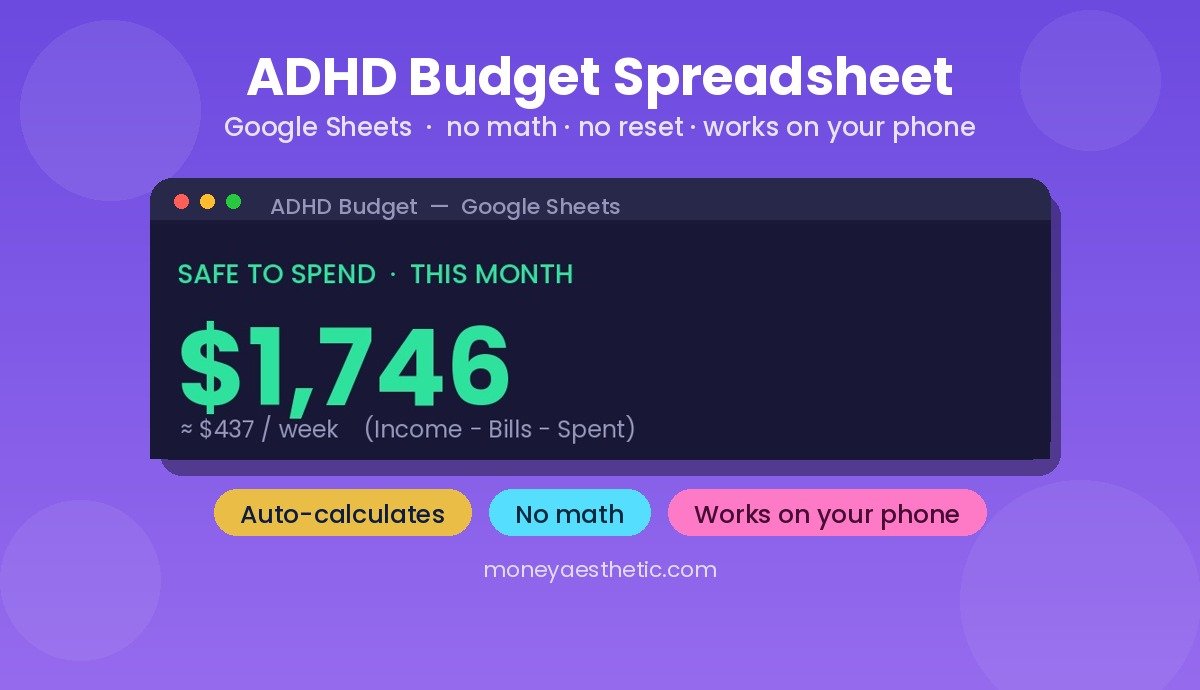
One less number that moves
Budget billing freezes your power bill. This sheet handles everything it does not: bills flip from Due to Paid to Late in color, Safe-to-Spend stays pinned at the top of one tab, and savings jars give your true-up money somewhere to live that is not your checking balance. No math, no monthly reset.
Get the ADHD Budget Spreadsheet →Who should turn budget billing on, and who should skip it?
This is a fit question, not a good-or-bad question. Run yourself through these instead of reading another pros-and-cons list.
Turn it on if: your bill swings hard between seasons, your income is steady but your margin is thin, you have been surprised by a summer or winter bill in the last two years, or a fixed due-date amount is the difference between paying on time and paying late. Also turn it on if you are new to a place and have no idea what the bills will look like, since the flat number at least gives you something to plan around while you learn.
Skip it if: you are moving within the year, since some plans settle the whole balance when you close the account. Skip it if your usage is about to change a lot, like a new baby at home or someone switching to remote work, because your flat amount was built on a version of your life that no longer exists. And skip it if you know you will spend the difference in the cheap months, because then you are just deferring the pain and adding a bill you did not plan for. A baby moves a great deal more than the power bill, and how to budget for a baby walks through the rest of it.
If you land in the skip column, the DIY version works fine: budget your peak month every month and let the surplus pile up in a sinking fund. Same effect, and you keep the interest and the flexibility. A bill tracker printable or a budget calendar is usually enough structure to hold it.
Either way, the thing that trips people up is the same, and it is why I gave annual subscriptions their own running total in my ADHD sheet instead of burying them in a category. Charges that hit once a year are the ones a monthly budget is worst at seeing coming, because eleven months of evidence say they do not exist. A true-up is exactly that species of number.
The part nobody warns you about: the bill is also a reminder
Here is the wrinkle that most pages on this topic skip. Your electric bill is not only a charge. It is a signal, and you respond to it.
Economists Ben Gilbert and Joshua Graff Zivin studied hourly household electricity data collected by smart meters and found that households reduce consumption by 0.6% to 1% following receipt of an electricity bill. Nobody decides to do this. The bill arrives, it registers, the thermostat creeps up a degree, lights get turned off.
That study looked at ordinary billing, not budget billing, so nobody has measured this exact case. But follow the logic. Budget billing shows you the same number every month, which means the thing the researchers found people responding to is precisely what gets removed. If the bill is what nudges you, a bill that never changes cannot nudge you. Whatever that costs you shows up a year later in the true-up, by which point you cannot trace it back to anything you did.
So the honest way to run budget billing is to treat the true-up as a sinking fund from day one. Budget billing does not remove the variance in your bill. It concentrates twelve small surprises into one big annual surprise, and a big annual surprise is harder for most households to absorb than twelve small ones. The fix is not complicated: keep budgeting what your peak month actually costs, pay the flat amount, and move the difference somewhere you will not touch. Then check your actual usage on the bill once a quarter, because the number in the corner is now the only warning you get.
That last part is why I built the bills block in my ADHD sheet around status rather than amount. When the amount stops changing, the thing you need to see is whether it went out and whether it went out on time, not the digits. I also kept the savings jars in their own block instead of folding them into one savings line, specifically so a fund like this one has a labeled home. A true-up you are saving for and an emergency fund are not the same money, and if they share a cell they turn into one vague pile you will spend.
Frequently asked questions
Is budget billing worth it?
It is worth it if your bill swings seasonally and a predictable payment helps you avoid late fees, overdrafts, or credit card interest. It is not worth it if you will spend the surplus in the cheap months, because you will still owe that money at the true-up, only later and all at once.
Does budget billing save money?
No. Budget billing spreads the same annual cost across equal monthly payments. You pay for the same kilowatt-hours at the same rate. The savings, if any, are indirect: fewer late fees, fewer overdrafts, and less need to borrow to cover a spike.
What is a true-up on budget billing?
A true-up is the annual reconciliation. Your utility compares what you paid under the flat amount to what your actual usage cost. If you underpaid, you owe the difference, sometimes as one lump sum. If you overpaid, you get a credit or refund. Ask your utility whether their true-up is billed at once or spread out, because that varies by company.
Can my budget billing amount change during the year?
Yes. Ohio’s consumer advocate notes that a budget billing account is reviewed periodically and may be adjusted depending on your usage or changes in energy costs, so your flat payment can move mid-year. It is still far steadier than a real bill, but do not assume the first number is permanent.
What happens if I cancel budget billing?
You return to being billed for actual usage, and any accumulated balance is typically settled at that point. That means canceling right before a true-up you owe on does not make the balance go away. Check your specific plan, since utilities differ on whether they bill the balance immediately or roll it forward.
Is budget billing a good idea for renters?
It can be, especially in your first year somewhere when you have no usage history to plan around. The catch is moving: many plans settle in full when you close the account, so if you expect to move mid-year, budget for that balance landing on your final bill.
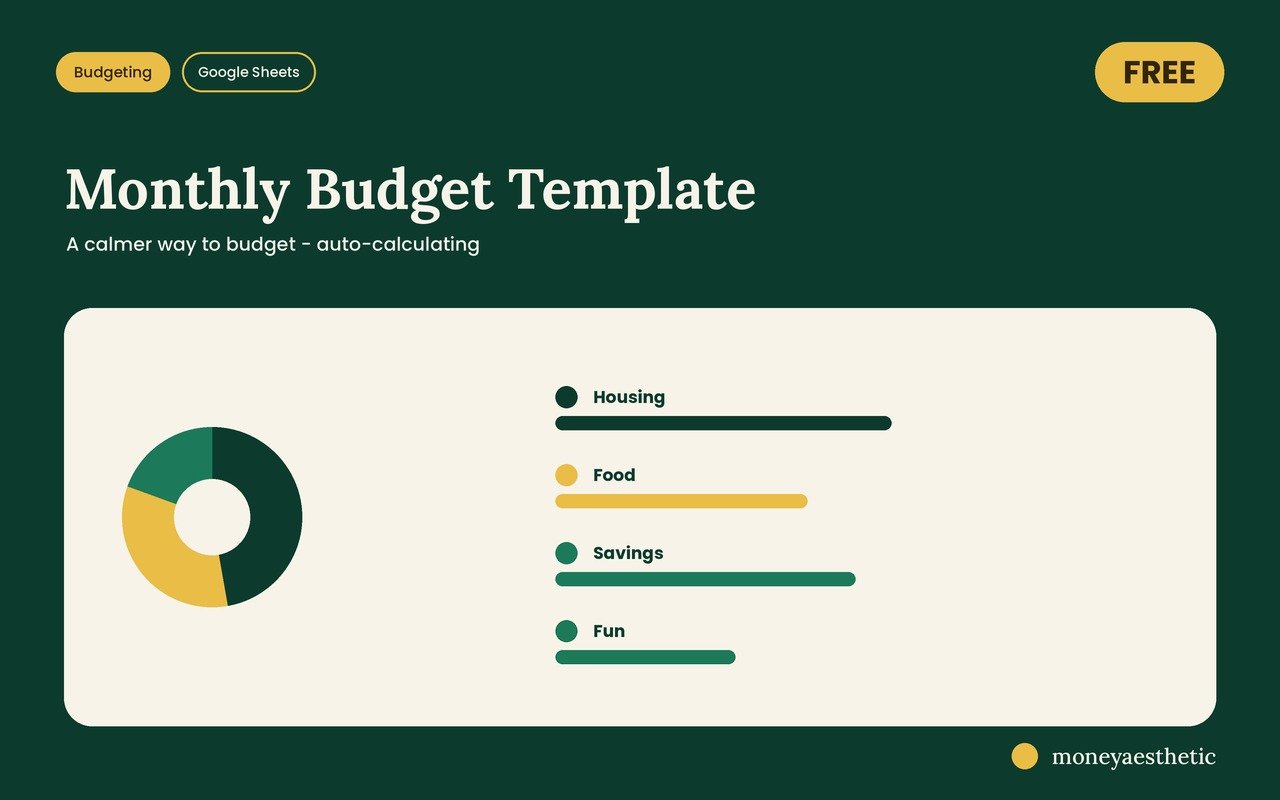
Not ready to buy anything? Start here.
The free Monthly Budget Template gives you one place to park your utility number, whether it is a flat budget-billing payment or your ugliest July bill. Make a copy, type your numbers, done in about five minutes.
Get the free Monthly Budget Template →Money Aesthetic publishes general educational information, not financial advice. Utility programs, true-up rules, and cancellation terms vary by company and by state, so confirm the details with your own provider before enrolling.