

Quick answer: In 2026 there is no single rule about who pays for the wedding. Most are funded by some mix of the couple and both sets of parents, and the split tracks the budget rather than tradition. In The Knot’s 2026 Real Weddings Study, family contributions covered roughly 62% of weddings over $41,000, while weddings under $12,000 were almost entirely paid for by the couple.
Someone asks the question at dinner, usually about four minutes after you announce the engagement. “So… who’s paying for all this?” And everyone at the table suddenly finds their napkin very interesting.
It’s the most awkward question in wedding planning, and it stays awkward because nobody answers it out loud. People say things like “we’ll help” and “don’t worry about the flowers,” and then five months later a venue wants a non-refundable deposit and the room goes quiet again. So let’s do the un-awkward version: here’s who actually pays in 2026, what tradition says, and how to turn a vague “we’ll help” into a real number you can plan around.
Key takeaways
- There is no default any more. The couple, one family, both families, or all four parents — every combination is normal in 2026.
- The size of the wedding predicts who pays better than tradition does. Bigger budgets lean on family money; smaller ones are self-funded.
- Traditional etiquette split the bill by side of the family. It survives as a starting point for negotiation, not as a rule.
- A promise is not a contribution until it has a number, a date and a category attached to it.
Who Pays for the Wedding Now That Nobody Follows the Old Rules?
Who pays for the wedding in 2026 is genuinely a case-by-case answer, but the most common shape is a blend: the couple funds the largest single share, one or both sets of parents contribute a fixed amount or claim a specific category, and nobody covers everything. The Knot’s read-out of real couples found that 50% paid the minority of their wedding, 36.8% paid the majority, and 13.2% paid for all of it themselves.
Read those three numbers again, because they say something useful. Almost nobody is in the situation the etiquette articles describe. Half of couples are getting meaningful family money, but only about one in eight is paying the whole thing alone. Which means the real question was never “who pays.” It’s “who pays for what, and how much” — and that’s a conversation, not a tradition.
The average wedding tells you the scale of what’s being divided up. The Knot’s 2026 Real Weddings Study, which surveyed 10,474 US couples married in 2025, puts the average American wedding at $34,200 for 117 guests, or about $292 for every person who walks through the door.
Why Does the Size of the Wedding Decide Who Pays for It?
Wedding budget size is the strongest single predictor of who funds it. In The Knot’s 2026 study data, couples spending over $41,000 had roughly 62% of the cost covered by family, and averaged 141 guests. Couples spending under $12,000 averaged 92 guests and paid for their own celebrations, leaning on DIY decor and friends as officiants.
That relationship runs in both directions, and it’s worth sitting with. Family money doesn’t just show up because the wedding is big. The wedding gets big because family money showed up, and because parents who contribute usually arrive with a guest list of their own. The same study found Gen Z weddings are still primarily supported by parents and family, while millennials, marrying later and funding more of it themselves, spend about 15% more and invite fewer people.
So if you’re trying to guess your own answer before the conversation happens, the guest list is your tell. A 60-person wedding you can cover yourselves stays yours. A 150-person wedding almost always involves somebody else’s money and somebody else’s opinions, and pretending otherwise is how people end up quietly resentful in February. If you want the full picture of what’s being divided, the wedding budget breakdown by category shows where the money actually goes.
What Does Each Family Traditionally Pay For?
Traditional American wedding etiquette assigned costs by side of the family, and while almost nobody follows it exactly any more, it’s still the script people have in their heads when they sit down to talk. Knowing it is useful for exactly one reason: it gives you a neutral opening that isn’t “so, um, how much were you thinking?”
| Who | Traditionally covers | What usually happens in 2026 |
|---|---|---|
| Bride’s family | Ceremony venue, reception, catering, flowers, photography, invitations, the dress | Contributes a set amount or funds one big category, rarely the whole reception |
| Groom’s family | Rehearsal dinner, officiant and license, the bar, music, bride’s bouquet, honeymoon | Usually keeps the rehearsal dinner, sometimes adds the bar |
| The couple | Historically very little | The largest single share, plus everything nobody claimed |
| Wedding party | Their own attire and travel | Unchanged, and still the fairest rule on the list |
The reason the old version collapsed isn’t only that it’s dated. It was built for couples marrying at 22 out of their parents’ houses. The average person getting married now has their own income, their own credit card and very strong opinions about the playlist, and the money follows that.
How Do You Ask Your Parents to Contribute Without It Being Weird?
Ask specifically, ask early, and ask for a number instead of a favor. The awkwardness in this conversation almost always comes from vagueness, not from money. Here’s the version that works:
- Decide your own number first. Know what the two of you can fund on your own before anyone else is in the room. Then any contribution is a bonus rather than a rescue.
- Talk to each set of parents separately. Nobody wants to name a figure while the other family listens and does math.
- Ask for an amount, not a category. “Would you be comfortable contributing a set amount?” is far easier to answer than “would you cover catering?” Catering has no ceiling and everyone knows it.
- Write down what they say the same day. Amount, who it’s from, when it arrives, what it’s earmarked for.
- Say out loud what the money buys. If a contribution comes with guest list input attached, that’s fine, but agree on it now rather than discovering it at the seating chart.
Then put every answer in one place. Not four text threads and a note on your phone. One sheet where each contribution is a line item, so the total updates itself and you can see instantly what’s still unfunded.
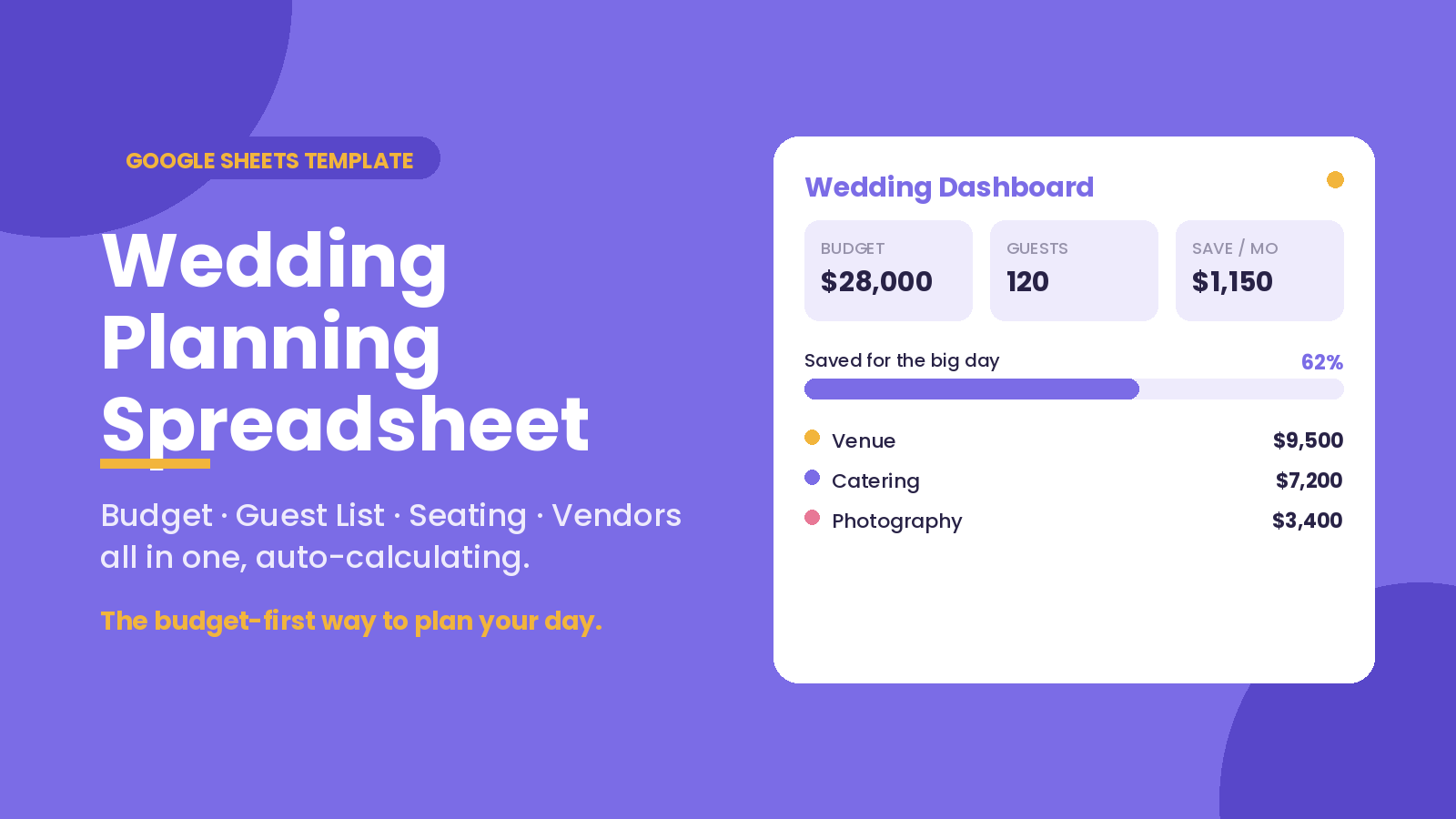
One place for every “we’ll help with something”
The Wedding Budget Spreadsheet keeps contributions and costs side by side, so the moment someone commits a number you can see exactly what’s funded, what’s still on you, and what your guest count is doing to the total. Deposits and final payments track separately, and the math is already wired in. It’s 9.99, and it will save you the third rewrite of your budget at midnight.
Get the Wedding Budget Spreadsheet →Common Misconceptions About Who Pays for the Wedding
“The bride’s parents are supposed to pay for everything.” They were, in an era when brides didn’t have their own bank accounts. Today the couple is the single largest funding source, and expecting one family to carry a five-figure event because of a century-old custom is how families stop speaking to each other.
“If our parents pay, we don’t have to budget.” The opposite, honestly. Money from someone else arrives with timing attached, and vendors don’t care whose money it is when a deposit is due in March. Contributions make a wedding budget more important, not less.
“Splitting it 50/50 between the families is the fair way.” It sounds fair right up until one family invites 40 people and the other invites 12. Venue, catering and bar are priced per guest, so an even split quietly charges the smaller family for the bigger family’s cousins.
“Asking for money makes us look like we can’t afford it.” Half of couples are receiving family contributions. The ones who look unprepared are the couples who assumed help was coming and never confirmed it.
The Part Nobody Tells You: A Pledge Isn’t Money Until It Has Three Things
Every wedding budget that falls apart falls apart in the same place, and it isn’t the flowers. It’s the gap between what somebody offered and what somebody actually sent. A contribution only counts once it has three things: a number, a date, and a category. Miss any one of them and what you have is a feeling, not a funding source.
The number is obvious. The date is the one everybody skips, and it’s the one that hurts: a parent planning to contribute from a year-end bonus is genuinely helping, just not in March when the venue wants 30% down. The category matters because unassigned money gets spent twice in your head, once on photography and once on the bar. A wedding budget spreadsheet with a promised column and a received column settles all three of those in about ten minutes.
There’s a fourth thing worth settling while you’re at it: whose card the deposit goes on. If a parent is contributing but you’re the one paying the vendor, you carry that balance until their transfer lands, and every non-refundable deposit is legally yours. Decide that before you sign anything, not after.
And the split itself: if two families are contributing and the guest lists are lopsided, weight the shares by head count instead of cutting the total in half. Roughly half of a typical wedding budget is priced per guest, so head count is the honest denominator. If planning around a smaller number is starting to look better and better, planning a wedding on a budget is the version where you trim the guest list instead of the relationship. Plenty of couples quietly redirect the difference toward saving for a house, which is its own kind of romantic.
Frequently Asked Questions
Do the bride’s parents still pay for the whole wedding?
Rarely. The Knot’s data shows the couple is now the largest single funding source, with 36.8% of couples paying the majority of their own wedding and 13.2% paying all of it. The bride’s family covering everything is now the exception rather than the expectation.
What are the groom’s parents traditionally supposed to pay for?
Traditional etiquette gives the groom’s family the rehearsal dinner, the marriage license and officiant fee, the bar, the music, the bride’s bouquet and boutonnieres, and historically the honeymoon. In practice most modern families keep the rehearsal dinner and negotiate the rest.
Who pays for the rehearsal dinner?
The groom’s family, by tradition, and this is one of the few conventions that mostly survived. It stuck because it is a bounded, predictable cost with a natural host role attached, unlike catering, which has no ceiling.
Who pays for the wedding rings?
Each partner traditionally buys the other’s ring, so the couple covers both bands between them. The engagement ring is separate and usually paid for by the person proposing, well before any wedding budget exists.
Who pays for the wedding dress?
Traditionally the bride’s family, along with the veil and accessories. Today it gets split about as often as anything else, and many brides simply buy their own dress so that nobody else gets a vote on it.
Is money from parents for a wedding taxable?
A gift is not taxable income to the person receiving it, and the giver only files a gift tax return above the annual exclusion, which the IRS sets at 19,000 dollars per recipient for 2026. Each parent can give that amount to each member of the couple, so one set of parents can contribute up to 76,000 dollars without filing.
How do you split wedding costs if one family invites more guests?
Weight each family’s share by their guest count rather than splitting the total evenly. Venue, catering and bar are priced per person and make up close to half of a typical budget, so a head-count split reflects what each side is actually adding to the bill.
What happens if someone promises money and then backs out?
You absorb it, which is exactly why an unconfirmed pledge should never sit in your budget as funded. Track promised and received amounts in separate columns, and only commit to a vendor once the money for that deposit is money you already have.
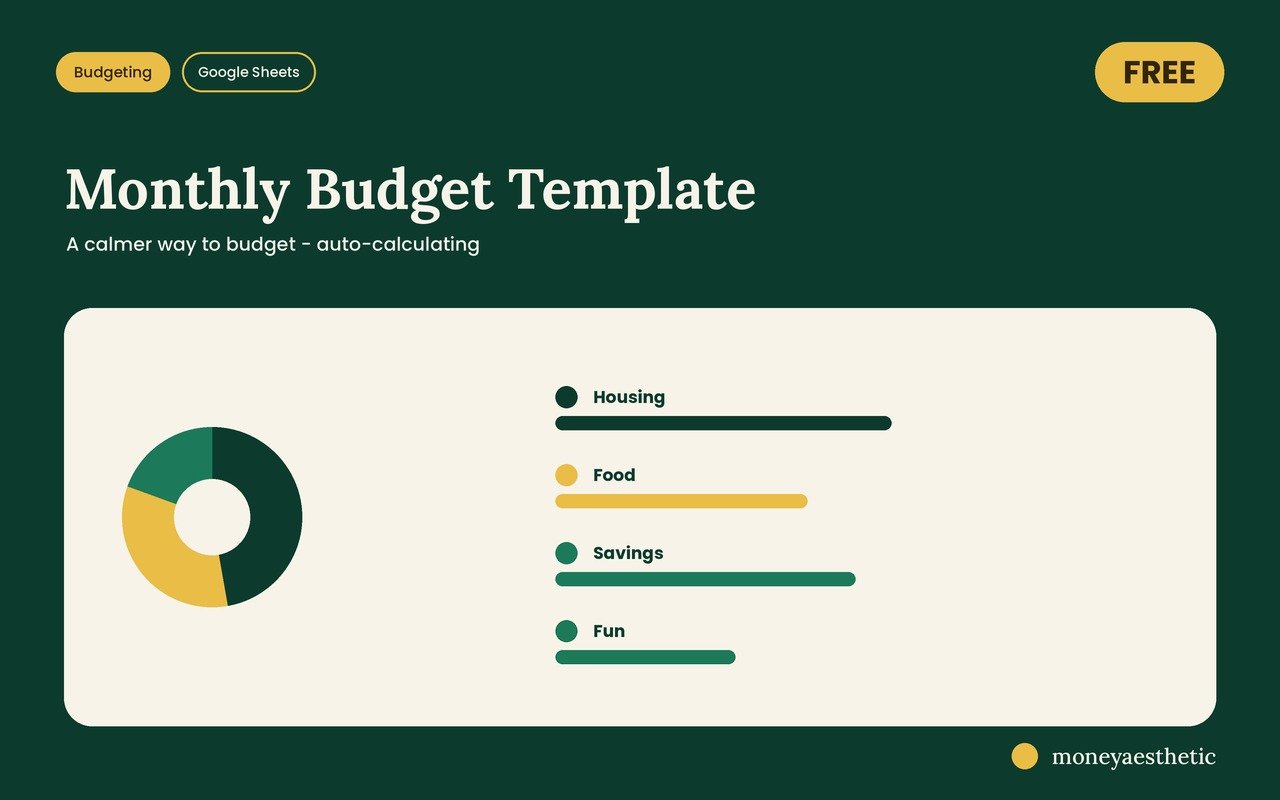
Still working out what your own share can be?
Before the wedding sheet, there’s the everyday one. The free Monthly Budget Template shows what your income is really doing each month, which is the number that decides how much of the wedding you can fund yourselves. One page, nothing to build, costs nothing.
Get the free Monthly Budget Template →This article is general information, not personalized financial or tax advice. Gift tax rules and contribution limits change, and every family’s situation is different — check current IRS guidance or talk to a tax professional before making a decision based on it.