

To save for a house, you probably need less than you think. In most cases the minimum down payment is at least 3% (not the mythical 20%), FHA loans allow as little as 3.5%, and many loans require 5% or more, per the Consumer Financial Protection Bureau. On a median-priced new home ($410,700 in the second quarter of 2026), 5% down is about $20,500. Pick your real number, keep it in a high-yield savings account, and automate a set amount each payday.
If you’ve ever run the numbers on a house, closed the tab a little too fast, and quietly decided renting is fine actually: hi, welcome, you’re among friends. When a normal starter home has a comma sitting in a place your brain wasn’t ready for, “just save up” can feel like a punchline.
But here’s the trap in waiting until it feels doable: it rarely does. Rent can creep up, the goalpost can slide back, and the longer you go without an actual plan, the more it seems like other people got a memo you missed. They didn’t. A plan can be as simple as picking a number and feeding it a little each month. That’s the whole move, and it’s very learnable, even on a normal income.
Key takeaways
- You may not need 20% down. In most cases the minimum is at least 3%, and many loans require 5% or more.
- Your real target is the down payment plus closing costs (2–5%) plus a small cushion, not the down payment alone.
- Keep house money in a high-yield savings account, not the stock market. Your timeline is too short to gamble with it.
- The number that makes it feel real is monthly: your target, minus what you’ve already got, divided by the months until you want to buy.
How much do you actually need to save for a house?
Let’s kill the scariest myth first. That “you need 20% down” rule? It’s not a rule. It’s the point where you can skip private mortgage insurance on a conventional loan. Useful, but nowhere near required. In reality, the CFPB says you need at least 3% down in most cases, many loan types and lenders require 5% or more, and FHA loans allow as little as 3.5%.
So what does that look like in real dollars? The median newly built home sold for about $410,700 in the second quarter of 2026 (U.S. Census Bureau and HUD data). Here’s the same house at a few different down payments, so you can see how wide the range really is:
| Down payment | On a $410,700 home | Who it’s for |
|---|---|---|
| 3% (the minimum in most cases) | about $12,300 | Low-cash entry (eligible VA/USDA borrowers may put 0% down) |
| 3.5% (FHA loans) | about $14,400 | Lower credit scores |
| 5% (many loan types and lenders) | about $20,500 | What many loans ask for, or more |
| 20% (no PMI on a conventional loan) | about $82,100 | The “someday” number |
Now add the part that’s easy to forget: closing costs, which usually run 2–5% of the price, another rough $8,200 to $20,500. So your honest all-in target isn’t just the down payment; it’s the down payment, plus closing costs, plus a small cushion so you’re not moving in with next to nothing to your name. With a 3–3.5% down loan on that price, the down payment plus closing costs lands roughly between $20,500 and $34,900 before your cushion. That’s a real number, but a much less terrifying one than $82K.
Where should you keep your house fund?
Short version: not in the stock market, and not in your regular checking account where it’ll quietly become groceries. Money you plan to spend in the next few years shouldn’t ride the market’s mood swings. If stocks drop sharply the year you’re ready to buy, that could be your kitchen renovation gone.
The sweet spot is a high-yield savings account. Shop the rate, though: the FDIC’s national average savings rate was just 0.38% in August 2026, so compare APYs before you open an account, because these rates change over time. If an account paid a 3.5% APY, for example, $30,000 would earn about $1,050 in a year just for letting it sit. Keep it in its own separate account, nicknamed something you’ll respect (“House. Do Not Touch.”), so it doesn’t blend in with spending money. If saving for a house is your version of a giant, high-stakes sinking fund, this is the jar you keep it in.
How to save for a house, step by step
Here’s the part that turns “someday” into a date on the calendar. It isn’t fancy. It just has to actually happen.
- Set your all-in target. Down payment (start with 5–10% of local prices), plus closing costs, plus a small cushion. One number. Write it down where you’ll see it.
- Find the money in your budget first. Before you cut anything, see where it’s going. A quick monthly budget template shows you the leaks, and it can be less painful than you fear, since trimming subscriptions or takeout may free up real money.
- Open a separate high-yield savings account. Different bank, even, so transferring it back out takes annoying effort. Friction is your friend here.
- Automate the transfer for payday. Set it to move the day your check lands, before you can “feel it.” Money you don’t see is easier not to miss.
- Attack high-interest debt in parallel. If you’re carrying credit card balances, paying those down can improve your debt-to-income ratio, one number lenders use, and free up cash flow. Not sure where to start? Decide which debt to pay off first, then keep saving alongside it.
- Throw your “extras” at it. Tax refund, bonus, birthday cash, the raise you just got: send it straight to the house fund before lifestyle creep claims it.
Find your down payment money
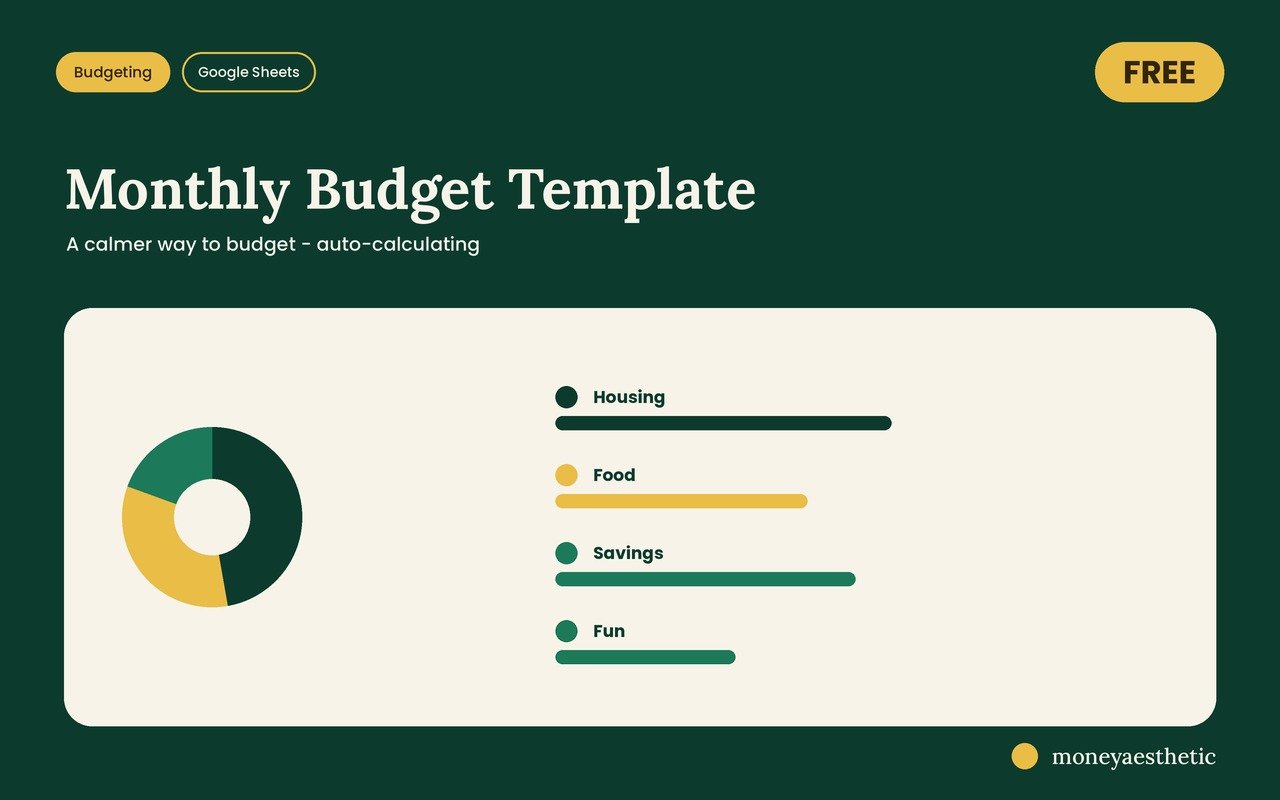
You can’t save what you can’t see. The free Monthly Budget Template does the math for you. Type in your income and bills, and it shows exactly what’s left to send to your house fund each month. No formulas, no spreadsheet skills, no guilt. It’s a simple way to turn “I should save” into an automatic number.
Get the free Monthly Budget Template →The house-fund math that’s easy to skip
“Save more” is easy advice to give and hard to act on. Here’s the calculation that makes the whole thing click.
Take your all-in target, subtract what you’ve already saved, and divide by the number of months until you want to buy. That’s your monthly number: the amount that, on autopilot, gets you there on time.
Say your target is $30,000, you’ve got $6,000, and you’d love to buy in about two and a half years (30 months): ($30,000 − $6,000) ÷ 30 = $800 a month. Now the goal isn’t a scary five-figure wall. It’s one monthly transfer you can actually look at and go, “okay, is that real for me?” If a wedding is on your list too, you may end up running this exact math twice, once for the down payment and once for the wedding. Keep them on separate sheets (this one for the house, a wedding budget spreadsheet for the other) so neither quietly eats the other.
And if $800 makes you laugh-cry, good. Now you have options instead of vibes. Stretch the timeline to 40 months and it drops to $600. Aim for a 5% down loan instead of 10% and the target shrinks. Add a side income and the months collapse. You’re no longer staring at a total that feels out of reach; you’re adjusting three dials until the monthly number fits your life. That’s the difference between a wish and a plan, and it’s a lot easier to hold the line each payday when you know the exact number you’re protecting. (Making that number stick is really just learning to stick to a budget, which is more about removing friction than white-knuckling it.)
Saving for a house: myths that keep you renting
“I need 20% or don’t bother.” Nope. That’s the PMI-free threshold on a conventional loan, not the entry fee. In most cases the minimum is at least 3%, and FHA loans allow 3.5%. Waiting for 20% can mean more time paying rent.
“I’ll invest it so it grows faster.” Tempting, risky. On a short timeline, a market dip right before you buy can set your progress back. House money belongs somewhere boring.
“There’s no room in my budget.” Maybe, but a lot of us haven’t actually looked. Even $200 a month, automated, is $7,200 in three years before interest. Small and consistent beats big and someday. This is exactly the trap behind living paycheck to paycheck: the money moves before you can save it, so you have to grab your slice first.
“Down payment assistance is a scam / not for me.” Also no. Many states, local governments and nonprofits offer homebuyer programs, and some include down payment assistance or subsidized loans. Worth a search before you assume you’re on your own.
Saving for a house: FAQ
How much should I save to buy a house?
Plan for the down payment plus closing costs (2–5% of the price) plus a small cushion. On a median new home ($410,700 in Q2 2026), a 5% down payment is about $20,500, but with a 3–3.5% loan your down payment could be closer to $12,300–$14,400 before closing costs.
Do I really need 20% down to buy a house?
No. Twenty percent lets you skip private mortgage insurance on a conventional loan, but it isn’t required. The minimum down payment is at least 3% in most cases, and FHA loans allow as little as 3.5%.
How long does it take to save for a house?
It depends on your target and how much you save monthly. Divide your all-in goal, minus current savings, by your monthly contribution. Saving $800 a month toward a $24,000 gap takes about 30 months; saving $400 doubles the time.
Where should I keep my down payment savings?
A separate high-yield savings account is a good fit because the money stays easy to reach. The FDIC’s national average savings rate was only 0.38% in August 2026, so compare high-yield APYs before you pick an account. Avoid the stock market for money you’ll need in the next few years.
How can I save for a house on a low income?
Automate a small, fixed transfer each payday, target a low-down-payment loan, and look into down payment assistance programs. Even $150–$200 a month adds up, and freeing money in your budget is a good place to start.
Should I pay off debt or save for a house first?
Usually both at once. Knock down high-interest debt like credit cards while still saving something for the house, since lenders look at your debt-to-income ratio. If your rate is low, saving alongside minimum payments can work.
What is included in closing costs?
Closing costs can include appraisal fees, tax service fees, title insurance, government taxes, and prepaid items like property taxes and homeowners insurance. They typically run 2–5% of the purchase price, so budget for them on top of your down payment rather than as an afterthought.
How do I stop dipping into my house fund?
Keep it in a separate account at a different bank, nickname it clearly, and automate deposits so you don’t rely on willpower. Making it harder to move money back out can help your down payment survive to closing day.
Money Aesthetic shares general educational information, not financial advice. Your situation is your own, so use what fits your life, and check with a qualified professional before any big money decision.