

Quick answer: To do Christmas on a budget, pick one total before you buy anything, split it between gifts and the non-gift stuff, then shrink the list instead of the joy. The Fed’s May 2026 household report found only 63% of adults would cover a $400 emergency with cash or its equivalent, so that total has to fit your real paychecks.
Here’s how Christmas usually goes sideways. Most people don’t decide to overspend. You grab a little something for a coworker, a few extra stocking stuffers, a second roll of wrapping paper, a last-minute tin of cookies for the neighbors. Each one is small. Then January shows up with a card statement that feels like it belongs to someone else.
Doing Christmas on a budget isn’t about being the cheap one at the table. It’s about deciding once, early, what this holiday is allowed to cost, and then letting yourself enjoy it without the little voice in the back of your head doing math all month.
Key takeaways
- Set one total number first. Every gift, meal and roll of tape comes out of it.
- Split gifts from everything else. Food, decorations, cards and wrapping need their own line in the plan.
- Cut the list before you cut the magic: draw names, try a 4-gift rule for kids, and lean on free traditions.
Christmas on a Budget, Explained in One Number
Christmas on a budget means the whole holiday has a single spending limit, and every purchase is measured against it. That includes gifts, but also food, travel, decorations, cards, postage and wrapping. Without one number, each purchase only gets compared to your mood that day, and moods are very generous in December.
The number doesn’t have to be small. It has to be decided. A bigger Christmas you planned in November feels a lot calmer than a smaller one you discovered in January.
The easiest way to land on that number is to work backward from cash, not from wish lists. Add what you’ve already set aside for Christmas to what you can realistically pull from each paycheck between now and December 25. That total is your Christmas. Anything above it is borrowed from next year.
When we built the free christmas budget planner, that’s exactly why “how often you get paid” and “your next payday” sit right on the dashboard next to the total. A holiday budget means very little as one big December figure. It starts to mean something when the sheet counts the paychecks left before Christmas and tells you what to put aside from each one.
How Much Do People Actually Spend on Christmas?
There’s no single right amount to spend on Christmas. Surveys give a rough sense of scale, but your number should come from your own paychecks, and it should cover the non-gift costs as well as the presents.
In the National Retail Federation’s 2025 holiday survey, released October 16, 2025, consumers planned to spend $890.49 per person on gifts, food, decorations and other seasonal items. Of that, $627.93 was for gifts for family and friends, and $262.56 was for things like food or candy, decorations and greeting cards.
That second number is the one budgets forget. If you only plan for presents, a big slice of the season has no home in your plan, and it lands on a card instead.
Don’t treat $890.49 as a target, though. It’s an average from a survey of 8,247 adults, not a recommendation, and your number should come from your income, not someone else’s. If you want help picking a figure that fits your paycheck, our guide on how much to spend on christmas gifts walks through it person by person.
How Do You Do Christmas on a Budget, Step by Step?
You do Christmas on a budget in five steps: set the total, split it into gifts and non-gift costs, list people before ideas, give each person a cap, and log every purchase as it happens. The order matters. Ideas come last because ideas are where the overspending lives.
- Set the total from cash. Money already saved plus what you can set aside from the paychecks left before Christmas. Write it down somewhere you’ll see it.
- Split it in two. One pot for gifts, one for everything else: hosting, travel, decorations, cards, postage, wrapping. Decide the split before you shop.
- List names, not gifts. Who’s actually on the list this year? Coworkers, teachers and the cousin you see once every three years are allowed to get a card instead.
- Cap each person. Divide the gift pot across the names. If the caps feel tiny, the list is too long, and that’s useful to know now rather than on December 22.
- Log as you go. A cap only works if the real price goes next to it the same day you buy.
Step five is the one people skip, and it’s the one that saves the plan. In the planner’s Gift List, each gift row has a budget and an actual cost side by side, and only the actual-cost cell turns red when it passes the budget. One splurge shows up clearly, without turning your whole list into a wall of red that makes you want to close the laptop.
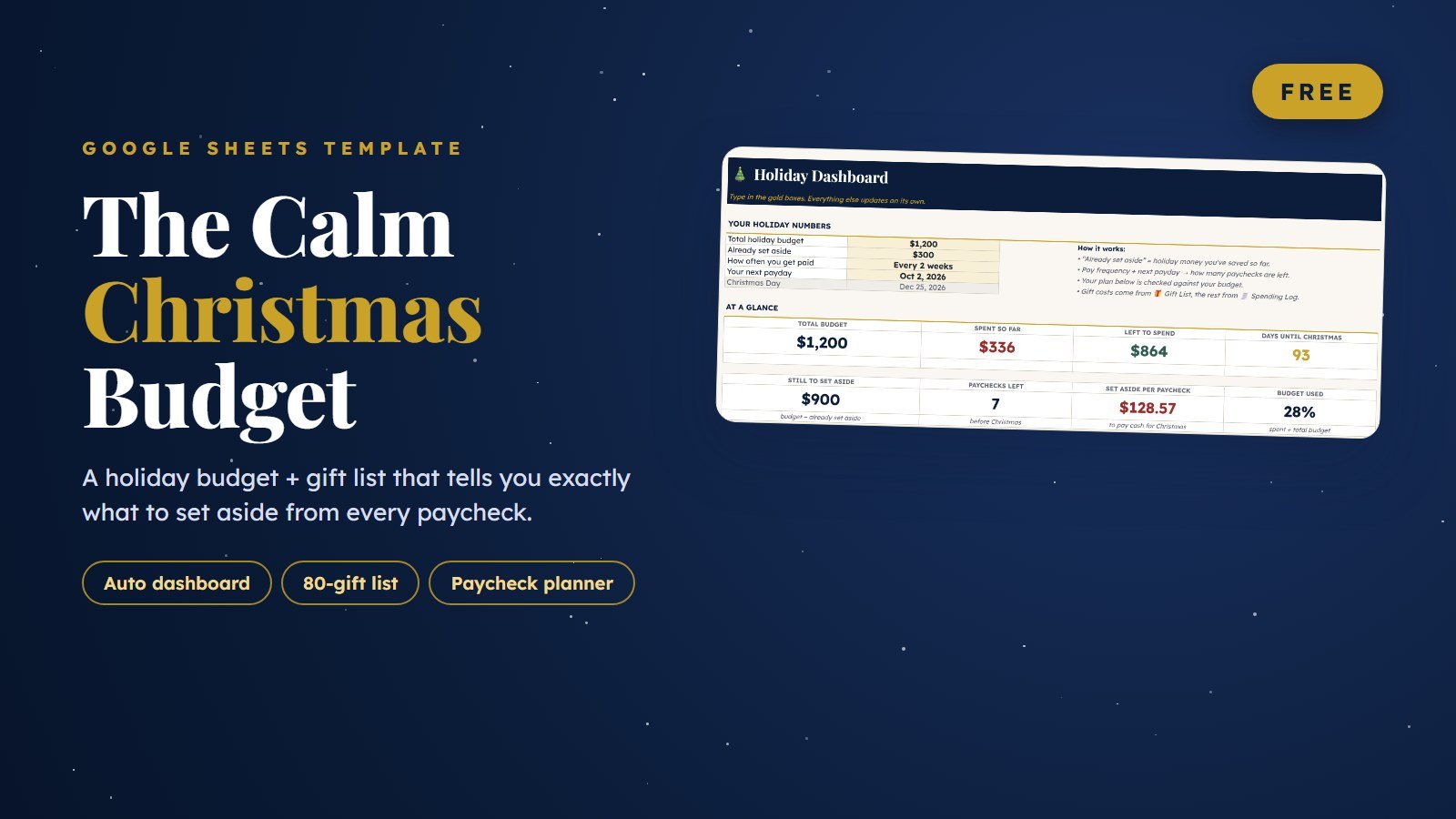
Your whole Christmas, one number, zero guesswork
Type your total, how often you get paid and your next payday, and the sheet tells you what to set aside each paycheck. List up to 80 gifts with a budget beside each one, and log the food, wrapping and postage too. Free for Google Sheets.
Get the free Christmas Budget Planner →How Can I Make Christmas Special on a Budget?
You make Christmas special on a budget by spending on the few things people will remember and getting creative with the rest. Kids remember traditions, not price tags. Adults remember being thought of. A smaller, more deliberate holiday usually reads as more personal, not less.
A few ideas that cost little or nothing:
- The 4-gift rule for kids: something they want, something they need, something to wear, something to read. It gives the gift pile a shape, which makes it easier to stop.
- Draw names for adults. Instead of everyone buying for everyone, each person buys one thoughtful gift. Suggest it early, before anyone has shopped.
- A lights night. Hot cocoa in travel mugs, a playlist, and a slow drive past the best-decorated streets in town.
- Make one thing together. Cookies, paper snowflakes, a dried orange garland. The making is the gift.
- Gift time. A babysitting night for a tired sibling or a home-cooked dinner can land harder than another candle.
If you’re juggling a long list of people, a dedicated christmas gift list template keeps names, ideas and caps in one place so nothing gets bought twice.
What Do I Do If I Have No Money for Christmas?
If you have no money for Christmas, scale the holiday to the cash you have and skip new debt. Tell the people closest to you early, switch adult gifts to a name draw or a no-gift year, and focus kids’ gifts on a small, well-chosen few. A quiet Christmas you can afford beats a loud one you’re still paying for in March.
The tempting shortcut is Buy Now, Pay Later. According to the Federal Reserve’s Economic Well-Being of U.S. Households in 2025 report, published in May 2026, BNPL use edged up to 16% of all adults, and 11% of BNPL users had a payment trigger an overdraft or non-sufficient funds fee from their bank in the prior year. A few small payments feel harmless in December. They hit in January and February, right when the regular bills are back.
The same report found 63% of adults would cover a hypothetical $400 emergency expense using cash, savings, or a credit card paid off at the next statement. If you’re not in that group yet, protecting even a small cushion matters more than one more present.
Already carrying holiday charges from last year? Start there before adding new ones. Our guide on how to pay off buy now pay later debt lays out the order, and a debt payoff spreadsheet shows the date it’s all gone. Seeing that date is often what makes a smaller Christmas feel like a choice instead of a loss.
Where Does a Christmas Budget Usually Leak?
A Christmas budget usually leaks through the small non-gift costs: wrapping, cards and postage, stocking stuffers, holiday outfits, party contributions and the extra grocery runs for hosting. Most of them don’t feel like “Christmas spending” in the moment, so they rarely get a line in the plan.
That’s the reason the free planner has a separate Spending Log next to the Gift List, with categories such as Food & Hosting, Wrapping & Supplies, Cards & Postage and Stocking Stuffers. A gift list on its own only tracks gifts. The log catches the rest, and the dashboard keeps one running “left to spend” figure for both.
The other leak is timing. Shopping late means paying whatever the store charges on December 20, plus rush shipping. If you’d rather have order-by dates and “order now” alerts for every gift, the christmas gift tracker PRO version adds them, along with a payday-by-payday savings schedule. And if you’re reading this early enough, the guide on how to save for christmas covers setting money aside before the season starts.
What is the 4-gift rule for Christmas?
The 4-gift rule gives each child four gifts: something they want, something they need, something to wear and something to read. It keeps the gift pile thoughtful and gives you a natural stopping point, which makes a kids’ gift budget much easier to hold.
Should I use a credit card for Christmas gifts?
Use a credit card for Christmas only if you can pay the full balance at the next statement. In the Fed’s $400 question, a card paid off at the next statement is grouped with cash and savings. Carrying the balance turns this year’s gifts into next year’s interest.
Is it okay to tell family I’m on a budget this year?
Yes, and the earlier you say it, the easier it is. A short message in November, such as suggesting a name draw for the adults, gives everyone time to adjust and often relieves people who were stretched too.
How do I budget for Christmas if I’m starting in November?
Starting in November, count the paychecks left before December 25, decide what you can set aside from each one, and add any money already saved. That sum is your Christmas total. Split it between gifts and non-gift costs before buying anything.
This article is for general educational purposes and isn’t financial advice. Figures come from the sources linked above as of their publication dates. Consider your own situation, or talk with a qualified professional, before making financial decisions.