

Quick answer: An elf welcome back letter skips the introductions. In a few short sentences it says “I’m back,” remembers one thing from last year, notices one thing that’s new this year, and gives a one-line reminder of the no-touching rule. Most Scout Elves come back during a week-long window at the end of November, so the letter doesn’t have to land on December 1st.
The second year of elf is easier than the first, right up until the night before it starts. Your kid remembers everything. They remember the elf’s name, the marshmallow snowman, the morning it was “stuck” in the freezer. Then a letter shows up that says “Hi! My name is Pip and I’m a Scout Elf,” and a seven-year-old squints at you like you’ve been replaced by a stranger.
That’s the whole problem with most elf welcome back letters: they’re arrival letters with “back” pasted in. A returning elf isn’t meeting your family. It’s picking up a conversation. Here’s how to write that version, plus mix-and-match lines you can copy tonight.
Key takeaways
- Don’t re-introduce the elf. Your kid already knows it.
- Name one real thing from last year and one thing that’s new this year.
- Keep the rules to a single reminder line.
- A late elf is normal: the official return window runs from late November into December.
What should an elf welcome back letter say?
An elf welcome back letter should say four things: that the elf is back and happy about it, one specific memory from last Christmas, one thing the elf has noticed is different this year, and a short reminder not to touch it. That’s it. Four to six sentences for young kids, a short paragraph for older ones. No name, no backstory, no list of five rules.
The memory line and the “what’s new” line do the heavy lifting. They’re the two lines a printed template can’t fill in for you, and they’re the ones that make your kid believe the elf actually lived in your house last year. “I see you lost your front tooth!” beats any rhyme about North Pole snow.
Welcome back letters, explained: why it isn’t the arrival letter again
A first-year arrival letter and an elf welcome back letter do different jobs. The arrival letter explains the whole tradition: who the elf is, why it’s here, what the rules are. The welcome back letter assumes all of that and spends its few lines on your family instead. Swapping one for the other is a common mistake on elf letters.
| Part | First-year arrival letter | Welcome back letter |
|---|---|---|
| Opening | “Hello! My name is…” | “I’m back!” |
| The tradition | Explains Santa, reports, flying home each night | Skip it, or one short line |
| Rules | The full set | One reminder line |
| Personal line | Something about meeting them | A memory from last year + something new |
| Length | Can run longer | Shorter is better |
When we put our elf letter set together, we gave every design its own “I’m back” letter instead of reusing the arrival letter with one word changed. A returning elf that introduces itself again sounds like it forgot your family, and kids pick up on that fast. If you’re writing your own, start from a blank page rather than last year’s arrival letter. (For the very first year, the elf arrival letter guide covers what to say.)
Build your letter: pick one line from each row
The fastest way to write an elf welcome back letter is to choose one line from each row below and put them in order. Change the names, change anything that doesn’t sound like your elf, and you’re done in a couple of minutes.
| Row | Option A | Option B | Option C |
|---|---|---|---|
| 1. I’m back | “I’m back, [name]! Did you miss me?” | “Guess who Santa sent back to your house?” | “Special delivery: one elf, returned to the right family.” |
| 2. Last year | “I still laugh about the morning you found me in the cereal box.” | “I told Santa about how you helped your sister last year.” | “Remember when you wrote me that note with the drawing of a dog?” |
| 3. Something new | “You got so tall!” | “This house is new to me. I love your room.” | “I hear there’s a new baby. I can’t wait to meet them.” |
| 4. Reminder | “Same rule as always: no touching, or my magic fades.” | “Remember, look with your eyes, not your hands.” | “You know the rule. I trust you.” |
| 5. Sign-off | “Love, [elf]” | “Your elf, reporting for duty” | “See you in a new spot tomorrow!” |
Two finished examples, built straight from the rows:
- For a five-year-old: “I’m back, Maya! Did you miss me? I still laugh about the morning you found me in the cereal box. You got so tall! Same rule as always: no touching, or my magic fades. Love, Pip.”
- For a family that moved: “Guess who Santa sent back to your house? This house is new to me, but I found you anyway. I told Santa about how you helped your sister last year. You know the rule. I trust you. See you in a new spot tomorrow! Jingle.”
Our elf letter template set has an “I’m back” letter in each of its three designs, with every word editable, so you can drop your chosen lines straight in.
When does a returning elf come back?
Most returning elves come back during Scout Elf Return Week, which the official Elf on the Shelf FAQ describes as “a week-long window at the end of November, leading into December.” The same page says some elves return at the end of November and others “may wait until the second week of December.” So December 1st is a common choice, not a deadline.
That gives you room. If your December is packed, the elf can come back the weekend after Thanksgiving. If you forgot until the 5th, the elf isn’t late, it’s just one of the elves that took a little longer. The official FAQ even lists kid-friendly reasons for a delay, like extra training, a snowstorm, or a few pit stops on the way.
A late-elf line you can use: “Sorry I’m late! A snowstorm kept me at the North Pole an extra few days, but I flew as fast as I could to get back to you.”
What if a lot has changed since last year?
A lot changes in a year, and the welcome back letter is the right place to acknowledge it. One sentence about the change is enough. The elf doesn’t need to explain how it knows; elves just know things.
- A new house: “Santa gave me your new address. It took me one try to find you.”
- A new sibling: “I hear there’s someone new in the family. I’ll keep an eye on them too.”
- A kid who’s starting to wonder: skip the cute stuff and go with a mission-report voice, like “Agent Theo, your elf has returned for the season. Report to be filed nightly.”
- Last year ended badly (the elf got touched, or there were tears): “Last year is all fixed. My magic is back to full power.” The official FAQ suggests a note to the elf or Santa when an elf gets touched, so a fresh start fits.
We built the letters so you can change every word in free Canva, rules included, because the rule list a four-year-old needed last year rarely fits a six-year-old this year. Rewriting one line beats printing last year’s letter and crossing things out.
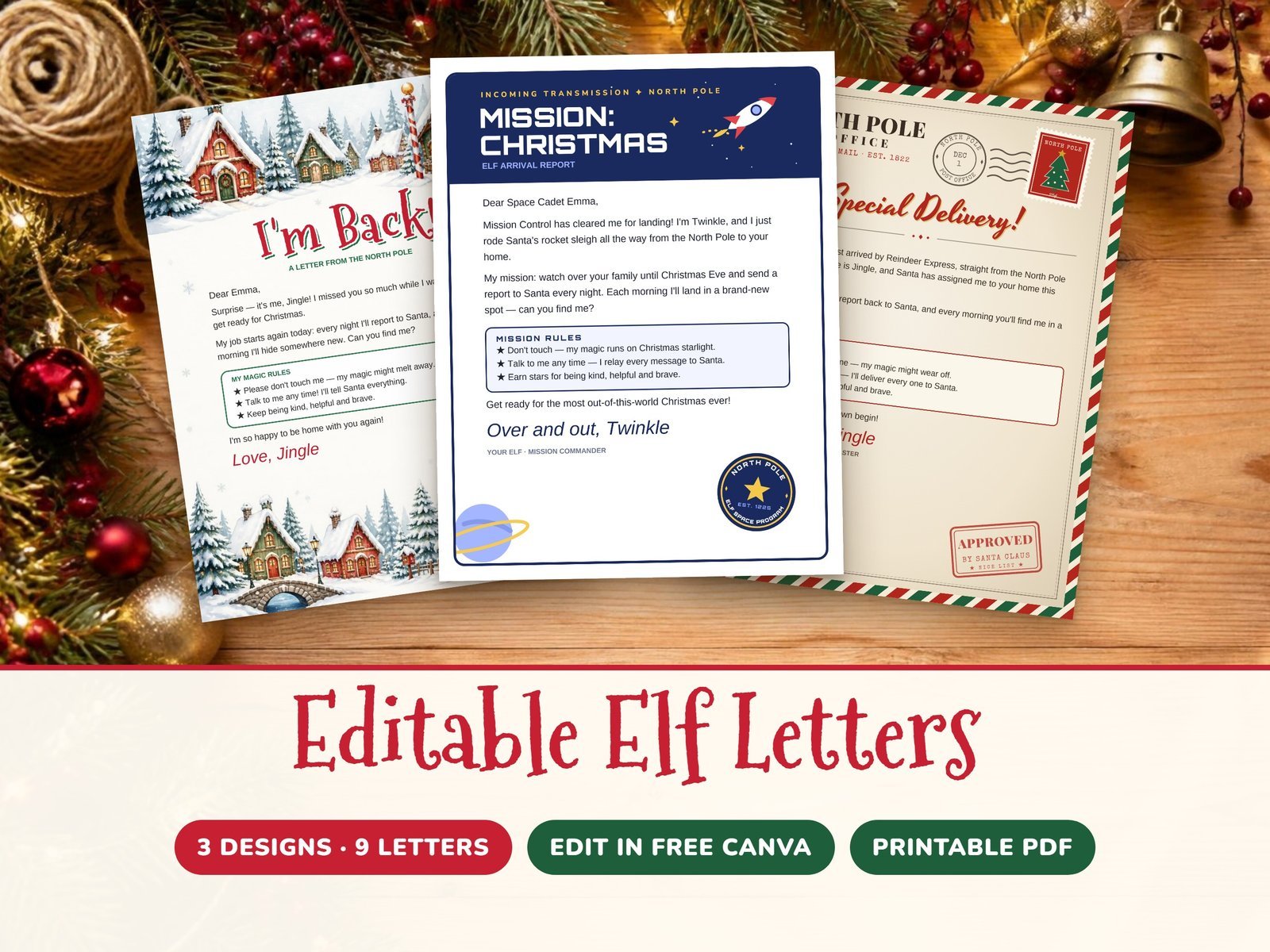
The “I’m back” letter, ready tonight
Nine editable elf letters: arrival, “I’m back” and goodbye, in three designs. Type the names in free Canva, or print the fill-in PDF and write them by hand. One $7.99 set you can reuse next year.
Get the elf letter set →Picking up where last year’s goodbye left off
A good welcome back letter quietly answers last year’s goodbye letter. If the elf promised “see you next year,” the return letter can open with “I promised I’d come back, and here I am.” If your kid sent a drawing back to the North Pole, the elf can mention it hanging in the workshop. Kids notice that kind of continuity, and it costs nothing.
That’s also why it helps to keep the goodbye letter. Tuck it into the ornament box in December, and next November you have your memory line already written. If you haven’t planned the end of the season yet, our elf goodbye letter guide has wording that sets up a good comeback.
For older kids, we gave the Space Mission design an “Elf Return Report” instead of a “hello again” letter, so a kid who rolls their eyes at “I missed you!” gets a mission briefing instead. Same job, different voice.
Keeping the comeback cheap
The elf’s return doesn’t need a big entrance to work. Paper is cheap elf magic: a letter, a short note, a drawing propped against a mug. A letter set you can edit and print again each year turns the elf’s comeback into a quick job with no new purchase.
December has plenty of other places for money to go. The National Retail Federation’s October 15, 2026 forecast puts November and December retail sales at $1.013 trillion, up 4.2% over 2025, so there’s no reason for the elf to add a new costume every morning. If you’re keeping the whole holiday on a plan, our guide on how much to spend on Christmas gifts starts with one total for everything, elf included.
FAQ
How do I announce the elf is back?
Leave a short welcome back letter next to the elf on the first morning. Say “I’m back,” mention one memory from last year, notice one thing that’s new, and remind your child not to touch the elf.
What do you write in an Elf on the Shelf letter when the elf returns?
Skip the introduction your child already knows. Write four to six short sentences: a happy “I’m back,” one real memory from last Christmas, one change you’ve noticed this year, a one-line rule reminder, and a sign-off.
What if our elf comes back late?
That’s normal. The official Elf on the Shelf FAQ says most elves return during a week-long window at the end of November, and some wait until the second week of December. A “sorry I’m late” line in the letter covers it.
Do I need a new welcome back letter every year?
You need new lines, not a new letter. Keep the same design and change the memory line and the “what’s new” line each year so the letter matches what really happened.

Give the rest of December a plan
The free Christmas Budget Planner for Google Sheets sets one total for the holiday, shows how much to set aside each payday, and keeps your gift list in one place.
Get the free Christmas Budget Planner →The Elf on the Shelf is a trademark of CCA and B, LLC (The Lumistella Company). Money Aesthetic is not affiliated with or endorsed by them. This article is general information; the letter templates mentioned are our own designs.