

Quick answer: A honeymoon budget is easier to trust when you build it from four lines instead of guessing a total: getting there, the nights, what you spend each day, and a buffer. Price the flights first. The BLS’s August 2026 CPI release shows airline fares up 23.4 percent over the prior 12 months, so a fare you remember from last year may be too low.
Here is how a honeymoon usually gets budgeted. Somebody says “we’ll figure it out after the wedding.” Then the wedding eats every spare dollar for a year, the trip gets booked in a happy rush, and the bill shows up right when you are writing thank-you cards.
No judgment. The honeymoon is the fun part, and nobody wants to put a spreadsheet next to the fun part. But the trip is also a wedding expense that can follow you home, because it is so easy to put on a credit card.
So let’s give it a real number. It takes about one evening, and you only need four lines.
Key takeaways
- Build the honeymoon budget from four lines: travel, nights, daily spending and a buffer.
- Price flights before anything else, because airfare rose much faster than prices overall over the 12 months ending August 2026.
- Add the small “paperwork” costs, like ID fees, before you book anything.
- Decide how you will pay before you book, not after.
- Give the trip its own savings line and due dates inside your wedding budget.
How Much Should a Honeymoon Budget Be?
A honeymoon budget should be the number your four lines add up to, not a number borrowed from someone else’s trip. Travel, nights, daily spending and a buffer cover the main costs of a honeymoon. A beach week and a road trip can both be great honeymoons, and their budgets have nothing in common, which is exactly why a national average tells you so little about yours.
That is also the honest answer to a question that shows up in Google’s “People also ask” box: “is $5,000 enough for a honeymoon?” Enough for what? Five thousand dollars can be plenty for a long weekend a few hours’ drive away and tight for two weeks across an ocean. You can’t know until the lines are filled in.
The good news is that the lines are easy. Here they are, with a made-up example so you can see the shape:
| Line | What goes in it | Example (7 nights) |
|---|---|---|
| 1. Getting there | Flights or gas, bags, airport parking, transfers | $1,400 |
| 2. The nights | Nightly rate × nights, plus taxes and resort fees | $1,750 |
| 3. Each day | Food, activities, local transport, per day × days | $1,050 |
| 4. Buffer | About 10 percent of lines 1 to 3 | $420 |
| Total | $4,620 |
Those example numbers are placeholders, not a recommendation. Swap in your own quotes. The math is the part that matters: $250 a night for seven nights is $1,750, and $150 a day for seven days is $1,050.
Why Should You Price the Flights First?
You should price flights first because airfare has been climbing much faster than prices overall. The Bureau of Labor Statistics’ August 2026 CPI release lists airline fares up 23.4 percent over the last 12 months, while the all items index rose 3.4 percent over the same stretch. A budget built on last year’s fare is built on the wrong number.
Here is what that means in practice, and it is my favorite reason to do this in order. If you pick the destination first, fall in love with the hotel, and then look up flights, the flights get whatever money is left. When fares jump, that leftover disappears. If you price the flights first, you find out on day one whether the dream destination fits, while changing your mind is still free.
Same release, one more line worth knowing: the lodging away from home index rose 2.4 percent in August after falling 2.8 percent the month before. Hotel prices move around month to month, so screenshot the quote you are budgeting from and write the date next to it.
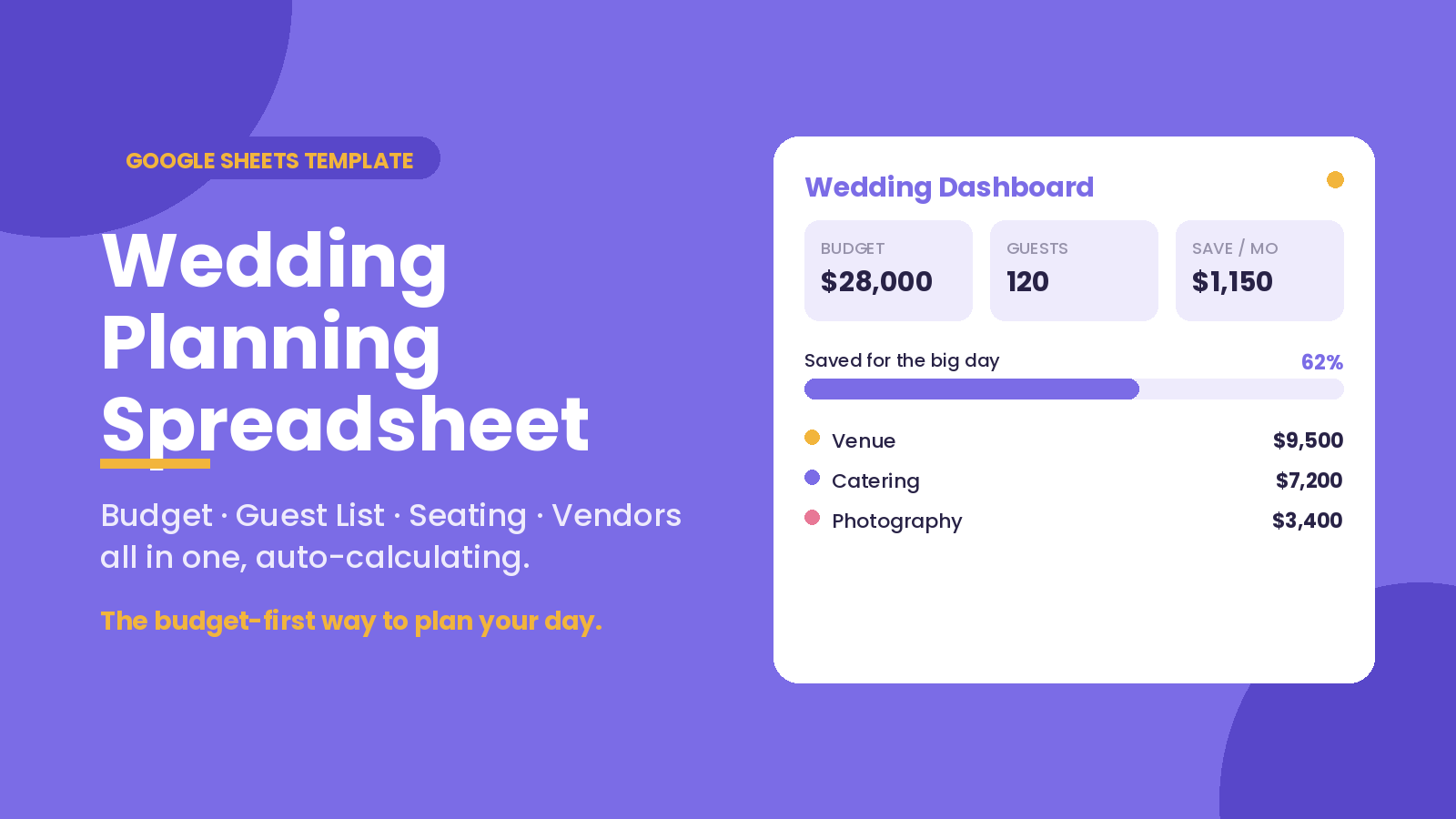
This is the part a planner does well. In the wedding budget spreadsheet, the honeymoon budget sits on the EXTRAS tab, so the trip has its own lines instead of hiding inside “miscellaneous.” Type your numbers into its rows for flights, hotel, food, activities and shopping, and it totals your estimate and actual for you.
Plan the wedding and the trip in one place
Budget, vendors, guest list, a payment schedule with countdowns, and a honeymoon budget on the EXTRAS tab. It is a Google Sheet, so you can share it with each other.
The Small Costs That Show Up Before You Leave
A few honeymoon costs have nothing to do with the destination. They come from paperwork, and they are easy to forget because they are small. One that changed this year: starting February 1, 2026, travelers without an acceptable ID at a TSA checkpoint can pay a $45 fee to use TSA ConfirmID, and the fee covers 10 days from the travel date on the receipt.
For two people, that is $90 you did not need to spend. TSA’s list of acceptable identification includes a state-issued REAL ID-compliant driver’s license and a U.S. passport, so check both of your IDs the week you book, not the week you fly.
While you are at it, look at the name on each ID, especially if either of you is changing names. Book each ticket in the name printed on the ID that person will actually carry on the trip, and hold off on changing documents until you are home if the timing is tight. I would put “check IDs and names” as its own line on the honeymoon budget with a $0 cost and a due date, because a to-do with a date is harder to forget.
What Happens If the Honeymoon Goes on a Credit Card?
If the honeymoon goes on a credit card and you pay it down slowly, interest turns the trip into a second, smaller trip you pay for and never take. The Federal Reserve’s G.19 consumer credit release put the average interest rate on credit card accounts assessed interest at 22.15 percent in the second quarter of 2026.
Run that on a $4,000 honeymoon. Pay $200 a month at 22.15 percent and it takes 26 payments to clear, with about $1,038 in interest along the way. Drop the payment to $150 and it stretches to 38 payments and about $1,558 in interest. That math assumes the rate holds steady and nothing new gets added to the card, which is a generous assumption for newlyweds furnishing an apartment.
What that number actually tells you: saving ahead costs nothing extra, while carrying the trip at $200 a month costs about $1,038. The same $4,000 saved ahead is $400 a month for 10 months or about $334 a month for 12. If the wedding is a year out, trimming one wedding category a little may be easier than paying a card company that interest later.
How to Fit the Honeymoon Into Your Wedding Budget
The honeymoon fits into a wedding budget as its own savings line with its own due dates, just like a vendor. Put the total from your four lines on the budget, divide it by the months until you book, and move that amount into a separate account every month. That turns the trip into a sinking fund instead of a surprise.
- Fill in the four lines with real quotes, flights first.
- Add the buffer. Ten percent is a good starting point for a trip you have never taken.
- Write down the deposit dates. If a hotel or package wants money ahead of the trip, that date belongs next to your vendor deposits.
- Pick one funding source per line. Savings, a family gift, a honeymoon fund on your registry. Write it next to the line so nobody double-counts the same money.
- Divide by the months you have left. That is your monthly number. If it is too big, change a line, not the math.
Step 3 is where I would slow down. A resort deposit due in March can land in the same month as a venue payment, and suddenly both feel urgent. If you already track vendor deadlines, add the trip to your wedding payment schedule. When I built the payment schedule on the budget tab of the spreadsheet, I gave every row a days-until-due countdown, so the resort deposit can sit right under the photographer’s balance and count down with it.
And if you are still deciding how the whole wedding gets paid for, the guide on how to pay for a wedding walks through savings, family money and what borrowing the gap actually costs. The honeymoon is just one more line in that plan.
Honeymoon Budget Questions
Is $5,000 enough for a honeymoon?
It depends on the length and the distance, so add up your four lines before you decide. Travel, nightly rate times nights, daily spending times days, and a 10 percent buffer will tell you in a few minutes whether $5,000 covers the trip you want.
Is $4,000 enough for a honeymoon?
It can be, especially for a shorter trip or one you can drive to. A quick way to check is to price flights first, since the BLS’s August 2026 CPI release showed airline fares up 23.4 percent over 12 months. If the fare eats half of the $4,000, look at closer destinations or fewer nights.
How much should we save each month for a honeymoon?
Divide your honeymoon total by the months until you pay for it. A $4,000 trip saved over 12 months is about $334 a month, or $400 a month over 10 months. Put it in a separate account so it doesn’t get spent on the wedding.
Should the honeymoon be part of the wedding budget?
Yes, as its own line. Keeping it on the same sheet means its deposits show up next to your vendor payments, so two big bills don’t land in the same month by surprise.
Find the honeymoon money in your monthly budget
A monthly number only works if it fits next to rent and groceries. Our free template shows the whole month on one page, so you can see where the savings line comes from.
This article is for general education and isn’t financial advice. Prices, fees and interest rates change, so check current quotes and your own card terms before you book.