

Quick answer: A savings tracker printable is a one-page sheet where you fill in a box, a bar or a jar every time you set money aside, so progress becomes something you can see instead of something you have to remember. It works because visible progress is motivating, and it matters right now: the Bureau of Economic Analysis put the U.S. personal saving rate at just 3.0 percent in July 2026.
Here is the thing nobody says out loud about saving money. The hard part is almost never the first week. The first week is easy, and honestly kind of fun. You put fifty dollars aside, you feel like an adult, you tell someone about it.
The hard part is week nine. Nothing dramatic happens at week nine. You just quietly stop checking, and three months later you find the money already spent on nothing you can name.
That gap between starting and finishing is exactly what a savings tracker printable is built to close. And there is a specific point where most of them stop working, which almost nobody warns you about. So let’s start there.
Key takeaways
- A savings tracker turns an invisible bank balance into something you fill in, which is the whole reason it beats checking your account.
- Research says the tracker should flip at the halfway point: count what you have saved early on, count what is left near the end.
- Starting a tracker with a few boxes already filled nearly doubled completion rates in one classic study.
- Missing a week is not a failure state. The tracker only breaks when you stop looking at it.
Why Do Savings Trackers Stop Working Around the Halfway Mark?
Savings trackers stall in the middle because the thing that motivated you at the start quietly becomes the thing that discourages you. In a 2012 study published in the Journal of Consumer Research, Minjung Koo and Ayelet Fishbach found that people work harder when their attention is pointed at whichever number is smaller: what they have completed, or what they have left to do.
Their small-area hypothesis is genuinely useful once you translate it out of academic language. Early on, four boxes filled out of twenty feels like momentum while sixteen remaining feels like a mountain, so early on you want to be looking at the four. Near the end, sixteen filled is old news, but four remaining feels close enough to sprint for.
Most printable trackers only show you one of those two views for the entire run. A coloring-in thermometer shows accumulated progress the whole way, which is perfect for the first half and mildly demotivating by month eight. A countdown sheet does the reverse and feels brutal in week one.
The fix is embarrassingly simple: write both numbers on the sheet. Put a small “saved so far” box and a small “left to go” box at the top, and circle whichever one is smaller each time you update it. You are not changing the plan. You are changing which number your eye lands on, and that turns out to be most of the game.
There is a second trick worth stealing. In a study of 300 car wash customers, Joseph Nunes and Xavier Drèze handed out two loyalty cards that required the exact same number of visits: a plain eight-stamp card, and a ten-stamp card with two stamps already given for free. Over nine months, 19 percent of people finished the plain card. 34 percent finished the pre-stamped one. Same work, nearly double the finishers.
So do not start your tracker at zero. If you already have two hundred dollars in savings, shade in the boxes that money covers before you hang the sheet up. Starting at four out of twenty instead of zero is free motivation, and it is your money either way.
What Is a Savings Tracker Printable, Exactly?
A savings tracker printable is a single sheet of paper with a goal at the top and a set of segments underneath that you mark off as you save. The segments might be twenty boxes worth fifty dollars each, a thermometer you color upward, a jar you shade in, or a grid of numbered squares you cross off in any order. The format changes; the job never does.
The job is to move your savings goal out of your bank app, where it lives as a number that looks identical whether you are winning or losing, and onto a surface where progress is physically visible. Your bank shows you a balance. A tracker shows you a shape, and shapes are what your brain actually reacts to.
That is also why paper holds its own against apps. An app only reaches you once you have opened it, which is to say once you were already thinking about money. A sheet on the fridge catches you when you were not.
How Do You Set One Up in About Ten Minutes?
Setting up a savings tracker takes one decision and four small steps. The decision is the goal amount, and it is the step people stall on longest, so take the pressure off: you can change it later, and a slightly wrong goal you actually track beats a perfect goal you never start.
- Name the goal and the amount. “Savings” is not a goal. “Car repairs, 1,200 dollars” is a goal. If you have no idea what number to use, a starter emergency fund is a reasonable default, and our guide on how much emergency fund you need walks through how to size one.
- Pick your segment size. Divide the goal into 20 to 30 chunks. A 1,200 dollar goal becomes 24 boxes of 50. Fewer than 20 segments and it feels like nothing is happening. More than 30 and each box feels meaningless.
- Backfill what you already have. Per the car wash study above, shade in the boxes your existing balance already covers. Do this before you hang it up.
- Add the two numbers at the top. “Saved so far” and “left to go,” updated every time you fill a box. Circle the smaller one.
Then put it somewhere you pass without deciding to. Inside a cabinet door, on the fridge, clipped into the front of a binder. A tracker in a drawer is a piece of paper. A tracker at eye level is a system.
Which Savings Tracker Should You Print?
Pick the tracker that matches how your money actually arrives, not the one that looks prettiest on Pinterest. Three questions sort this out fast.
- Are your deposits the same size every time? If yes, use equal boxes, one box per deposit. If your income moves around, use a running-total sheet with a date and amount column instead, because forcing an irregular paycheck into equal boxes just creates weeks where you feel behind for no reason.
- Is this one goal or several? One goal gets one tracker. Several goals at once means you want a sinking fund layout, where each category gets its own small tracker on one page, so a good month for the car fund does not look like a bad month overall.
- Do you want a challenge or a plan? A challenge decides the amounts for you, which some people find freeing and some find stressful. If that appeals, our savings challenge guide covers seven. If you would rather set your own pace, a plain tracker wins.
One layout note that comes from making these for a living: keep the whole thing on one page. The moment a tracker spans two sheets, updating it stops being a five-second act and starts being a small task, and small tasks are exactly what gets skipped.
Print it, or type straight into it
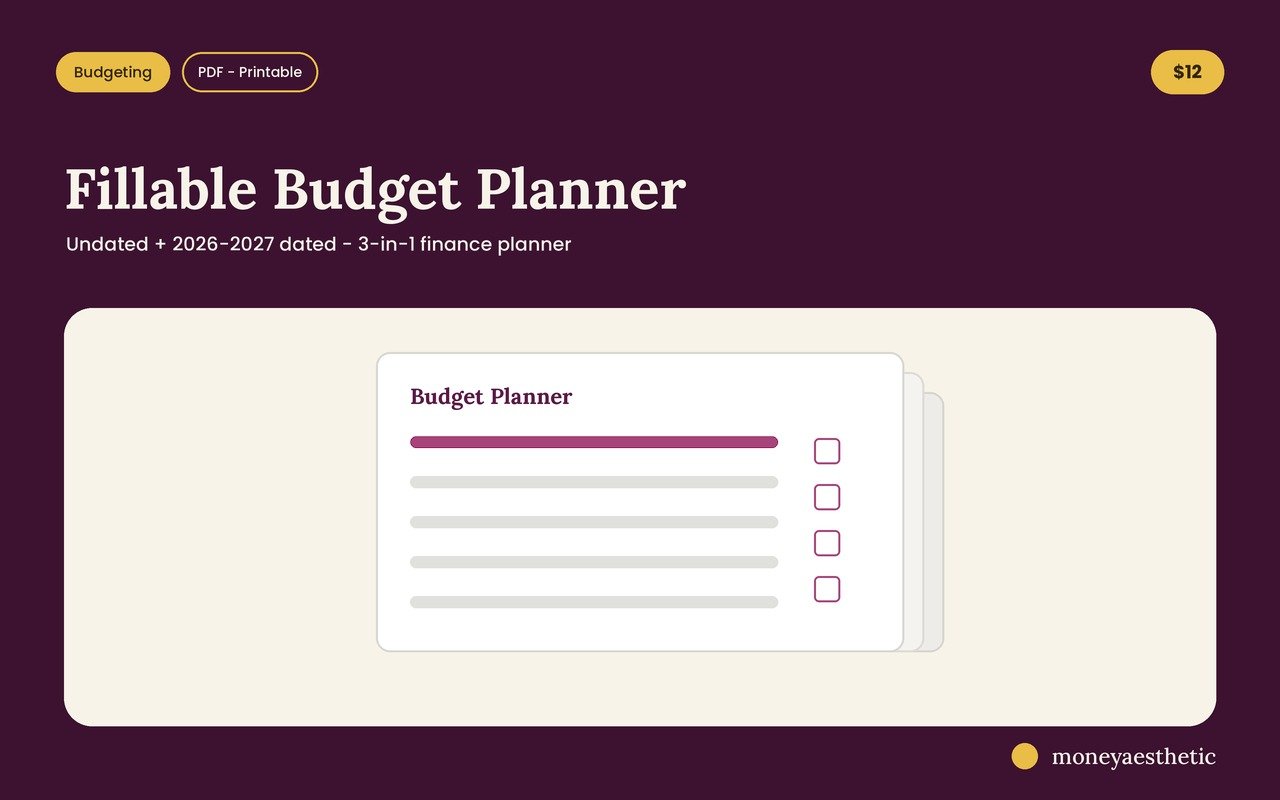
The Fillable Budget Planner has the savings pages, sinking fund pages, bill tracker and monthly budget already laid out, so you are filling in boxes instead of drawing them. It is undated, so today is a perfectly good starting point, and you get a dated version too. Type into it on a tablet or print the pages you want, as many times as you like.
Get the Fillable Budget Planner →I made that planner undated on purpose, and it is the design decision I would defend hardest. Dated pages quietly announce that the only clean place to begin is January, which turns an August decision into a five-month wait. One review on the planner page says the undated version let her start mid-month “with zero guilt,” and that is exactly the feeling dated pages get in the way of.
It ships with a dated 2026–2027 version alongside the undated one, because the two halves want opposite things. A calendar spread for due dates is better with the dates printed. A savings tracker is better with the boxes blank, so you decide what each one is worth.
What Do You Do When You Miss a Week?
Missing a week costs you one week of savings and nothing else, unless you decide it means something. That decision is the actual risk. The tracker survives an empty box easily. What it does not survive is being taken down, because a tracker you have stopped looking at has already stopped working.
So the rule is: leave the box empty, do not backdate it, do not make up for it with a double deposit that wrecks next week’s groceries, and just fill the next one. An honest gap is information. It usually means the segment size was too big for the month you were actually having, which is a five-second fix.
The context helps here too. According to the Federal Reserve’s Economic Well-Being of U.S. Households in 2025 report, released May 13, 2026, 63 percent of adults said they would cover a 400 dollar emergency expense using cash or its equivalent. That number has not moved since 2024. The rest did not name cash. And nobody lands in that group because of one skipped week.
Which is the quiet argument for paper over willpower. A savings tracker is not a motivation tool that runs on how disciplined you feel this month. It is a memory tool that keeps working on the months when you feel nothing at all, and those are the months that decide whether the goal happens.
Do savings trackers actually work?
They work for the same reason progress bars work: visible progress is more motivating than an abstract balance. Research on goal monitoring published in the Journal of Consumer Research found that where you point your attention changes how hard people keep working, which is exactly the variable a tracker controls. A tracker will not create money you do not have, but it takes away the excuse that you could not tell how you were doing.
What should a savings tracker printable include?
At minimum: the goal name, the target amount, and 20 to 30 segments you fill in. Add a “saved so far” and a “left to go” box at the top so you can look at whichever number is smaller. A date column helps if your deposits are irregular. Anything beyond that is decoration, which is fine, but it is not doing the work.
Is a printable savings tracker better than an app?
They do different jobs. An app is more accurate and updates itself, but you only see it when you already opened it. A printed tracker on the fridge or a cabinet door catches you when you were not thinking about money at all, which is when a nudge is worth the most. Plenty of people run both, with the app holding the real balance and the paper holding the motivation.
How do I choose the goal amount for my tracker?
Pick a number tied to a specific thing rather than a round number that sounds impressive. Car repairs, a security deposit, a flight home, a starter emergency fund. Specific goals survive a bad month because you can picture what quitting costs you. If the number feels intimidating, cut the goal in half and run the tracker twice.
What size should I print a savings tracker at?
Standard letter size at 100 percent scale is the safe default, since it prints correctly on any home printer and fits a binder. Half-letter works well if you want it in a pocket planner. Whatever you choose, keep one goal to one page, because a tracker that spans two sheets turns a five-second update into a small task, and small tasks get skipped.
Can I use one savings tracker for several goals at once?
Yes, and for most people it is the better setup. Give each goal its own small tracker on a single shared page, the way a sinking fund sheet is laid out. Keeping them side by side means a strong month for one goal does not get hidden by a flat month for another, which is what happens when you merge everything into one total.
Not sure where the savings are coming from yet?
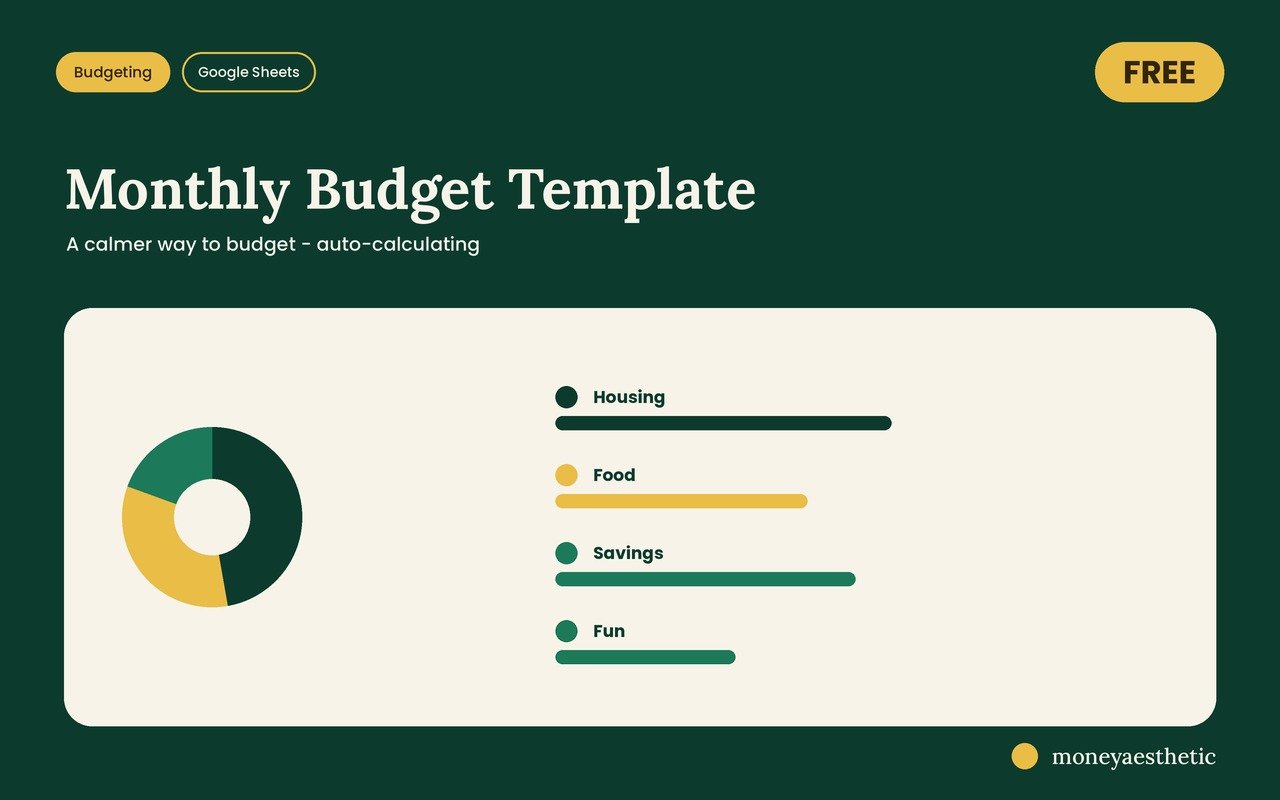
A tracker shows you progress, but it cannot tell you which fifty dollars to move. The free Monthly Budget Template lays income, bills and spending on one page so the gap becomes obvious, and it costs nothing to try.
Get the free Monthly Budget Template →This article is general information, not financial advice. Savings needs, income and personal circumstances vary, and the figures cited reflect the sources and dates named. Consider speaking with a qualified financial professional about your own situation.