

Quick answer: A yearly budget planner puts all twelve months on one page so the bills that show up once or twice a year stop ambushing you. List your income by month, write every once-a-year charge into the month it lands, add a line for surprises, then price next year line by line. Consumer prices (CPI-U) were up 3.4 percent in the 12 months ending August 2026, per the BLS.
Here’s the thing about monthly budgets: they’re great at months. They’re bad at years.
You can nail January, February and March, feel like a financial genius, and then April shows up with a car registration, a renewal you forgot you signed up for, and a birthday you definitely knew about. None of it was a surprise, exactly. It just wasn’t on the page you were looking at.
That’s the whole job of a yearly budget planner. It’s the page that sees around the corner, so the “surprise” bills are just bills.
Key takeaways
- A yearly budget planner is a twelve-month overview, not twelve separate budgets.
- The once-a-year bills are the whole point. Write each one into the month it actually hits.
- Give unexpected expenses their own line. In the Fed’s 2025 survey, 59 percent of adults had at least one major one in the prior 12 months.
- Don’t raise every line by the same inflation number. Electricity, shelter and groceries moved at different speeds in the 12 months to August 2026.
A Yearly Budget Planner, Explained
A yearly budget planner is one overview page that tracks income, spending, savings and what’s left for all twelve months side by side, plus a list of the costs that don’t come monthly. A monthly budget answers “can I cover this month?” The yearly page answers a different question: “which months are going to be heavy, and am I ready for them?”
The one I’d build has four parts. A month-by-month row for income, expenses, saved and net. A list of irregular bills with the month each one lands. A line for the stuff you can’t predict. And a place to look back in December.
That’s it. It doesn’t replace your monthly page. It sits in front of it.
When I laid out the undated version of our fillable budget planner, I put the twelve-month Money Overview on page 3, before a single monthly page. You see the shape of the whole year before you get into any one month’s details, and that order is on purpose.
Why Does a Monthly Budget Miss So Much of the Year?
A monthly budget misses the year because a lot of real spending doesn’t arrive in twelve even pieces. In the Bureau of Labor Statistics’ Consumer Expenditure Survey for 2024, the average household spent $78,535 over the year, and several lines inside that total are the kind that can land as one big bill instead of a steady drip.
Look at a few of them. Vehicle insurance averaged $1,993. Apparel and services came to $2,001. Entertainment was $3,609. Education was $1,569, and cash contributions were $2,292. If any of those comes to you as a single charge, a monthly budget will feel “blown” that month even though you did nothing wrong.
Then there’s the stuff you can’t schedule. The Federal Reserve’s 2025 household survey, published in May 2026, found 59 percent of adults had at least one major, unexpected expense in the prior 12 months. A major vehicle repair or replacement was the most common at 30 percent, followed by a major house or appliance repair at 22 percent and unexpected major medical expenses at 21 percent.
Read that 59 percent the way I read it: a surprise expense in a given year is more likely than not. So planning a year with zero room for one isn’t optimistic. It’s just a plan that’s missing a line.
How Do You Fill Out a Yearly Budget Planner in One Sitting?
You fill out a yearly budget planner by working from what’s certain to what isn’t: income first, then fixed monthly bills, then once-a-year costs placed in their real months, then a surprise line, then a quick look at which months come out negative. The slow part the first time is going back through old statements.
- Write down income for each month. Not a yearly salary divided by twelve. If you’re paid every two weeks, some months get an extra check, so mark your 3 paycheck months now. Freelance or seasonal? Use your realistic low for each month.
- Add the fixed monthly bills. Rent or mortgage, utilities, phone, minimum payments. These stay about the same most months, which makes them the easy part.
- Pull the last 12 months of bank and card statements. Scroll for anything that happened once or twice. Renewals, registrations, memberships, annual subscriptions, school costs, the holiday stretch. Write each one down with the month it hit.
- Drop each one into its month. This is where the year gets lumpy on paper, which is exactly what you want to see.
- Add a surprise line. Pick a monthly amount you can live with and put it in every month. It won’t cover everything. It covers more than zero.
- Find the heavy months and spread them out. If November is going to be ugly, divide that total by the months you have left and start setting it aside now. A sinking funds tracker is an easy way to keep those piles separate.
If you’re thinking “this sounds like a lot of setup,” yep. That’s the part a template takes off your plate. Filling in blanks you already have is a very different Saturday than drawing the grid first.
Your whole year, already laid out
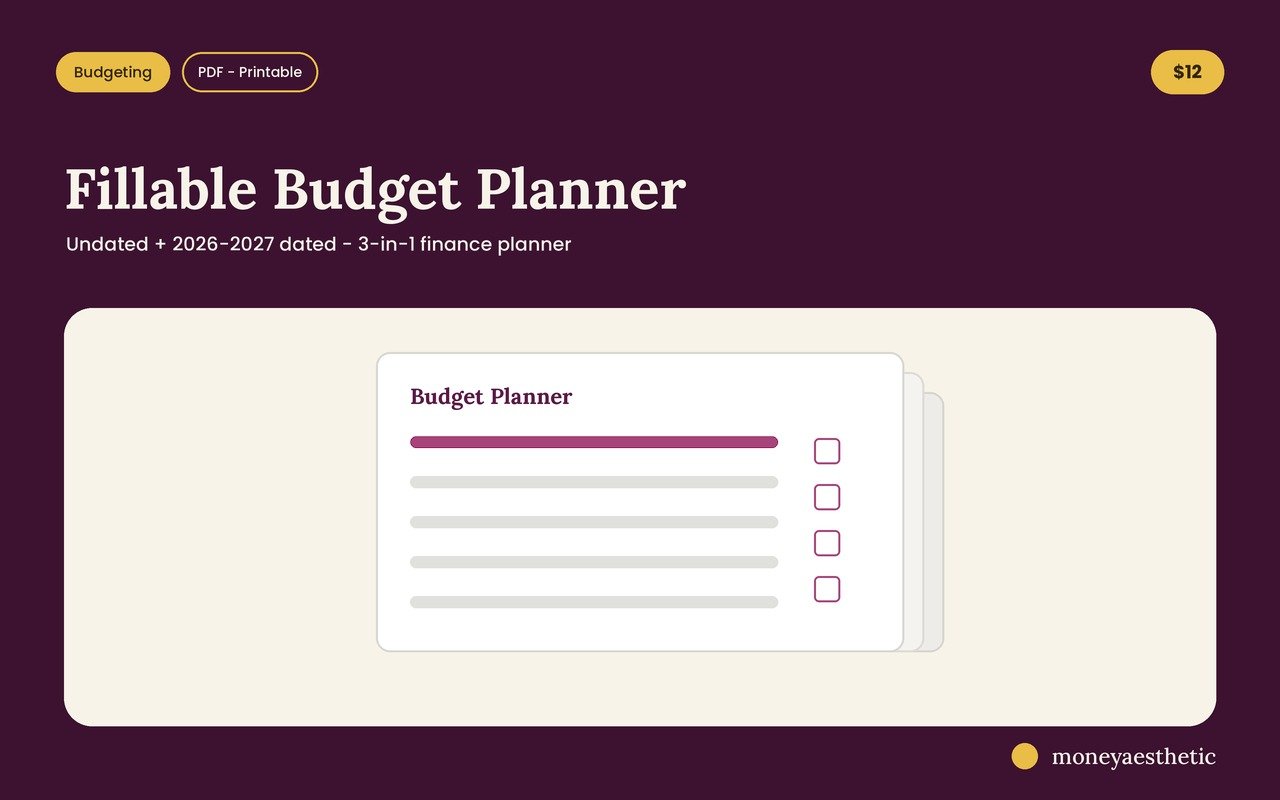
The Fillable Budget Planner has a Money Overview page with one row per month, plus a subscriptions and fixed bills page, a holiday budget, a year in review, and a full monthly set for every month. Type in it or print it. Undated (twelve months), or dated from July 2026 to December 2027 (eighteen months).
Get the Fillable Budget Planner →What Goes on Each Page of a Yearly Planner?
A yearly planner works best as a few short pages that each do one job, rather than one giant sheet. Here’s how I’d split it, and when you actually touch each page.
| Page | What you write there | When you touch it |
|---|---|---|
| Twelve-month overview | Income, expenses, saved and net for each month | Once at the start, then a quick update at each month’s end |
| Subscriptions and fixed bills | Every recurring charge, how often it bills, when it renews, the amount | At the start, and any time you sign up for something |
| Irregular and holiday costs | The once-a-year stuff and the month it lands | At the start, then a check-in before each heavy month |
| Year in review | What you planned against what happened, and what to change | December, or whenever your year ends |
One design choice I’d defend all day: the subscriptions page in our planner has a “Keep?” column and a total that runs the list times twelve. A small monthly charge reads as nothing. Twelve of them written as one yearly number reads very differently, and that column is there so the cancel-or-keep call happens on the spot.
Should You Raise Every Line for Inflation Next Year?
You shouldn’t raise every line by the same inflation figure, because prices don’t move together. The Bureau of Labor Statistics’ Consumer Price Index for August 2026 showed all items up 3.4 percent over 12 months, but that single number hides a wide spread between the lines on your planner.
Over those same 12 months, electricity rose 3.8 percent, shelter rose 3.0 percent, food rose 2.7 percent, and food at home rose 2.2 percent. Gasoline jumped 27.4 percent and airline fares climbed 23.4 percent.
So a flat 3.4 percent bump would pad your groceries a little too much and leave a road-trip budget way short. The better move is boring but it works: look at what each line actually cost you this year, then nudge the ones that clearly moved. For your own house, your own statements are a better guide than a national average.
And if a line went down? Leave it lower. A yearly budget that only ever goes up can quietly teach you to spend the cushion.
What Do You Do With the Page Come December?
In December, the yearly page turns into your starting data for next year: compare planned against actual for each month, circle the months that ran negative, and carry the lessons into the new overview before January begins. A blank grid can’t tell you what to do with it once the year is over, and this review is the step that makes year two easier than year one. If you would rather plan next year in Google Sheets, the free 2027 budget planner has a 12-month plan where you type each line once.
Three questions are enough:
- Which months went over, and was it a real surprise or a bill I should have written down?
- Which once-a-year costs were missing from my list? Add them now while you remember.
- Did my surprise line get used? If it ran dry by June, it was too small.
That’s why our planner has a Year in Review page at the back, and why the dated version runs eighteen months, from July 2026 through December 2027. Starting mid-year shouldn’t mean waiting for January, and you get a full calendar year after that to do the review properly.
If you want to keep the monthly side simple too, the free printable budget planner guide walks through what belongs on a single month’s page, and a budget calendar helps you see due dates inside each month.
Yearly budget planner questions
What bills do people forget to budget for?
The bills people forget are usually the ones that don’t come monthly. Annual subscriptions, renewals, registrations, memberships, school costs and the holiday stretch are easy to miss because they don’t show up in a normal month’s statements. Scroll back a full 12 months to catch them.
Is there a free yearly budget planner?
We don’t have a free yearly one. Our free monthly budget template is a Google Sheet with budget vs. actual, savings goals and a bill checklist on one tab, for one month at a time. If you want a twelve-month overview, a subscriptions and fixed bills page, a holiday budget and a year in review on paper, the Fillable Budget Planner has those.
Should a yearly budget be done monthly or annually?
Both, in two different layers. The yearly page shows which months will be heavy and gets set up once, and the monthly page handles the day-to-day spending. A short update to the yearly page at each month’s end keeps the two in sync.
When should I start a yearly budget?
Start whenever you have 12 months of statements to look back on. A year doesn’t have to begin in January. Starting mid-year gives you time to prepare for the heavy months before they arrive.
How much should I put in the surprise line?
There isn’t one right number, so start from your own history. Add up what unplanned repairs and bills cost you last year and divide by twelve. If you have no history yet, pick an amount you can keep every month and raise it once the budget holds.
Not ready for the whole year yet?
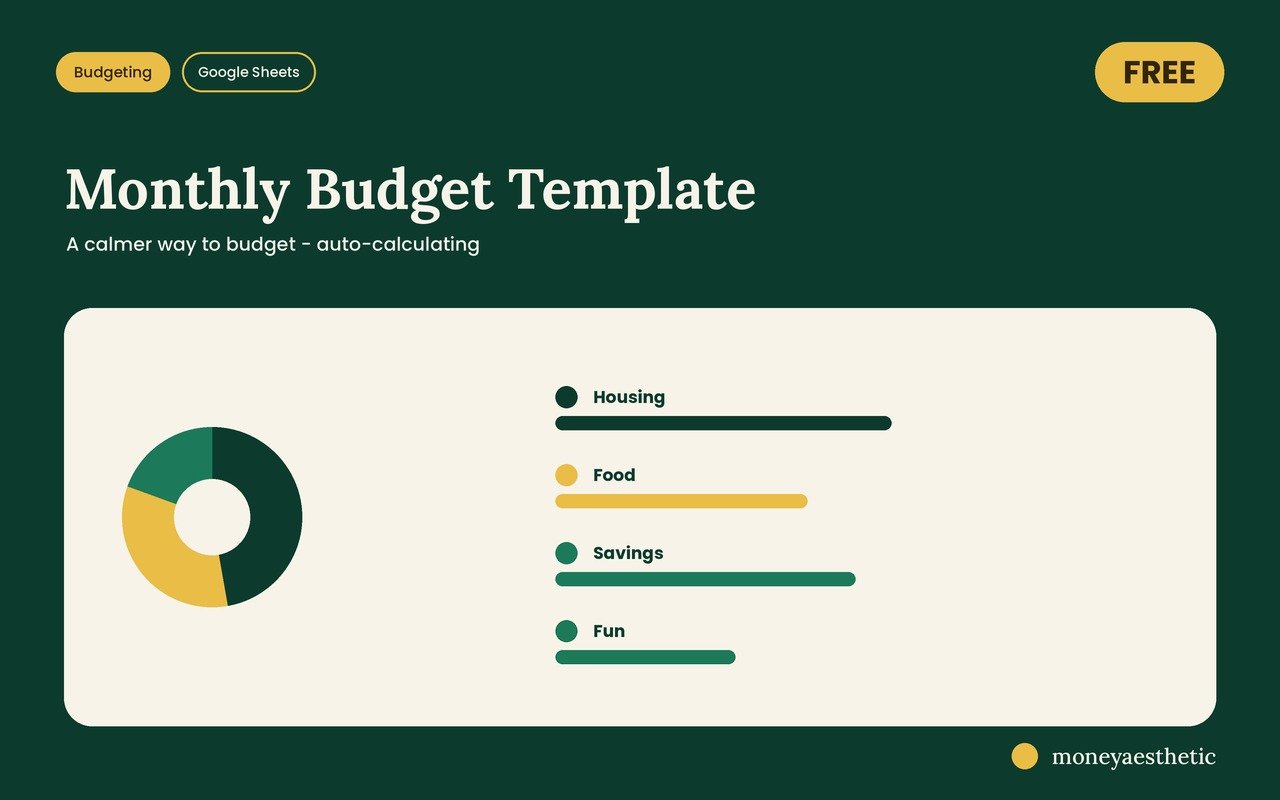
Start with one month. The free Monthly Budget Template puts budget vs. actual, savings goals and a bill checklist on one Google Sheets tab, so you can get a clean month under your belt before you zoom out.
Get the free Monthly Budget Template →This article is for general education only and is not financial advice. Your situation is your own, so consider talking with a qualified professional before making major money decisions.